

































![A Ledger of the Soul: Navigating the Allah-Bhagavant Nexus in a 19th-Century Puruṣākāra Jñāna Caupara [Gyan Chauper]](https://counterpointbd.com/uploads/images/202608/image_430x256_6a93baa3b09a7.jpg)




















The End of Politics?
The crisis of politics is not its end, but its hollowing. The machinery we inherited was not designed to govern algorithmic power or planetary limits. Recognizing this is not defeatism but intellectual honesty.


Two Funerals, One Moment
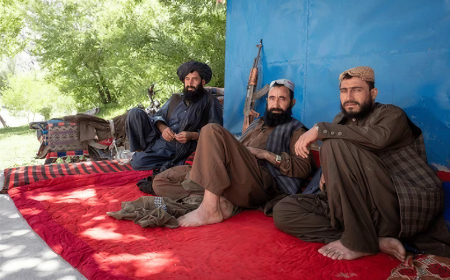
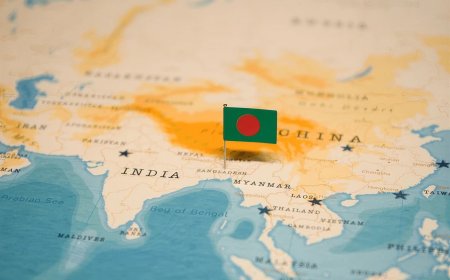
Begum Khaleda Zia, thrice elected Prime Minister of Bangladesh, passed away recently. Millions attended her funeral prayers. Weeks earlier, Osman Hadi, a 33-year-old figure associated with the July 2024 uprising, outspoken in his demand for social justice, was assassinated in broad daylight in Dhaka. Millions attended his funeral prayers as well.
The differences between these two figures could not be more stark. Khaleda Zia represented continuity, institutional memory, and inherited political authority.
Osman Hadi represented rupture -- moral urgency, generational dissent, and a refusal of business as usual.
Yet, the near-equal volume of public mourning raises an unsettling question: What exactly are people grieving, and what are they yearning for?
Is politics itself at a turning point? Are we approaching what W.B. Yeats once imagined as a moment when “the centre cannot hold”? Or, more bluntly, are we living through a “Where to now, St. Peter?” moment -- where the old order persists as ritual, but belief has thinned beyond repair?
The Post-Political Condition
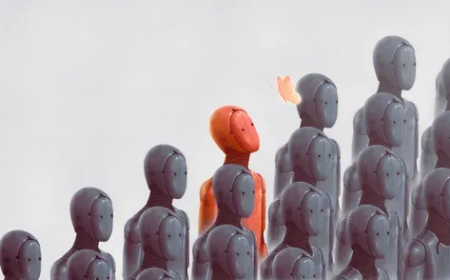
Across continents, Gen Z-led uprisings have erupted -- leaderless, networked, and deeply skeptical of inherited authority. These movements are not merely demands for reform. They express doubt about the very architecture of politics itself.
Participation feels hollow. Representation feels symbolic. Elections occur, yet the forces shaping everyday life -- algorithms, supply chains, financial markets, military-industrial systems -- remain largely untouched by popular will.
Politics survives, but increasingly as ceremony.
In the digital age, this imbalance deepens. What can elected governments realistically do to regulate artificial intelligence, restrain transnational capital, or enforce planetary ecological limits within a system designed for territorial sovereignty? The answer is increasingly uncomfortable: Very little.
Corporate Sovereignty Before the Nation-State
The roots of this crisis are not new. When Queen Victoria extended Crown protection to the East India Company, the modern world quietly crossed a threshold. The Company was neither a nation nor accountable to a people. Yet it exercised sovereign powers: Taxation, warfare, administration, and justice.
This marked an early form of post-national governance -- corporate sovereignty. Authority no longer flowed from collective consent but from profit, backed by imperial force. The world was not prepared for this transfer of power. Capital acquired sovereignty centuries before democratic mechanisms could restrain it.
The Collapse of Empires, Not the Triumph of Nations
The end of World War II is often framed as the birth of a new international order. In truth, it marked the violent collapse of European empires. The Westphalian nation-state system functioned as an administrative repair -- borders, flags, constitutions -- designed to stabilize a fractured imperial world.
Yet the economic logic of empire survived intact. Extraction, accumulation, and hierarchy continued, now mediated through markets rather than colonial administrators. Sovereignty was nationalized in form, but not in substance.
Socialism and the Temporary Rebalancing of Power
Socialism forced a historic negotiation between capital and society. The welfare state emerged not from generosity but from necessity -- a ceasefire between accumulation and legitimacy.
Where this compromise held, social democracy stabilized state-society relations and reduced inequality. Where it failed, oligarchic systems emerged, often replacing colonial elites with domestic ones. The divergence of postcolonial trajectories is best understood through this uneven settlement.
The Structural Limits of Westphalia in a Planetary Age
Today’s crisis arises from a fatal mismatch. Planetary systems -- climate, AI, finance, logistics, militarism -- operate at scales and speeds that territorial states cannot govern. Nation-states increasingly manage populations rather than power.
Sovereignty persists as symbolism. Real decision-making migrates to algorithmic systems and corporate infrastructures that are transnational, opaque, and optimized rather than deliberated.
Democracy, once a radical promise, risks becoming a legitimizing cover for systems it no longer controls.
The Void Between Real Power and People’s Power
This widening void lies at the root of planetary destruction, unending inequality, and hyper-militarism. Ecological collapse proceeds without accountability. Permanent war economies thrive without democratic consent. Inequality deepens despite electoral participation.
Division is cultivated. Demagoguery distracts. Love and hate are manufactured at scale, allowing non-elected powers to operate undisturbed. Politics feels hollow not because people have disengaged, but because engagement no longer reaches power.
War, Dark Ages, and the Refusal of Prophecy
Is capital capable of stabilizing itself? History suggests it does -- but only after crisis and destruction. Militarization absorbs surplus capital, disciplines labor, and reasserts state relevance. War is not inevitable, but it is structurally incentivized.
Speculation about world war or dark ages risks false certainty. A future collapse, if it comes, is unlikely to resemble medieval decline. It would be technologically advanced yet morally fragmented -- knowledge abundant, wisdom scarce.
History rarely chooses a single path. More likely, stabilization, conflict, and regression will unfold unevenly, layered across regions and classes.
Ethics as Orientation, Not Solution
In the absence of effective political containment, ethics quietly return. Concepts such as ihsaan, insaaf, dharma, ren, and ubuntu do not offer governance blueprints. They offer restraint -- an insistence that power be tempered by responsibility.
This is not a program. It is a posture.
After Politics
The crisis of politics is not its end, but its hollowing. The machinery we inherited was not designed to govern algorithmic power or planetary limits. Recognizing this is not defeatism but intellectual honesty.
If politics is to recover substance, it will not do so through spectacle or acceleration. It will emerge, if at all, through restraint, ethical clarity, and the slow rebuilding of legitimacy between people and power.
Until then, we stand not at the end of history, but at the end of illusion.
Sujaul Khan is an Assistant Professor at North South University.
References
1. Arendt, H. (1958). The Human Condition. University of Chicago Press.
2. Arendt, H. (1970). On Violence. Harcourt, Brace & World.
3. Arrighi, G. (1994). The Long Twentieth Century: Money, Power, and the Origins of Our Times. Verso.
4. Foucault, M. (2007). Security, Territory, Population. Palgrave Macmillan.
5. Harvey, D. (2005). A Brief History of Neoliberalism. Oxford University Press.
6. Marx, K. (1867). Capital, Volume I. Hamburg.
7. Polanyi, K. (1944). The Great Transformation. Beacon Press.
8. Streeck, W. (2016). How Will Capitalism End? Verso.
9. Wallerstein, I. (2004). World-Systems Analysis: An Introduction. Duke University Press.
10. Yeats, W. B. (1921). The Second Coming.