



























































Old Dhaka, New Story: The Architect Who Refuses to Build Walls
When the monsoon comes and two thirds of the land submerges, that is not devastation alone. The water withdraws and leaves behind a fine sediment of silt, and the landscape turns into vast patches of fertility, and then the wind comes and moves across it.
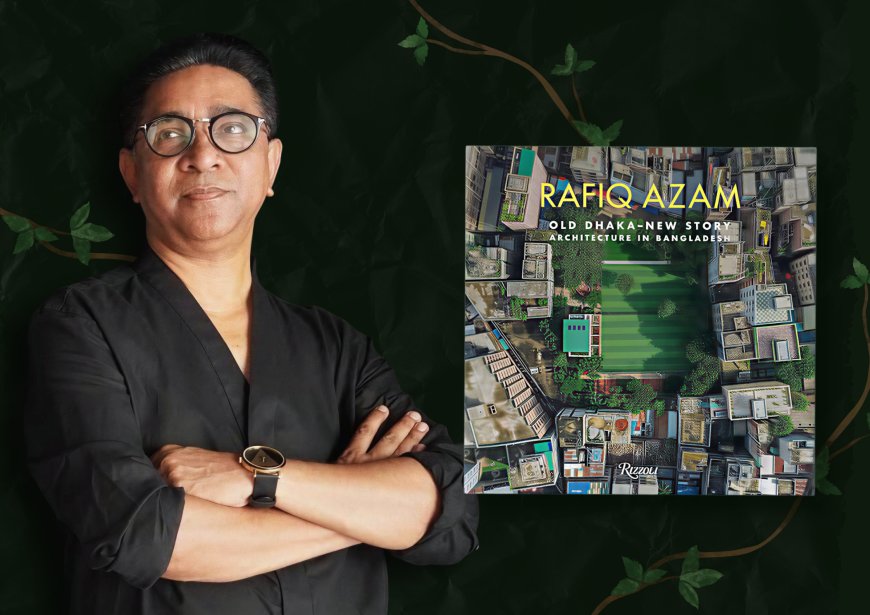
I spent an evening at Tu'Do Café for a book talk on Rafiq Azam: Old Dhaka, New Story: Architecture in Bangladesh, the architect's new monograph, and what unfolded over the course of the evening was less a discussion of buildings than a discourse on how a city might be made liveable again.
The evening began with a screening of Between Earth and Light: The Life and Work of Architect Rafiq Azam, Shankha DasGupta's docu-fiction portrait of the architect's life, philosophy, and body of work. Introducing the screening, DasGupta explained that he had originally set out to make a documentary about architecture, and that this intention collapsed almost immediately once he began meeting Azam, travelling with him, sitting through long discussions and longer journeys, because Azam never spoke about buildings.
He spoke about air, nature, trees, water, everything except the discipline he had spent his life practicing. DasGupta said this reoriented his entire understanding of what an architect is and what architecture might be, and that it became his privilege to film not the structures themselves but the philosophy that produced them.
The film opens in a place far removed from concrete. A boy stumbles upon a box of colours and falls irrevocably in love with painting, and when he hears from a cousin that BUET will permit him to paint and draw, he gives everything he has to secure admission. He fares miserably in every other subject and scores high in drawing.
One of his teachers recalls that the boy was besotted with drawing. He observed that there was an unmistakable instinct for creativity in him, something that could not be contained or disciplined into ordinary shape, and that he was made to be an architect.
The film returns often to the country itself, to rivers and trees and the ordinary abundance of the landscape, and it makes the case that Azam was always attuned to nature, and that this is why he became a pioneer in this field.
There is a scene in the film where Azam reflects on a world saturated with aggression, disrespect and mistrust even in an age that congratulates itself on being globalized, and on the way our appetite for high walls and hegemony manufactures the very estrangement we then lament. He speaks about glass as an architecture of mutual respect, a boundary that does not pretend the other side does not exist.
The Country Made of Water
When Azam took the floor he began, characteristically, with water. He spoke about the delta, about a country of roughly 148,000 square kilometres receiving the melt of the Himalayas across a catchment more than two million square kilometres wide, fourteen times larger than Bangladesh itself, and all of that water traversing this land on its way to the Bay of Bengal.
He said that philosophically we have never accepted this, that we behave as though we possess land when what we actually possess is water, and that having convinced ourselves we have land we began building roads and elevated expressways and metro lines and a hundred other interventions that obliterated the movement of water. Now we reckon with the consequences of that decision every single day.
He described listening as a child to the international coverage of his country, the endless CNN and BBC segments in which Bangladesh surfaced only as flood and cyclone and catastrophe. He said he began reading about the country himself and arrived at an entirely different conclusion, that this is one of the most beautiful countries in the world.
When the monsoon comes and two thirds of the land submerges, that is not devastation alone. The water withdraws and leaves behind a fine sediment of silt, and the landscape turns into vast patches of fertility, and then the wind comes and moves across it.
He said this is like poetry, and that you will not encounter it in most other places. All my life, I had known annual inundation simply as part of the landscape. Seeing it instead as a form of generosity made me realize how limited our language for describing our own geography can be.
By the third year of his studies he had found what he had been searching for all along, poetry and humanity and beauty and softness, and architecture began accommodating all of it.
He posed the question that has propelled his work since. Why is only the ground floor a ground floor? He has designed apartment buildings where every floor is a ground floor, where you can ascend 20 or 30 or 40 storeys and still retain your greenery, your water, your birds, your trees, your sky. He said we will die anyway, so we may as well live surrounded by what we love.
The Wall That Should Be Weak
Azam was born and raised in Old Dhaka, and he returned repeatedly to what that place taught him about space. He described a raised platform in front of a house that connects the home to the street, and the way people would sit there and observe the road like a theatrical space, someone calling out, someone hawking something, everything alive and shifting continuously.
Often the house owner would leave out a pitcher of drinking water for whoever passed. That, he said, tells us that architectural space was once generous and steeped in humanity.
All of it has been dismantled now in the name of becoming civilized, supplanted by tall walls, apartments, gates, gardens sequestered behind security cameras. He invoked Rumi to explain his own change of position, that yesterday he was clever and wanted to change the world, and today he is wise and is changing himself.
So he abandoned the project of changing the world and started changing his designs. He wants places where children can run up and down for no reason at all, where an old person can sit, where a household connects to the street, where birds can come and where two people can fall in love, and why not. It is a modest set of demands, and the fact that it sounds as radical is an indictment of what we have permitted our cities to become.
Azam mentioned how every time he returned he found his friends looking older than him and afflicted with illnesses they could not treat, that the city had become so degraded and so exhausting that people had relinquished any belief that anything could improve, and that they would congratulate him on his work abroad while he sat there thinking that he had done nothing for them, nothing for his own community.
Since 1998 he has undertaken 31 projects across Old Dhaka, in partnership with the city corporation and with the residents themselves, training them, talking to them, and then building. He described a site belonging to the Hindu community with a pond that had been entirely filled in and an open crematorium that neighbours were attempting to shut down, and a field that had been left derelict, and how five years of community work and negotiation and pressure eventually yielded the funds to transform it.
He spoke about the drug trade that operated there, the threats made against his life, the times he was rescued, the days he spent in hiding. He said he does not know why he did it, except that he was desperate.
That place is now a park where Hindu and Muslim residents congregate together. He tore down the walls and the field became visible from every direction, and the neighbourhood took only a few years to convert a crime zone into public space.
He walked us through the transformations, the illegal shops replaced by open ground, the alley that was the sole entrance to a park and was obstructed by a wall for no reason anyone could articulate, the single drain that could not carry the rain in a city where a hundred millimetres in an hour is routine and the national building code presumes half of that.
The Girl Named Swapno
He said he has wept three times in his life, and one of those times he was standing in a flooded alley feeling wholly defeated, telling himself that this was not his job and that he could not manage it. Then he asked a girl standing nearby for her name and she said Swapno. Dream.
He said he was flattened by it. Here was a girl labouring to get to school and to have a decent life, and all of us, the professionals and the politicians and the businessmen together, were ensuring she would not get one. So he decided he would do it or he would die attempting it.
What followed was arithmetic. The drain was covered and became a walkway. The illegal shops were relocated to the other side so their owners could operate legally and could even rent out the space. Eight years on, that water is still what the neighbourhood drinks, in summer and in monsoon alike.
The locals planted fruit trees along the street, apple and star fruit, hundreds of them, and the street now yields something back to the people living on it. The residents run their own programmes there now. Rents in the area have risen, so people are earning a little more. The abandoned building was refurbished rather than demolished, and the ground floor became a women's club, with a bookshop above it and rooms for education and weekend schools.
Azam closed on a question about why any of us do the work we do, and he answered it himself, that what binds all of us together is the wish to see our children grow up happily and safely. So let us do it, he said, and let us ensure that the laughter of our children becomes the new city.
Right now, a single afternoon of rain causes the city to stop, water rising through Mirpur and Jatrabari and Old Dhaka into homes and shops and schools, millions of people wading to work through streets that were never designed to let water go anywhere. We built over the canals and filled the retention ponds and paved whatever remained, and then we treated the flooding as an act of nature rather than the predictable outcome of our own planning.
What Old Dhaka, New Story offers is the alternative that water can be gathered rather than fought, that a drain can become a walkway, that a neighbourhood can drink the rain that used to drown it. Azam has demonstrated it at scale, in the most difficult part of the city, for eight years running.
I left the event that evening feeling physically altered. My shoulders had dropped down. My breathing had slowed. I walked out into a Dhaka evening that I have complained about all my adult life and found myself looking at the trees along the road, at the water pooling near the kerb, at a boy running somewhere with no particular reason to run, and I felt attuned to all of it in a way I had not felt in a long time.
Azam builds nourished buildings, buildings that hold water and light and greenery on every floor, and I understood that an evening can nourish a person in the same way, that you can arrive at a room depleted and leave it fed.
Azeema Anhar is an English Language Instructor at ULAB and member of the editorial team at the weekly Counterpoint.