































































The Ice Failed Upstream. The Debt is Downstream.
Nepal is owed something more substantial than sympathy and more useful than a loan charging interest on damage it did not cause. Monitoring of unstable ice and glacial lakes concerns the whole basin and should be funded on a standing basis, with hydrological data crossing borders as a matter of routine rather than negotiation.

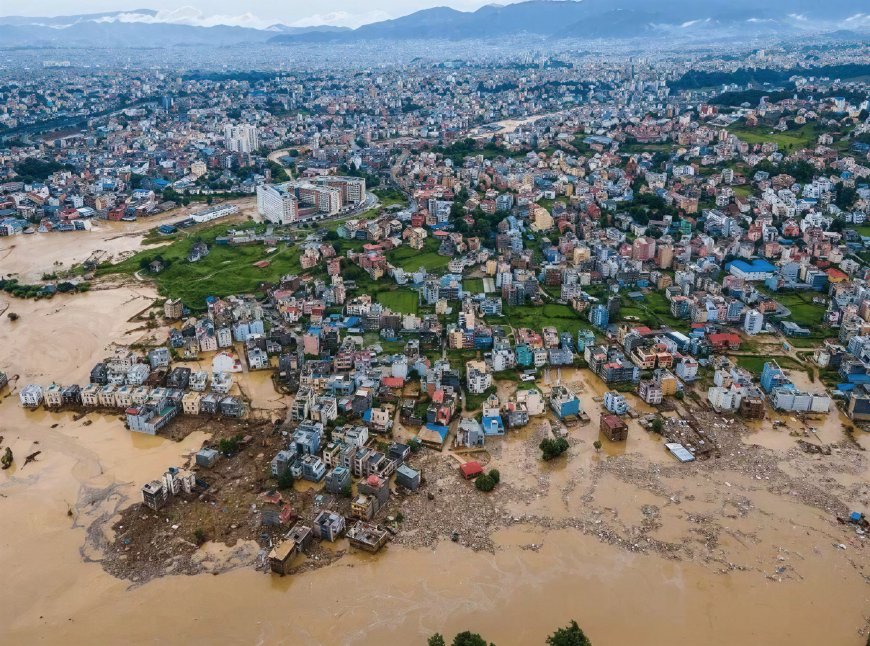
Nepal’s Flood Forecasting Division first heard of the Bhote Koshi surge when the Rasuwa district office telephoned, after the automatic gauges had already gone dead.
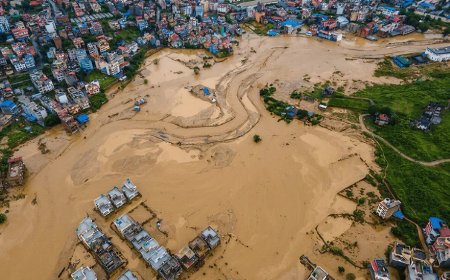
On the morning of August 26, a mass of ice and rock collapsed into the Lhende along the Nepal-China divide. When the water impounded behind that blockage broke through, it carried ice, mud, and boulders rapidly down the Bhote Koshi and into the Trishuli. Early satellite reads put the failure inside Tibet, some 20 kilometers northeast of Rasuwagadhi.
By week’s end, Nepal’s disaster authority, its hydrology department, and the International Centre for Integrated Mountain Development (ICIMOD) were pointing to Langtang Lirung, on the Nepali side of that border river. Origin is still under investigation.
A key issue here is that the flood wrecked the automatic monitoring stations in the upper reaches of the river before they could transmit. The Kathmandu Post reports that none of them managed to send an alert. Word arrived instead through the district administration. Warnings went out within minutes, too late for Rasuwa.
The failure lay in detection rather than in response. Until a person on the bank or in a district office saw the water and called, there was no warning at all in time to save so many.
By Sunday Nepal had recovered more than 730 bodies from this flood, with nearly 2,500 still missing, hydropower workers, foreign travelers, and security personnel among them. Chinese official media reported 16 dead and more than 500 missing in Tibet.
Reuters reports the government’s estimate that rebuilding will cost four to five billion dollars, a preliminary figure from the finance minister. Nepal’s energy minister has put the share of national generating capacity affected at around a tenth.
This was the second disaster of this scale on the Bhote Koshi in just over a year. In July 2025, a lake on the Tibetan side drained suddenly, killed at least nine people, and carried away the Nepal-China Friendship Bridge.
After that 2025 flood Kathmandu and Beijing said they would share glacial-hazard information. Last week was the first real test, and the warning still did not arrive in time. Nepal’s disaster authority has said its Chinese counterparts were caught out as well.
In this part of the Himalaya, cross-border flood alerts still depend on the political relationship, not on a standing duty to the people living below the ice.
A firm scientific account of what set that mass of ice and rock in motion may take time, but the wider trend requires no such guesswork, as climate change is increasing the likelihood of ice-rock collapses and outburst floods of this family.
The Hindu Kush Himalaya is called the Third Pole for holding more ice than anywhere outside the Arctic and Antarctic, and the water towers of Asia for the ten major transboundary rivers that rise in it.
ICIMOD reports that the rate of glacier loss across the range has roughly doubled since 2000, and its assessments indicate that under high greenhouse gas emissions as much as 80% of the region’s glacier volume could be lost by the end of this century.
As glaciers thin, meltwater gathers in lakes held back by loose moraine, and warming thaws the permafrost that binds rock at altitude. The response so far has been to fit each arrangement to the disaster that already happened, while the hazard moves to uncertain terrain no arrangement covers.
The Trishuli becomes the Narayani, then the Gandak, and joins the Ganges in Bihar. That water reaches us in Bangladesh as the southernmost part of the delta. The corridor that killed people and washed away villages is the upper reach of the basin whose treaty we are about to renegotiate.
The 1996 Ganges Treaty expires this December, and its renewal will be negotiated against flow assumptions drawn from a historical record that the river is steadily departing from. Dhaka and Delhi will bargain over the division of a regime the mountains are already rapidly rewriting.
Nepal sits at the head of that catchment and Bangladesh at its end, and neither had much hand in the warming now reshaping it. Nepal accounts for roughly a tenth of 1% of global greenhouse gas emissions, and Bangladesh for well under 1%.
Neither country built the fossil economy whose warming is destabilizing ice across the range, and neither commands the emissions decisions that will determine how much more of it fails.
I have described this as climate coloniality, the ongoing working of colonial and capitalist power to determine whose land is made unlivable, whose knowledge counts as credible, and whose institutions decide what will be done.
The people in Nepal and Tibet who faced this massive disaster live beneath a danger produced elsewhere, on a stretch of river no arrangement has made a standing obligation to watch.
Inside its borders, Nepal has lowered Tsho Rolpa, lowered Imja and installed sirens in the valley below, and last year secured a Green Climate Fund grant of 36.1 million dollars to lower and protect four more dangerous lakes.
In January, the United States, the largest historical emitter, walked off the Green Climate Fund the day after announcing it would leave the UN climate convention, and completed its exit from the Paris Agreement later that month. The OECD reports that development assistance from donor governments fell by 23% in real terms last year, the steepest annual contraction on record.
The fund established at COP27 to address loss and damage holds pledges of around 822 million dollars, not cash in hand, against a preliminary Nepali estimate of four to five billion to rebuild.
Nepal is owed something more substantial than sympathy and more useful than a loan charging interest on damage it did not cause. Monitoring of unstable ice and glacial lakes concerns the whole basin and should be funded on a standing basis, with hydrological data crossing borders as a matter of routine rather than negotiation.
Reparative finance should reach affected countries as grants. Communities living below the ice should hold authority over how their valleys are rebuilt, since they know the terrain and will live with the result. Climate justice requires at least this much, and very little of it is in place.
What remains undecided is whether the people of the mountains, and we in the delta downstream of them, will be left to absorb a fossil debt that is not ours.
Farhana Sultana is Professor of Geography and the Environment at the Maxwell School of Citizenship and Public Affairs at Syracuse University, and editor of “Confronting Climate Coloniality” (Routledge). She has written on water governance, climate justice, and South Asia for more than two decades. www.farhanasultana.com