


















































How Much Should Bangladesh Pay Its Garment Workers?
Welfare cannot be achieved by serving solely the interests of the factory owners or of the workers' unions. Nor can it be served by protecting garment workers at the expense of other industrial workers.
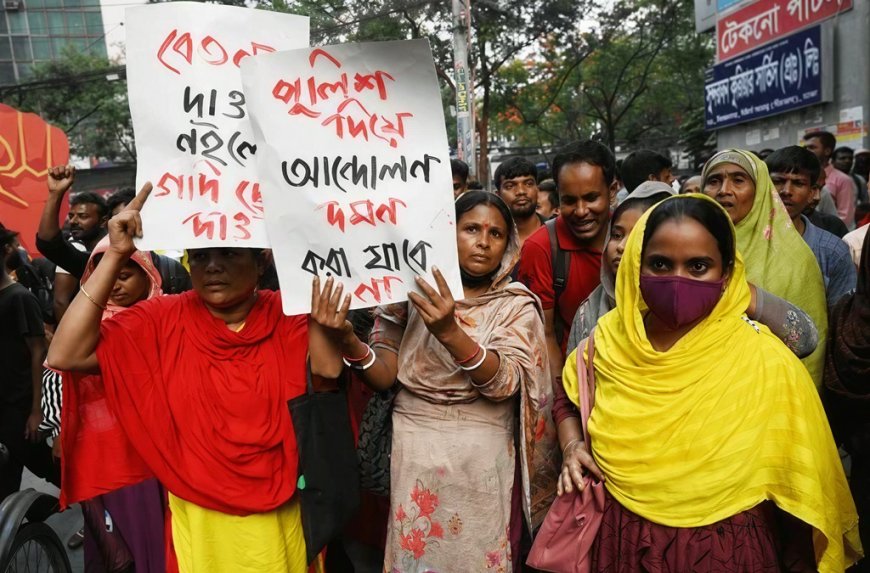
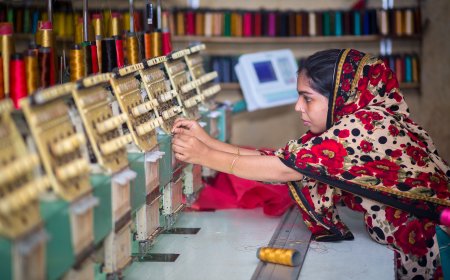
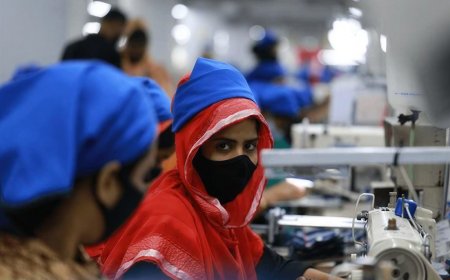
Can a garment worker in Gazipur, Ashulia or Narayanganj afford a decent life for her family on the current legal minimum wage?
The government formed the Minimum Wage Board on 1 November to revise the minimum wage for garment workers. The workers' representatives have proposed Tk 32,000 for Grade 4.
The Bangladesh Garment Manufacturers and Exporters Association (BGMEA) has argued that a Grade 4 worker already earns Tk 19,500 on average, and Tk 22,000 with the festival bonus, overtime and other benefits.
The Centre for Policy Dialogue (CPD) has recommended a minimum wage between Tk 18,578 and Tk 24,204. The stakeholders' positions vary significantly.
Which of these arguments holds? Or do we need a different estimate?
In my view, we do.
Factors That Govern Minimum Wage
Section 141 of the Bangladesh Labour Act 2006 requires the Wage Board to take into account the cost of living, the standard of living, the cost of production, productivity, the price of products, inflation, the nature and risk of the work, business capability and the socio-economic conditions of the country and the locality.
The International Labour Organization (ILO) Minimum Wage Fixing Convention, 1970 (No. 131) groups the same considerations under two heads: the needs of workers and their families, and economic factors such as productivity and the level of employment.
In my reading, the factors reduce to two questions: The cost of a decent life for the worker's household, and the industry's capacity to pay.
The cost of living has to come first, as the minimum wage determines the income of the lowest-paid worker. CPD estimates that Tk 16,351 is needed only to restore the purchasing power of the Tk 12,500 fixed in 2023. A lower figure would therefore cut the real wage of a new entrant.
The capacity to pay matters as much, as factories will not comply with an unaffordable minimum wage. That capacity is under pressure. In a letter to CPD this week, BGMEA reported that production costs rose by 25% to 30% over three years while export prices fell by 2.6%. The Commerce Minister told Parliament in September that 405 garment factories closed between July 2023 and June 2026.
Garment exports fell by 1.64% in FY2025-26, and private sector credit growth fell to a record low of 4.17% in September. According to BGMEA, Bangladesh's minimum wage also rose by 136% between 2016 and 2026, against 54% in Vietnam and 50% in Cambodia.
However, Bangladesh started from a lower base. Its minimum wage of US$100 remains below Vietnam's US$144 to US$207, Cambodia's US$210 and Guangdong's US$405.
The Board also needs to define the earnings counted against the minimum wage. According to the ILO, a monthly minimum wage pays for the normal hours of a full-time worker, and overtime payments should be excluded from its calculation.
BGMEA's figure of Tk 22,000 is a fair measure of take-home pay. It does not measure the minimum wage. Overtime depends on orders, and orders fall in the lean season. As such, a worker cannot plan her rent on overtime.
The Expected Outcomes From Wage Negotiations
The wage negotiation should be governed by total welfare. Welfare cannot be achieved by serving solely the interests of the factory owners or of the workers' unions. Nor can it be served by protecting garment workers at the expense of other industrial workers.
The ready-made garment (RMG) industry employs the largest share of industrial labour in Bangladesh, and any change in its wage will influence wages across other industries.
The end goal should therefore balance the welfare of the RMG workers, the competitiveness of the factories against competing nations, and the effect of the wage on other industries and on inflation.
The Global Living Wage Coalition (GLWC) defines the living wage as the pay a worker needs in normal working hours for a decent standard of living for her family.
For 2025, it estimates the living wage at Tk 25,166 a month for the satellite cities and districts surrounding Dhaka, home to most garment factories. CPD's own estimate of Tk 24,204 is close to it. BGMEA has questioned the assumption of 1.58 earners per household behind both estimates.
With two earners, the living wage needed per worker would fall to about Tk 19,900. Either way, the living wage is a benchmark for the minimum wage, not its legal definition. In 2024, the ILO and its tripartite constituents agreed that wage-setting should promote incremental progression from minimum wages to living wages.
The minimum wage of RMG workers in countries like China and Vietnam falls well below the living wage. A minimum wage equal to the living wage in a single revision would put Bangladesh ahead of all its competitors relative to the cost of living, and would test the competitiveness and the wider welfare explained above.
The evidence from Bangladesh shows the gap can close over time. Between 2016 and 2025, the living wage for the satellite cities rose by 85%, while the minimum wage rose by 136%.
I therefore see the goal in two steps. In this revision, the minimum wage should take a worker's pay, without overtime, to 80% of the living wage. Over the following revisions, it should close the remaining gap in steps linked to productivity.
Minimum Wage That Satisfies Most Conditions
A Bangladeshi worker on the minimum wage earns Tk 14,117 a month without overtime, or 56% of the living wage for the satellite cities. With 52 hours of overtime, she earns Tk 17,467, or 69%. Even BGMEA's figure of Tk 22,000 covers only 87% of the living wage.
Our competitors are also far from the living wage. Without overtime, pay covers 55% to 57% of the living wage in Vietnam and 61% in Guangdong. Sri Lanka, at 26%, is below Bangladesh.
Cambodia shows 95%, but against a low national benchmark of US$242. A CNV Internationaal survey (2024) found that at least half of Cambodian garment workers spend US$412 or more a month on living expenses.
A minimum wage of Tk 17,830, an increase of Tk 5,330 or 42.6%, takes pay without overtime to 80% of the living wage. At US$143, the minimum wage would be level with Vietnam's Region IV and remain below Vietnam's Region I, Guangdong and Cambodia.
Vietnamese employers also pay 21.5% of the wage in social, health and unemployment insurance. Bangladeshi employers do not pay an equivalent contribution. Bangladesh would therefore keep its cost advantage.
A minimum wage of about Tk 22,445, within CPD's range, would take pay without overtime to the full living wage. At US$180, however, it would exceed Vietnam's Region IV by a quarter if set in a single revision.
Figure 1 shows the two steps alongside four competing countries. Each bar shows pay with overtime, and the circle marks the minimum wage plus bonuses. The circle reaches the dashed 80% line in step 1 and the black 100% line in step 2.
Figure 1. Monthly pay of minimum-wage garment workers against the living wage, 2026
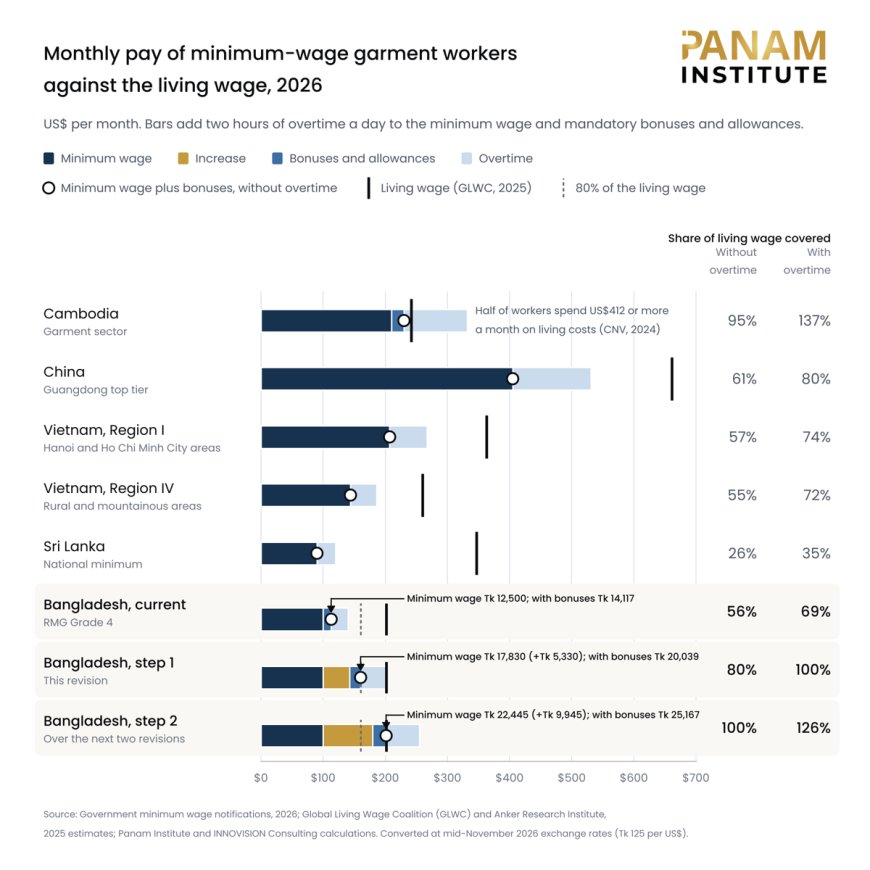
Panam Institute and INNOVISION Consulting built Figure 1 on a like-for-like basis. We started from the legal minimum wage for garment workers in each country in 2026 and added all mandatory benefits.
For Bangladesh, these are the two festival bonuses and an attendance bonus of Tk 500, the average BGMEA cited in 2023. We then compared pay with the GLWC living wage for the area nearest the factories, both without overtime and with two hours of overtime a day.
In China and Vietnam we used the legal overtime caps of 36 and 40 hours a month. Finally, keeping the current wage structure, we calculated the minimum wage needed to take pay without overtime to 80% and 100% of the living wage.
We left out India and Pakistan, as most garment workers there do not receive the legal minimum wage. In Pakistan, Arisa (2025) found that 86% of surveyed workers were paid less than they were legally owed.
In the Delhi National Capital Region, Fair Wear (2019) found that 70% were not paid the minimum wage. In these two countries, the legal minimum wage would overstate the labour cost of the factories.
Significance And The Way Forward
In my view, Tk 17,830 is the minimum acceptable figure for the Board. Over the next two revisions, the minimum wage should rise to about Tk 22,445 in steps linked to productivity. A staged path matters for three reasons.
Firstly, a large single increase will raise local prices. Garment workers live in dense settlements close to their factories. After past revisions, landlords in these areas raised rents by more than the increase in the house rent allowance.
The national inflation figures do not include these local rent increases. A large increase in a single revision will therefore lead to a large rise in rent, and the worker will keep a smaller share of the increase.
Secondly, other industries follow the garment minimum wage when they set their own wages. Many of these industries cannot pay the same minimum wage.
Thirdly, factories are already laying off workers. As per data from the Industrial Police, BGMEA and the Bangladesh Knitwear Manufacturers and Exporters Association (BKMEA), at least 20,000 workers lost their jobs in the first half of 2026. A minimum wage above the industry's capacity to pay will lead to further layoffs.
The Wage Board should set the Grade 4 minimum wage at Tk 17,830 or close to it. The Board should also set a path for the minimum wage to reach about Tk 22,445 over the next two revisions, in steps linked to productivity. The GLWC living wage for the satellite cities should be the reference for these revisions.
BGMEA and BKMEA should publish the total pay of workers from the payroll records of their member factories. The Board can then verify the claim of Tk 22,000.
Many global buyers have committed to a living wage in their supply chains. These buyers should therefore raise their purchase prices to cover the increase in the minimum wage.
It must be acknowledged that a garment worker in Gazipur cannot afford a decent life for her family on the current minimum wage.
With the festival and attendance bonuses, a minimum wage of Tk 17,830 will take her pay without overtime to Tk 20,039, or 80% of the living wage. It will also keep Bangladesh's minimum wage level with Vietnam's Region IV and below its other main competitors.
Bangladesh can therefore pay its garment workers more without losing its competitiveness.
Md. Rubaiyath Sarwar is the Managing Director of INNOVISION Consulting and a Trustee of Panam Institute.