





























































Democracy Returns to Banga Bhaban
By choosing Mirza Alamgir, the Prime Minister has placed institutional credibility above other considerations, and in doing so has strengthened the constitutional order his government is charged with restoring.
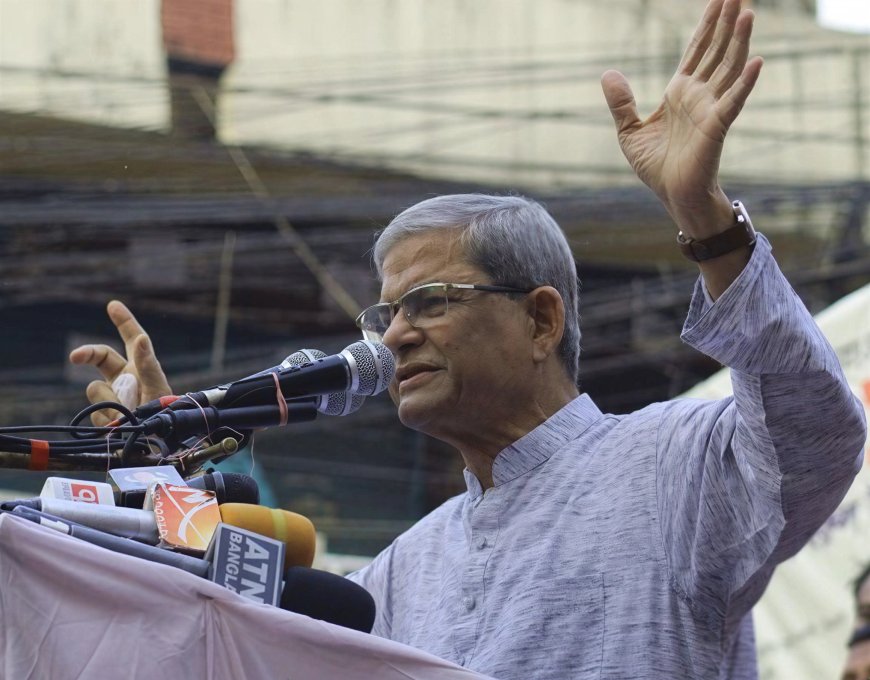
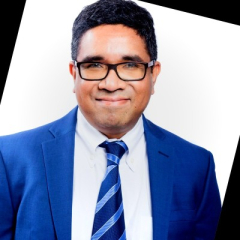
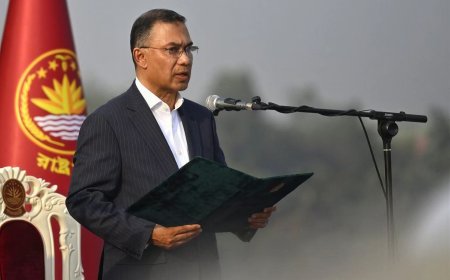
On August 20, the Bangladeshi Parliament is expected to elect Mirza Fakhrul Islam Alamgir as the 23rd President of the People's Republic of Bangladesh. BNP nominated him for the office following President Mohammed Shahabuddin's resignation, and he has since resigned as the party's Secretary General and from its National Standing Committee.
His election will mark the culmination of a public life that began in the classrooms of Dhaka College more than five decades ago. He deserves the country's congratulations, and its gratitude.
As we mark this moment at the height of his career, it is worth remembering what preceded it, and two photographs remember it best. The first is from December 2022, when police raided BNP's central office at Naya Paltan ahead of a planned rally, sealed the premises, and arrested party workers by the hundreds.
In the image that circulated around the world, the Secretary General of the country's largest opposition party sat alone on the sidewalk in front of his own party office, barred from entering it, composed and unbowed. A single man seated quietly on the pavement, with the thuggish machinery of a repressive police state arrayed all around him, became the enduring emblem of an opposition that could be locked out of its office but would not give up.
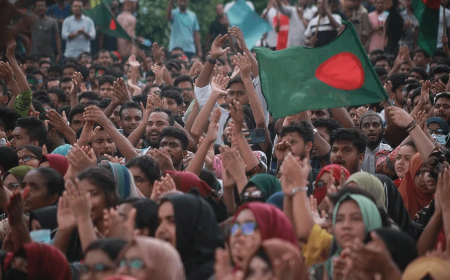
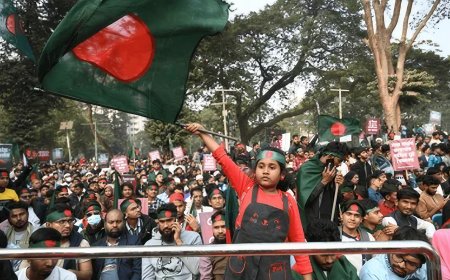
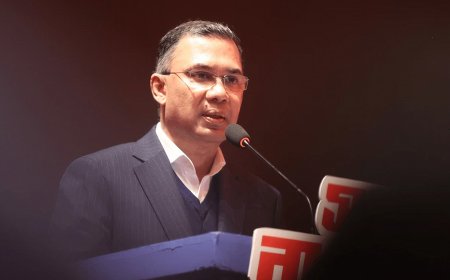
The second photograph is from October 2023, when he stood addressing BNP's grand rally in Dhaka as Hasina's police attacked it in flagrant violation of every democratic norm, dispersing a lawful assembly of hundreds of thousands by force and jailing the party's leadership, Mirza Alamgir among them, in the days that followed.
The purpose of that brutal crackdown was never a mystery. It was undertaken to clear the field for the dummy election of January 2024, a contest without an opposition, staged so that the regime could award itself another term.
With hindsight, we know of course that all of Hasina's horses and all of Hasina's men could not put back the regime together again. The 2024 January election that was supposed to secure Awami League's rule instead stripped it of its last claim to legitimacy, hollowed it out from within, and began its final disintegration as a political organization.
The crackdown of October 2023 and the dummy election of 2024 set the very conditions for the Hasina regime's defeat in the July-August 2024 uprising. The man jailed to make that election possible now ascends to the presidency of the republic.
The proudest accomplishment of his life, however, encompasses each of these episodes. Across 15 years of movement to regain democracy, his party BNP, his leader Khaleda Zia, and his country Bangladesh, never had cause to doubt Mirza Alamgir.
Those familiar with BNP's internal politics know that whenever anyone raised accusations against Mirza Alamgir, Khaleda Zia invariably sided with her Secretary General. She placed her confidence in him during the darkest years a Bangladeshi political party has endured, years of imprisonment, surveillance, enforced disappearance, and exile, when defection carried rewards and loyalty carried a price.
Unlike many others, he never betrayed that trust. In politics, where trust is the scarcest currency, a record of unbroken fidelity across 15 years of persecution is surely an achievement far greater than the Presidency or any other political office.
That fidelity was matched by diligence. After the storm of 1/11 left BNP in shambles, its organization fractured and its ranks demoralized, he was the right person to serve as its Secretary General.
As acting Secretary General from 2011 and Secretary General from 2016, he was the steady hand through which the party's leadership carried out the long and patient work of reorganization, and he discharged faithfully every responsibility entrusted to him. When the democratic opening arrived after the July 2024 uprising, he stood ready to meet it.
The office he now assumes asks something different of him. As President, he moves beyond a partisan role to become the guardian of the entire country and the person entrusted with safeguarding the constitutional process.
The presidency belongs to no party. It administers the oaths, acts as the Commander-in-Chief of the Bangladeshi military, convenes and dissolves, and in the gravest constitutional moments, it stands as the final custodian of the Republic. Here Bangladesh's own history offers an instructive model.
Former President Shahabuddin Ahmed, who served from 1996 to 2001 after a distinguished tenure as Chief Justice of Bangladesh, understood that the office's ceremonial character did not require its occupant's silence. He used his stature to speak candidly and to counsel the government of the day when the national interest required it.
I hope President Mirza Alamgir, fortified by the hard-earned knowledge of the last 15 years and connections across every level of the government and society, will follow that example, drawing on his profile and experience to speak up and provide guidance to the government as appropriate, with the independence the office demands and his own history has earned.
Credit is also due to the man who made the choice. Selecting a head of state was another major test of Prime Minister Tarique Rahman's leadership, and he passes it with flying colors. By choosing Mirza Alamgir, the Prime Minister has placed institutional credibility above other considerations, and in doing so has strengthened the constitutional order his government is charged with restoring.
Watching from the United States, as one of many in the diaspora who followed Bangladesh's long democratic struggle with hope, I find in this election a reason for confidence in the country's new chapter.
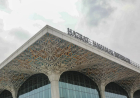
Banga Bhaban will soon be home to a man who earned it the hard way, on the sidewalk outside a raided party office, on a rally stage under assault, and through 15 years of trust. Congratulations and best wishes, Your Excellency.
Ehteshamul Haque is a lawyer who focuses on technology transactions. He teaches corporate law at American University.