









































































The Government Has Earned Time. But Now It Must Deliver.
Public confidence in the future is still stronger than satisfaction with current delivery. That “expectation premium” is a political asset -- but a time-limited one.


One hundred days is far too short a period to judge the ultimate success or failure of a government. It is particularly inadequate for judging a government confronting deep institutional, economic and governance challenges. Yet 100 days is long enough for citizens to begin asking a consequential question: Is the country moving in the right direction?
Our survey of 720 respondents offers a nuanced answer. The overall government performance score was 5.28 out of 10. The Prime Minister's leadership was rated higher at 5.75.
Confidence in the Prime Minister's future performance reached 5.90, while confidence in the government's future performance stood at 5.64. The report describes this pattern as cautious optimism: Respondents are not offering a blank cheque, but many have not given up on the possibility of stronger performance.
This should be interpreted carefully. The survey was conducted online and was not based on a nationally representative sampling frame. It should therefore be read as an evidence-based snapshot of participating citizens' perceptions, not as an estimate of national voting intention or nationwide approval. Its value lies in the consistency of the signals it identifies and the policy questions those signals raise.
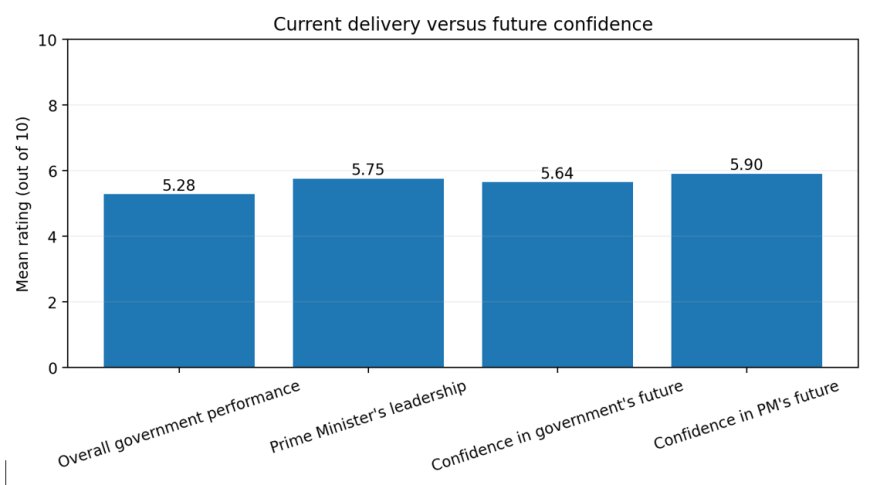
Figure 1. Current performance and future-confidence measures reported in the survey. Source: First 100 Days Performance Survey Findings.
The Central Message: Leadership is Ahead of Delivery
The most important political finding is the gap between confidence in leadership and confidence in the machinery of government. Respondents often viewed the Prime Minister more favourably than the institutions responsible for implementing policy.
In the report's regression analysis, Prime Ministerial leadership and administrative efficiency emerged as the strongest independent correlates of overall performance ratings, although the high correlations among policy ratings mean these relationships should not be interpreted as causal.
The policy implication is nevertheless compelling: The next phase should be less about announcing additional priorities and more about making existing priorities work. Citizens ultimately encounter government through police stations, hospitals, land offices, local administrations, utilities, regulators and public services.
Leadership can create direction and legitimacy; institutions determine whether those qualities become lived experience.
Leadership creates expectations. Institutions determine whether expectations become trust.
Law and Order is the Immediate Credibility Test
Law and order and public safety received the lowest mean score in the survey: 4.08 out of 10. Some 45.3% of respondents rated it between 1 and 3, while only 9.9% rated it between 8 and 10.
Written comments repeatedly raised crime, mob violence, weak enforcement and insecurity. These findings make public safety more than one underperforming policy sector; they make it a reputational floor for the government.
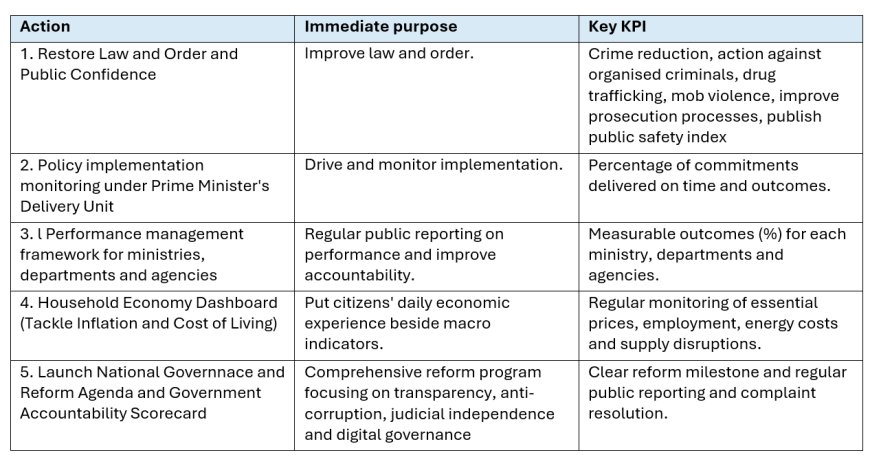
The Prime Minister should consider a time-bound National Public Safety and Law-and-Order Delivery Taskforce, designed not to centralize routine policing in the Prime Minister's Office but to establish measurable priorities, resolve coordination failures and demand consistent enforcement regardless of political identity.
Its agenda could include violent crime and extortion, mob violence, police response and professionalism, investigation-prosecution coordination, and protection of women and vulnerable groups. Progress should be reported publicly using a small set of clear indicators.
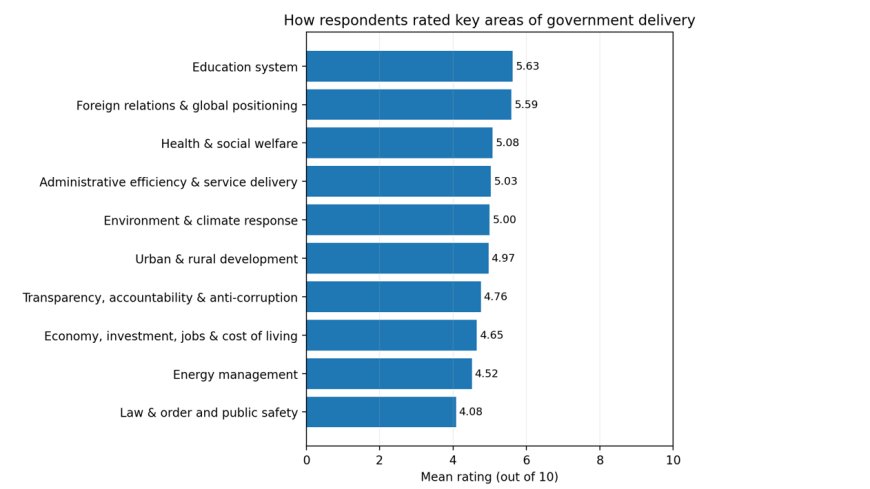
Figure 2. Mean ratings across ten sector-delivery measures. Source: survey descriptive results.
The Second Front is the Household Economy
The economy, investment, jobs and cost of living scored 4.65, while energy management scored 4.52. These are politically sensitive because citizens experience them directly through food prices, transport, electricity, rent, medicine, employment and the viability of small businesses. Macro-economic stabilization matters, but citizens rarely experience an economy through headline indicators alone.
The government should therefore complement macro-economic management with a household-economy lens. A monthly Cost-of-Living Dashboard could track a limited basket of essential prices, food inflation, energy costs, employment indicators and major supply-chain disruptions, with clear responsibility assigned for corrective action.
The purpose would not be another reporting exercise; it would be to make household pressure visible at the centre of government decision-making.
Administrative Efficiency is the Bridge
Administrative efficiency and service delivery scored 5.03. More importantly, administrative efficiency remained a strong independent correlate of overall performance in the report's modelling.
This matters because better administration can improve multiple sectors at once: faster decisions can support investment, better coordination can improve infrastructure delivery, transparent processes can reduce corruption opportunities, and more responsive field administration can improve citizens' experience of the state.
The Prime Minister should consider establishing a small, technically capable Prime Minister's Delivery Unit. It should not duplicate ministries. Its role should be to track perhaps 15–20 priority commitments and repeatedly ask four questions: What was promised? Who is responsible? What is the deadline? What measurable outcome has been achieved?
A simple green-amber-red status system could make delays visible and require recovery plans where implementation is off track.
Five Actions the Prime Minister Can Initiate
Give Ministries Outcomes, Not Activity Lists
The first 100 days were inevitably shaped by transition, appointments and policy announcements. The next six months should be judged differently. Each major ministry could be asked to identify three to five outcomes that citizens should reasonably expect within six months. The emphasis must be on outcomes rather than meetings, seminars, project launches or administrative activity.
The governing question should change from “What did the ministry do?” to “What changed because the ministry acted?” Public commitments would allow Parliament, journalists, researchers and citizens to distinguish implementation from announcement.
Fight Corruption Through Systems
Transparency, accountability and anti-corruption scored 4.76, with 33.5% of respondents assigning a low rating of 1-3. The durable response is not only investigation and punishment, important as those are, but reducing the opportunities through which corruption occurs.
Digitizing high-risk services, reducing unnecessary discretion, publishing procurement information, enforcing service timelines, improving audit trails and strengthening complaint mechanisms can make corruption harder to practice.
A focused 100-Day Service Reform Programme could target a limited number of high-contact public services where delays, discretion and citizen frustration are greatest. The survey itself does not identify which specific services should be selected; that choice should be informed by administrative complaint data and service-use evidence.
Protect the Areas Where Confidence is Stronger
Education was the strongest sectoral assessment at 5.63, followed closely by foreign relations and global positioning at 5.59. These strengths should be protected, but they should also be connected more directly to citizens' material expectations.
International engagement should increasingly translate into investment, trade, technology transfer, climate finance and employment opportunities. Education policy should connect human-capital development with the skills demanded by Bangladesh's future economy.
Communicate Progress -- But Do Not Substitute Communication for Progress
The survey suggests that many respondents already recognize the Government's direction and remain more hopeful about future performance than satisfied with current delivery. The priority is therefore not simply more messaging. It is measurable progress followed by credible communication.
A quarterly Government Delivery Scorecard should show what has been achieved, what is delayed and what corrective action is underway. A government that acknowledges slippage while demonstrating a recovery plan can build more credibility than one that communicates only successes.
Make Citizen Feedback Part of Governing
One broader lesson from the report is methodological. Citizen perception surveys need not be treated only as political polling. Used carefully, they can function as governance instruments that identify emerging concerns and test whether citizens are experiencing policy improvements.
The Government could commission a properly designed Citizen Pulse Survey at regular intervals, using a nationally representative sampling strategy and a stable core of indicators. Repeated measurement would allow policymakers to see whether perceptions of safety, prices, service delivery, corruption, education, healthcare and institutional confidence are improving.
That would also address the limitations of the present online survey and convert citizen feedback into a more robust longitudinal governance tool.
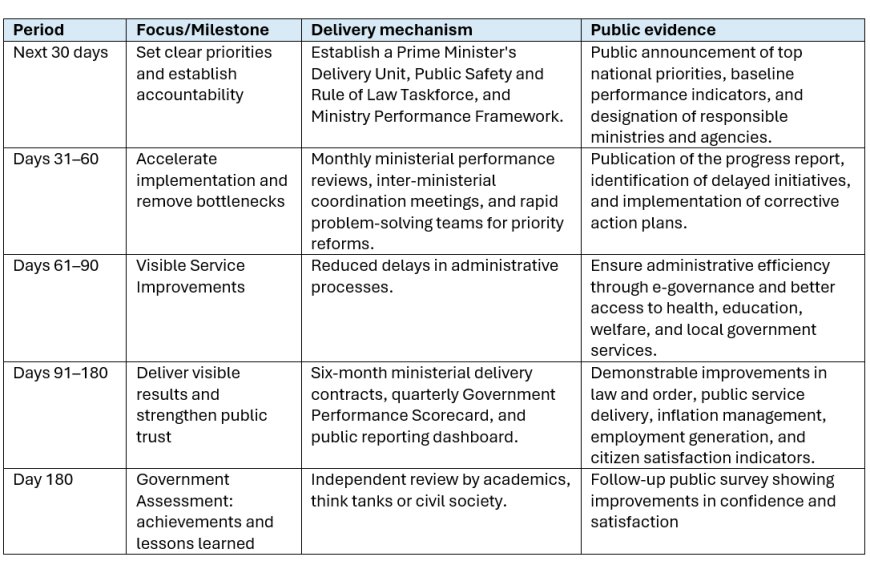
A Practical Next 180 Days (Six Months) Agenda
The government has finished its first half of the year. Moving forward, the next 180 days (six months) should emphasize delivering results, ensuring accountability, enhancing public safety, providing economic relief, and maintaining transparent performance management. The initial 100-day survey results reflect public goodwill, and now the goal is to turn that goodwill into tangible, measurable outcomes.
From the First 100 Days to the Next 1,000
The most encouraging message in the survey is that respondents have not closed the door on the Government. Confidence in future performance remains stronger than satisfaction with present delivery. That is valuable political capital, but it is also temporary.
The Prime Minister's strategic task is to transfer confidence from the individual to the institution: From leadership to ministries, from policy direction to public administration, and ultimately from promises to citizens' everyday experiences.
Bangladesh does not need hundreds of new priorities. It needs relentless implementation of a few important ones.
Make people safer. Reduce pressure on household budgets. Make government services work. Make corruption harder. Make officials accountable for outcomes. And show citizens, transparently and regularly, what is changing.
The first 100 days suggest that many respondents remain prepared to give the Government time. The next phase will determine whether that time becomes trust. Democratic legitimacy begins at the ballot box, but it is renewed every day through the experience of governance.
Dr Faysal Kabir Shuvo is an Australian-Bangladeshi environmental professional, researcher and policy analyst with multi-disciplinary expertise in urban and regional planning, geo-spatial analytics, water security, climate resilience, and environmental health.
Dr Khandakar Al Farid Uddin is a Social Sciences faculty member at Western Sydney University, Australia.
Source Note and Methodological Caution
This op-ed is based on Bangladesh's New Government 2026: The First 100 Days Performance Survey Findings, based on 720 online respondents, including 238 open-ended comments. The report combines descriptive statistics, qualitative feedback and inferential analysis.
Because the sample was voluntary, online and not based on a documented random or stratified sampling frame, the findings should not be treated as nationally representative estimates or evidence of causation. The Prime Ministerial actions proposed in this op-ed are policy recommendations derived from the survey's messages; they were not themselves tested by the survey.