





















































Post-2024 Bangladesh and the Closing of the Gates
An uprising can reclaim space without reclaiming sovereignty. It can capture a symbol without capturing the mechanism. It can change the occupants without changing the architecture of access.
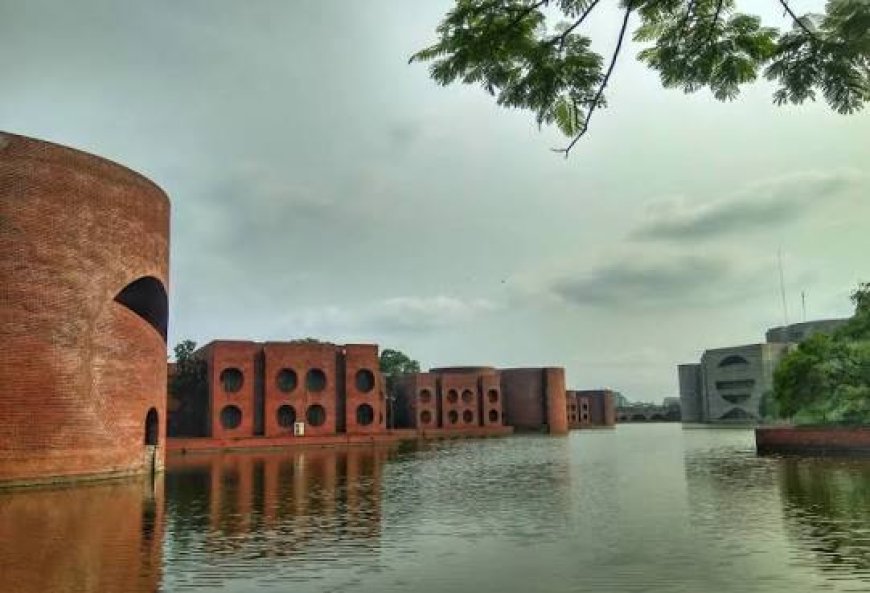
In 2013, when the Institute of Architects Bangladesh and some like-minded artists protested the state's decision to wall off Louis Kahn's South Plaza at the Jatiya Sangsad Bhavan, the objection was not merely technical or aesthetic.
Kahn had designed the South Plaza as an exquisite elevated public lawn, an enormous green threshold between the people and the monumental geometry of the legislature.
It was not decorative or merely ceremonial. It was a grand civic proposition: The state should not sit on one side of a fence while citizens remain on the other. The state fenced it anyway, an ignoble gesture in a city sorely bereft of public space.
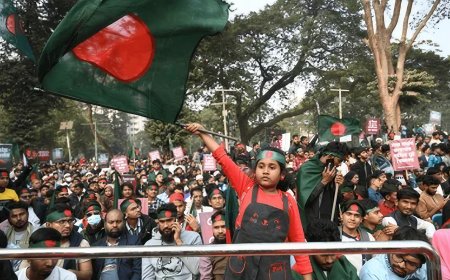
Eleven years later, on August 5, 2024, the distinction between citizen and state briefly disappeared.
Crowds entered Sher-e-Bangla Nagar through two gates only a few hundred metres apart: Ganabhaban, Sheikh Hasina's official residence, and the Sangsad Bhavan complex next door. For several extraordinary hours, both belonged to whoever was standing on the lawn.
But only one remained surrendered.
Ganabhaban recently became the July Uprising Memorial Museum. Its grounds were opened, the building preserved as evidence of a vanquished regime, a private residence of political power transformed into a public monument to its overthrow.
The parliament grounds, meanwhile, quietly returned to what they had been before: Off limits to general public. You may walk around them. You may admire them. You may photograph them. But the gates -- the cold, heavy, indifferent pieces of infrastructure guarding the machinery -- remain closed.
That difference may be the most revealing architectural fact of post-August Bangladesh.
A residence is a symbol of power. A legislature is an instrument of power. One tells you who occupied the house. The other determines who gets to write the constitution, the laws of the land, and the rules to get the licence, the land, the appointment, the contract, the budget and, ultimately, permission to do almost anything at scale. A crowd can be given the first without fundamentally disturbing the second.
A palace can become history. A legislature writes laws next Tuesday.
This is where I began wondering whether we are looking at the wrong fight.
The usual story of post-2024 Bangladesh has apparently divided the country into two political camps: A moderate liberal side and a resurgent religious right. It looks, apparently, as a tidy story. I think it does not describe the situation very well.
There are many more players, and they do not form two neat teams.
There is a secular left leaning group with no effective party machine; a tidy middle class that is politically articulate but rarely coalesces into an organized group; the remnants of the BNP's centrist tradition and their cohorts; whatever remains of the Awami League's civilian base; and an NGO-development sector that still lives partly by donor cycles.
On the other side are the disciplined and closely guarded Jamaat-e-Islami; covert and overt Salafi networks; the enormous, somewhat opaque Qawmi madrasa establishment; pirs, mazars and their local patronage networks, which sit somewhere in the middle of almost everything; and a bright, younger, university-based Islamist current with ambitions of its own.
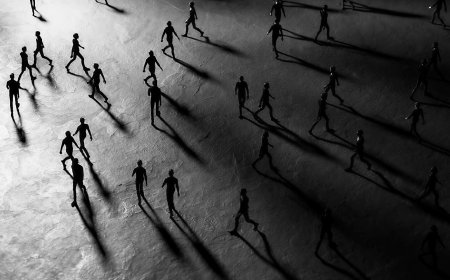
These are not really ten armies marching under ten flags. They overlap, compete, borrow people, negotiate, split and form temporary alliances. The exact number is less important than the fragmentation.
And here is the strange part: they may disagree violently about religion, history, culture and the future of the country, but once a contract, a piece of land, an appointment or an import licence appears on the table, they can discover the same door.
Is the real divide somewhere else?
There is a much older story behind this. Across much of the Muslim-majority post-colonial world, power has repeatedly learned to work with two broad kinds of political clothing. One is the modernizing secular/progressive coat. The other is the "authorized" religious coat.
The secular coat came with the language of progress, science, development, constitutionalism and modernity. Colonial administrations educated elites who could speak the language of the empire and later of the international system.
During and after independence, many of these people became national leaders, bureaucrats, industrialists, intellectuals and military officers. Many genuinely believed in what they were doing, built their countries with due diligence, while remaining loyal to the international geo-political economic ecosystems.
This eco-system learned that a modernizing elite could also be a very useful intermediary between society, the state and foreign capital.
The other coat was religious. The Saudi experience is an extreme and important example of what happens when a state decides that some forms of Islam are acceptable, administrable and useful while others are the opposite.
Syncretic, local and vernacular traditions can be treated as backward, suspect or simply inconvenient, while a more ‘standardized' religious authority are worthier of institutional backing.
Again, Bangladesh is not Saudi Arabia. But the pattern is worth noticing.
A pir, a shrine, a Baul tradition or a religious practice can possess something that centralized political systems find difficult to control: autonomous social legitimacy. It grows through families, places, memory and relationships. It does not need a ministry to exist.
An institution that can be registered, funded, regulated, promoted or excluded is easier to administer.
The question which comes to mind is whether the history of Muslim-majority postcolonial societies can be reduced to secularism versus Islamism. There is another layer of questions underneath it: Who gets to define "legitimate" Islam, and who gets to administer that legitimacy?
The same thing happens with the secular coat. Liberalism, socialism, nationalism, anti-communism and development have all served at different times as the language through which regimes presented themselves to the world.
Sometimes the same government wore several coats at once. Secular in the cosmopolitan cities, university campuses, quasi-conservative in the village, nationalist in the newspapers, socialist in speech, religious at the ceremonies and occasions, and colonial/ authoritarian in the office!
There is no need to assume that everybody is pretending. People can indeed believe deeply in the coat and coats they are wearing. After all, precedence, legacy and muscle-memory are the key tools of social production.
But the machinery can still use the coat. That is the uncomfortable part.
The machinery of power is remarkably indifferent to ideology. A religious trust applying for land can discover the same bureaucratic intermediary as a secular corporation.
A university Islamist faction can discover that access to a ministry matters more than access to its student constituency, or the appointment of the Vice-Chancellor is simply a matter of existence.
An NGO can discover that donor approval is not political power, but good terms with the Secretariat is a game changer. A business conglomerate can discover that ideology becomes remarkably flexible when a licence is involved.
Everybody arrives wearing a different coat. Everybody eventually discovers the same door. And behind the door is the same pen.
This is also where the comparison with Indonesia becomes interesting. It is fascinating to see Nahdlatul Ulama as an example of how a traditionalist, syncretic Muslim organization resisted hardline Islamism in post-Suharto Indonesia. But the important thing about NU is not simply that it is moderate.
It is organized. It has schools, scholars, economic networks, local legitimacy, and a social history built over generations.
The infrastructure came first.
That is the part Bangladesh cannot simply import.
We have pirs, mazars, Baul culture, and rich vernacular religious traditions. But much of this exists as social memory, local practice and dispersed patronage rather than as an institution with the organizational strength and independent resources of NU. You cannot manufacture a century of institutional capital because a political crisis has suddenly made it useful.
The lesson of Indonesia is therefore not: "Be more moderate." It is: "Build institutions before you need them."
And this brings us back to August 5.
For a brief moment, the dependency reversed. People did not petition. They did not wait for a permit. They did not negotiate access. They walked through the gates.
That matters.
It proves something political arguments often forget: agency is not granted by institutions. Sometimes it arrives physically. A crowd occupies the space the state thought it controlled, and for a few hours the distance between citizen and institution becomes zero.
But then the cameras disappear.
The crowd goes home. The bureaucrats return. The files move again. The gates are repaired. The coats come out. And the machinery waits.
That is why Ganabhaban and the Sangsad Bhavan tell two different stories. Ganabhaban became a museum because the symbolic order could absorb its capture. Sangsad remains an institution because institutional power cannot be absorbed so easily.
The public reclaimed a residence. The machinery of the state remained behind another gate.
Perhaps this is the great fault line running through much of the late capitalist postcolonial world. Not simply Islam versus secularism. Not Left versus Right. Not liberal versus conservative.
Perhaps it is society versus the machinery that administers society.
And if that is true, then the question facing Bangladesh is not which faction gets to wear the next coat. It is whether citizens can build institutions that no faction can simply inherit.
That is why the ten players matter. Not because one must defeat the other nine. Not because Bangladesh needs a new faction to join the fight. But because ten factions competing for access to the same machinery can reproduce the very system they claim to oppose.
The answer to ten factions is not an eleventh faction.
It is another architecture, an architecture built with the agency of the people, who, till now are citizens in exile in their homeland.
Kahn understood something about architecture that politics often forgets. A public building can be monumental without becoming a fortress. The South Plaza was meant to be a threshold, a place where the citizen and the state could meet without a wall between them.
The state put up the wall.
August 5, 2024 brought the wall down, at least for a while. It proved that an uprising can reclaim space without reclaiming sovereignty. It can capture a symbol without capturing the mechanism. It can change the occupants without changing the architecture of access.
The lawn is easy to celebrate. Opening the gates is harder. Because the real question was never simply who occupied the Ganabhaban. It was always who has symbolic and real access to the rooms where the destiny of the people is decided.
At this point, one may ask: “Why are the gates of the Jatiya Sangsad Bhavan, the House of the People, still shut off to the public?
Sujaul Khan is an Assistant Professor at North South University.