












































![A Ledger of the Soul: Navigating the Allah-Bhagavant Nexus in a 19th-Century Puruṣākāra Jñāna Caupara [Gyan Chauper]](https://counterpointbd.com/uploads/images/202608/image_430x256_6a93baa3b09a7.jpg)



















When Courts Meet Politics in Bangladesh
Democracies flourish when institutions remain stronger than personalities and when constitutional principles remain superior to partisan interests. Bangladesh's future cannot be secured through improvised arrangements or symbolic declarations alone.

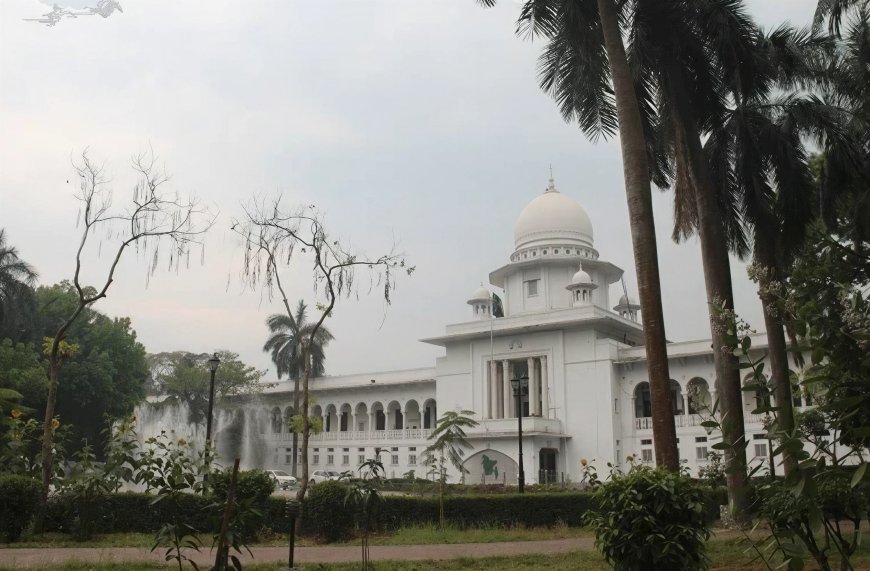
Bangladesh’s judiciary, ensnared in a political maelstrom, now stands under siege.
As courts enter the political arena, constitutional uncertainty deepens, and Bangladesh finds itself confronting an increasingly turbulent and unpredictable democratic storm.
Politics thrives on compromise, but constitutional democracy survives only through legitimacy.
When political arrangements begin to rely more on expediency than on legal certainty, the courtroom inevitably becomes the final battleground.
Recent controversies surrounding the so-called July Charter, constitutional reform initiatives and the legal challenges now emerging have once again demonstrated an enduring truth: No political consensus can permanently escape judicial scrutiny.
Bangladesh stands at a delicate crossroads.
Competing political forces, constitutional reform advocates and various stakeholders have attempted to project an image of unity and national consensus.
Yet beneath this façade lies a growing tension between political ambition and constitutional propriety. What appears harmonious on the surface often conceals unresolved legal and institutional questions.
The disputation surrounding the so-called July Charter and the proposed Constitutional Reform Council has elevated these tensions to a new level.
So-called supporters describe such initiatives as necessary mechanisms for national reconciliation and democratic restructuring. Critics, however, have raised fundamental questions regarding constitutional authority, institutional jurisdiction and democratic legitimacy. Inevitably, these questions have found their way into the judicial arena.
History teaches those constitutional systems cannot be reconstructed through declarations alone.
Grand political understandings, however noble their intentions, must ultimately pass the rigorous tests imposed by constitutional frameworks and judicial interpretation.
Otherwise, political agreements risk becoming castles built upon sand.
This is not merely a legal debate. It is a question concerning the very nature of sovereignty. Who possesses the authority to redefine the architecture of governance? Can unelected bodies or ad hoc councils assume responsibilities traditionally vested in Parliament and constitutionally mandated institutions? To what extent may political expediency substitute for constitutional procedure?
Such questions transcend personalities. They concern principles that outlive governments and political alliances. Throughout democratic history, courts have frequently acted as guardians against constitutional overreach.
Their role is neither to govern nor to obstruct political evolution, but to ensure that transformations occur within legally sanctioned boundaries. Judicial intervention often emerges precisely when political actors attempt to move faster than constitutional mechanisms permit.
Political actors from across the spectrum have sought to portray themselves as defenders of democratic reform.
Yet constitutional legitimacy cannot be manufactured through slogans, televised declarations or elite negotiations. It requires transparency, legality and public confidence.
The uncertainty generated by ongoing legal challenges may also carry profound implications for electoral politics.
Any ambiguity regarding constitutional procedures, parliamentary authority or the legality of institutional arrangements inevitably creates anxiety among political parties and prospective candidates.
Electoral mandates derive their strength from constitutional certainty. Without that foundation, victories themselves become vulnerable to controversy and judicial review.
Democracy demands not only elections but also institutions capable of commanding trust.
Political arrangements perceived as legally questionable may secure temporary advantages, but they rarely provide lasting stability. History is replete with examples where seemingly triumphant political coalitions eventually found themselves undone by constitutional realities.
Perhaps the greatest danger lies not in disagreement itself, but in the temptation to subordinate institutions to transient political calculations. Democracies flourish when institutions remain stronger than personalities and when constitutional principles remain superior to partisan interests. Bangladesh's future cannot be secured through improvised arrangements or symbolic declarations alone.
It requires patient consensus rooted firmly within constitutional norms.
Political actors may negotiate, reform and compromise, but they cannot circumvent the supremacy of law without inviting deeper instability.
Courts are often accused of entering the political arena.
In truth, courts usually arrive only after politics itself has ventured into constitutional territory. When politicians transform legal questions into political projects, judicial scrutiny becomes unavoidable.
Ultimately, constitutions are not obstacles to democracy; they are democracy's final insurance policy.
Political actors may celebrate unity today, but history has repeatedly shown that alliances built without firm constitutional foundations often discover, too late, that legality possesses a stubborn memory.
And when courts begin asking questions, political theatre gives way to constitutional reckoning.
The writer was a freedom fighter in 1971 to establish Bangladesh and is an independent political analyst based in Dhaka, Bangladesh, who writes on politics, political and human-centred figures, current and international affairs.