


































































A democracy cannot ask citizens to trust the ballot while treating one of their ballots as optional. The government received its mandate from the people. The July Charter received its mandate from the people as well. Both must be honored.

Democracies flourish when institutions remain stronger than personalities and when constitutional principles remain superior to partisan interests. Bangladesh's future cannot be secured through improvised arrangements or symbolic declarations alone.

If a hostile landlord evicts us from our rented housing, or if an institution terminates our employment based on proven discrimination, we will be able look toward our Constitution with hope for reassurance and justice.

If South Asia wants its uprisings to mean more than a change of management, it has to stop mistaking collapse for transformation.
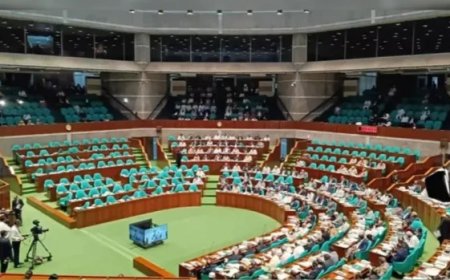
In functional democracies, losers succeed by diagnosing the situation precisely and organizing methodically. The goal is to defend the uncertainty of the next election. If an opposition misdiagnoses a policy defeat as a regime collapse, it loses the ability to speak to a combination of public segments.

There is a sensible way out, and it lies inside the Constitution, not outside it. If the new government wants to preserve the Reform Council model, it should table a constitutional amendment under Article 142 defining the Council’s status, powers, voting threshold, relation to Parliament, and oath.

One institution will carry three kinds of weight at once: The grief of a country that has buried its young; the fragile hope that it can still build rules stronger than instinct; and the scrutiny of a world deciding what kind of Bangladesh it must now learn to live with.

No one can predict exactly what Bangladesh's constitutional architecture will look like by year's end. The process will be messy, contentious, and imperfect. But the direction is clear. Two-thirds of voters have chosen a path away from capricious rule toward a system where power is tempered.

BNP has to govern not merely as the winner of an election but as the steward of a divided nation. Jamaat-e-Islami has to act as a parliamentary opposition, not as a liberation war revision society. The international community has to support democratic consolidation, not strategic alignment.

Opponents of the referendum write as though rejecting this package will clear the way for a more measured, item by item process of constitutional improvement. But nothing in Bangladesh’s recent history suggests that such a sequence will materialize on its own.

What we have here is selective presentation designed to secure approval through incomplete information. The ballot emphasizes what is popular; the fine print includes what is contentious.

By binding the concept of reform so tightly to the consensus commission's existence, and suggesting that the commission's end would spell the end of reform itself, we have propagated a dangerous fiction: that meaningful reform requires suspending normal democratic politics and governing through unelected technocrats.

The sooner we embark on our mundane journey for democracy fraught with its own setbacks and disappointments, the more likely we will find the peace, stability, and economic justice we yearn

Politics is not a moral monastery. It’s a battlefield of imperfect allies and temporary truces. If the NCP keeps attacking everyone around it, soon it will have no one left to fight beside. Reform may begin with rebellion, but it survives through relationships. And without those, no revolution lasts long enough to write its own constitution.

We need to close loopholes for unilateral amendments to the Constitution, otherwise the July Charter will not be worth the paper it is written on

NCP’s hesitation is an act of political commitment to the people of Bangladesh. It seeks to ensure that Bangladesh’s long-awaited democratic transformation is not undone by legal fragility or political opportunism.