

























































Time to Add Sexual Orientation and Gender Identity to the List
If a hostile landlord evicts us from our rented housing, or if an institution terminates our employment based on proven discrimination, we will be able look toward our Constitution with hope for reassurance and justice.


The current government of Bangladesh has declared that it is committed to implementing the July Charter, a document listing a group of state reform related proposals, which was formulated during the tenure of the Interim Government and signed by most political parties.
However, there remain some disagreements between the government and opposition parties regarding the method and process of its implementation. Despite these differences, this petition has been raised focusing on a specific issue with the expectation that the charter will ultimately be implemented through appropriate constitutional reforms.
In the 9th proposal of the July Charter, under the heading “Expansion of the List of Fundamental Rights,” there is a call to bring the various criteria recommended by the National Consensus Commission -- under the scope of fundamental rights for all citizens, along with a request for appropriate constitutional amendments and legislative measures.
In their Constitution Reform Report, under the proposal section titled “Fundamental Rights and Freedoms,” Article 4 outlines the criteria for protection against discrimination. These are reproduced below:
Sexual orientation refers to the biological and psychological process through which a person experiences sexual attraction and/or romantic feelings toward others. Modern research in behavioral genetics and neurobiology(1)(2)(3)(4) has shown that human sexual orientation is determined primarily through a combined interplay of roughly 50% genetic factors and 50% environmental influences.
Genetic factors have been elaborated as the complex interaction of thousands of tiny genes within the human DNA. And environmental influences have been elaborated as those found in the chemical and prenatal biological environment inside the mother's womb. In other words, every individual's sexual orientation is a biological reality.
A person’s "biological sex" is primarily determined by their chromosomes, hormones, and innate physical attributes. In the language of society and law, this is referred to as "gender" or "sex". Beyond this, there is also their "gender identity" -- how an individual deeply perceives themselves from within (often from early childhood) as a man, a woman, or another identity.
For most people (i.e. cisgender individuals), these two align perfectly. However, for some, they are fundamentally opposite. These individuals are our transgender friends.
This incongruence leads to a profound psychological condition known as "gender dysphoria," as described in articles (6) and (7) mentioned in the bibliography below. This internal gender identity -- whether of transgender or cisgender individuals -- is fundamentally innate and unchangeable.
However, for transgender people, through hormone therapy and surgical interventions, a person’s biological sex can be brought closer to their gender identity, thereby alleviating the excruciating psychological distress caused by this incongruence.
Since sexual orientation and gender identity are biological and immutable, no form of state-level discrimination based on these traits can be tolerated in Bangladesh 2.0. To this end, it is demanded that Article 28 of the Constitution of Bangladesh -- which currently states: "The State shall not discriminate against any citizen on grounds only of religion, race, caste, sex or place of birth" -- be amended to include all criteria recommended by the National Consensus Commission, along with the explicit addition of "sexual orientation" and "gender identity" to the list of non-discrimination criteria.
The inclusion of these two criteria will constitutionally prohibit all forms of discrimination against all members of the sexual & gender minority (LGBT+) community in Bangladesh. Should we face physical threats or death threats from family, relatives, acquaintances, or local neighbours, we will be able to claim the protection of law enforcement agencies and secure our rightful place in the state.
If a hostile landlord evicts us from our rented housing, or if an institution terminates our employment based on proven discrimination, we will be able look toward our Constitution with hope for reassurance and justice.
Politics
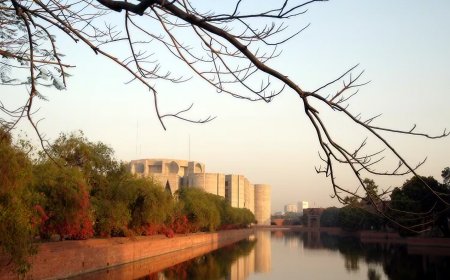
As of February 2026, Bangladesh is once again a Parliamentary Democracy. The current political party in power, the centrist Bangladesh Nationalist Party (BNP), has a two-thirds majority in parliament which, in the face of guaranteed resistance from Islamist and other conservative opposition parties, will be able to include the above two criteria in the Constitution if it so chooses.
It is safe to say that after the current window closes, Bangladesh's Constitution will probably not be revisited for a long time.
This petition needs esteemed readers' support via their kind signatures at: https://c.org/HPJf6JQNM9
Riaz Osmani is a political and social analyst.