






































































The Chemistry of Cinema
If filmmaking were simply the execution of something that already existed perfectly inside the director’s head, then perhaps the people around the director could be interchangeable. But I do not believe they are. The collective resonance of the actor and crew establishes a soul to the cinema.

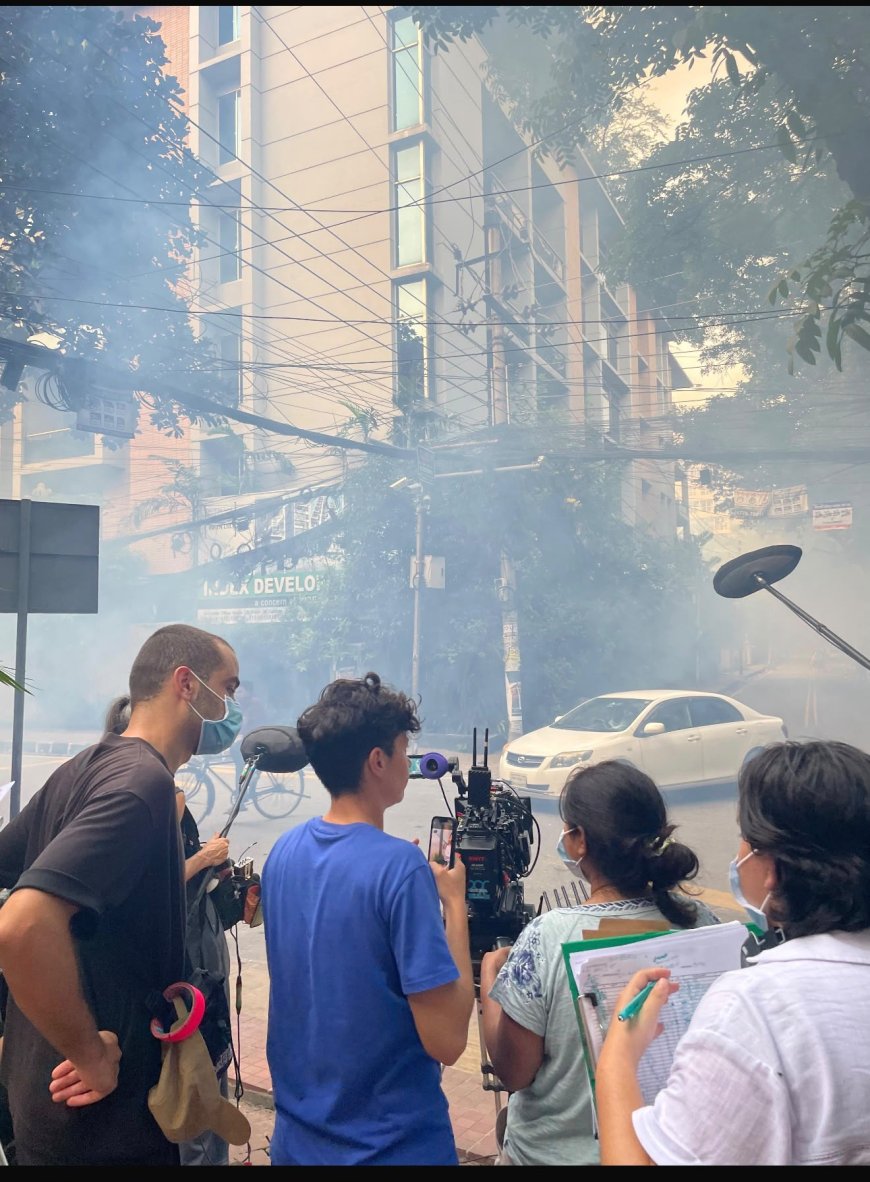
I often think about cinema through the idea of human chemistry -- about what happens when a group of people come together, physically and emotionally, to make something new.
There is research suggesting that when two people are in close proximity, certain physiological rhythms can begin to synchronize. Heart rates, breathing patterns, emotional states, even attention can begin to respond to the presence of another person.
I find this idea fascinating because it gives language to something I have always felt instinctively while making films: Human beings are constantly affecting one another, often without speaking.
For me, cinema grows out of this invisible exchange. When we make a film, we tend to describe the process through roles. There is the director, the actor, the cinematographer, the editor, the sound designer, the production designer, the composer.
Each person has a defined responsibility and a particular craft. But the film that eventually emerges is not simply the mathematical addition of those crafts. Something else happens between people.
There is chemistry. An actor responds to the energy of another actor. The cinematographer responds to the actor’s body, movement and emotional rhythm. I respond to the cinematographer and actor.
The editor later responds to everything that happened between us on set, the pauses, the hesitations, the accidental gestures, the moments we planned and the moments we could never have planned.
The sound designer encounters the images and begins to feel another emotional landscape underneath them. Each person receives something and transforms it. A film is constantly passing through human beings.
As a director, I feel my job is not only to communicate an idea. It is to create resonance.
Of course, directing involves words. We discuss characters, framing, light, rhythm, performance, movement, structure. We make decisions. We disagree. We explain things. But some of the most important communication in filmmaking is not verbal at all.
Sometimes it is presence. Sometimes I can sit beside an actor and feel that something has shifted before either of us has said anything. Sometimes a cinematographer understands what I am looking for from the way I am watching a space.
Sometimes I know that an actor has reached the emotional place of a scene simply from the way she is breathing. There are moments when everybody on set becomes extremely quiet, and somehow everyone understands that something delicate is happening and that it should not be disturbed.
Nobody has to announce it. That information moves through the room.
This is why I think filmmaking has a kind of emotional frequency. When people work very closely together, particularly over an intense period of time, they begin to learn one another’s rhythms. They begin to anticipate one another.
A look can replace many words, and a gesture can become an instruction. Sometimes what one person feels but does not express can still influence everyone around them.
For me, directing is partly about becoming sensitive to this field of information.
I have to resonate with many different people at once, which is probably the most emotionally exhausting part of filmmaking for me, yet it remains a deeply rewarding experience.
I have to communicate with an actor in one language and with the cinematographer in another.
I have to understand what the editor is seeing, what the sound designer is hearing, what the production designer understands about space and texture. And yet underneath all these different crafts there has to be some shared emotional current.
The stronger that current becomes, the more deeply we can communicate.
That does not mean everyone has to agree all the time. Chemistry is not the same as harmony. Sometimes friction creates something very powerful. These encounters can alter the film.
That is important because a film should remain alive enough to be changed by the people making it.
If filmmaking were simply the execution of something that already existed perfectly inside the director’s head, then perhaps the people around the director could be interchangeable. But I do not believe they are. The collective resonance of the actor and crew establishes a soul to the cinema.
Even if the screenplay remained exactly the same, even if we shot in the same locations with the same production design, the film would not be the same object without the same team. Each person introduces something irreducibly their own: Their memories, instincts, fears, desires, cultural references, emotional intelligence, taste, body, rhythm and way of looking at the world.
All of that enters the film.
An actor does not simply “perform” a character. Her own life has somehow passed through that performance. A cinematographer does not simply record an image.
The way that person sees light, bodies and space becomes part of the film’s consciousness. An editor brings a completely different relationship to time. A sound designer may discover an emotional dimension in a scene that nobody consciously recognized while shooting it. A director is therefore not working with instruments, they are working with human beings.
And human beings are organic. This is why I think cinema itself is organic. A film grows.
We often use industrial language around filmmaking: Production, schedule, workflow, delivery. And of course those structures are necessary. But underneath the machinery of filmmaking, something much more fragile and unpredictable is happening.
Human beings are meeting each other. They are influencing one another. They are becoming comfortable, uncomfortable, trusting, resistant, open, loving, frightened, excited. Their relationships are changing every day, and the film is absorbing all of it.
I sometimes think of a film almost like a living organism formed temporarily by the people making it. For a few weeks or months, these individuals come together and create a particular emotional ecosystem. Then the group disperses, everyone goes back to their separate lives., but something from that temporary formation remains inside the film.
That is why films can sometimes carry an atmosphere that is difficult to explain technically. You may not be able to identify exactly where it comes from. It is not simply the performance or the cinematography or the music. It is something that exists between all of those things. It is the residue of relationships.
It is human chemistry made visible and audible.
Perhaps that is one of the reasons cinema continues to feel mysterious to me even after making four feature films. You can prepare enormously, you can write for years, storyboard, rehearse, design, discuss and plan.
Eventually you bring people into a room, into a landscape, in front of a camera, and something begins to happen between them. One cannot fully control that, but one needs to flow in the rhythm, and navigate to bring the ship ashore.
For me, that is one of the central responsibilities of directing: To be attentive enough to recognize that life when it appears and to allow it to enter the film. Because ultimately a film is not only a collection of images and sounds. It is the sum total of many human encounters, many nervous systems, imaginations, emotions and intuitions briefly coming into contact with one another.
We mingle. We influence one another. We resonate and create something that leaves a mark on our minds and help us evolve as beings. That, to me, is the beauty of cinema.
Rubaiyat Hossain is a film mentor, screenwriter, producer and director. She is a visiting faculty at Smith College where she teaches Gender, Film and South Asia Studies.