


























































When Genealogy Becomes Propaganda
A Bengali Muslim could support the idea of Pakistan at one moment, fight for Bengali language rights at another, and later resist the Pakistani state itself. Political identity changes through historical experience. That change is not an inconvenience to history. It is history.

A new rule of history seems to be gaining popularity: First decide the political conclusion you prefer, then pick four or five convenient episodes from three centuries of history, add a weighty phrase such as “genealogical site,” and if a hundred years in the middle go missing, simply insert “the humiliation of Muslims” as the causal explanation.
Ishrat Manzil is, without question, an important historical site. Its history deserves preservation, serious public interpretation and perhaps even recognition as a museum or heritage site.
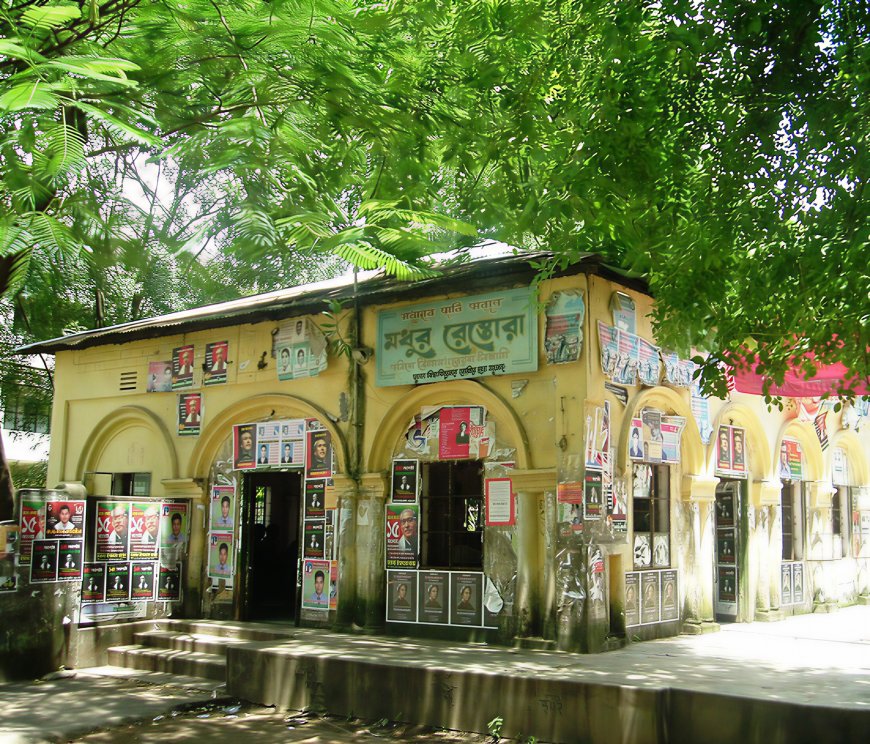
The problem is not the attempt to establish its significance. The problem is the way that history is arranged into a dramatic story in which the site becomes a sacred ground of Muslim political awakening and the post-1971 state supposedly turns it into Madhur Canteen in order to symbolically spit on Muslim history.
The first difficulty is architectural. The post effectively collapses Ishrat Manzil, the wider Shahbag Nawab estate and the present Madhur Canteen into the same physical site.
Banglapedia’s entry on Shahbag distinguishes them. Ishrat Manzil was one of the prominent two-storey mansions of the estate, where delegates to the 1906 Muslim educational conference were received. The building associated with present-day Madhur Canteen, by contrast, is described as the Jalsaghar or Skating Pavilion of the Shahbag garden-house complex.
Later historical accounts also describe that structure as a durbar hall, skating rink and ballroom. In other words, the argument has already wandered into the wrong building before it gets to the politics.
Ishrat Manzil itself also had a subsequent history distinct from Madhur Canteen. It later became associated with Hotel Shahbag, and the former hotel property was acquired for the Institute of Postgraduate Medicine and Research in the 1960s, with institutional use developing thereafter.
So the claim that the post-Liberation government simply converted Ishrat Manzil into Madhur Canteen as an anti-Muslim symbolic act does not fit the physical or institutional chronology.
The chronology becomes even more inconvenient when we turn to Madhur Canteen itself. The canteen was not a post-1971 invention of the Liberation War government. The Dey family’s association with food service at Dhaka University goes back to the university’s early years.
Aditya Chandra Dey began the business with university permission, and Madhusudan Dey later took over its running. By the Pakistan period, Madhur Canteen was already a recognized centre of student political life.
Its political history long predates 1971. The canteen became associated with the language movement, the 1949 university employees’ movement, the mass uprising of 1969 and other student mobilisations. Then came 1971. Pakistani troops attacked Madhusudan Dey’s home, killed members of his family and later killed him as well. After the war, his son Arun Kumar Dey resumed responsibility for the canteen.
So the line imagining the post-war state saying: “You planned the breaking of India here, now we will smoke and spit here,” may be provocative political theatre, but it is not archival evidence.
One cannot first write the state’s dialogue oneself, place that dialogue in the state’s mouth, and then use one’s own invented dialogue as proof of state intention. If that counted as historical method, archives would become wonderfully unnecessary.
The claim that “the demand for the Partition of Bengal was made here” also has a chronological problem. The Partition of Bengal took effect in 1905. The major Dhaka conference usually invoked in this narrative took place in 1906. Banglapedia traces the partition to a longer colonial administrative process, with proposals circulating before 1905, Curzon’s eastern Bengal tour in 1904 and the final decision announced in 1905.
It also notes that Nawab Salimullah was not simply an uncomplicated supporter from the beginning; Muslim opinion developed over time, and some prominent Muslims remained opposed to partition.
Genealogy can do many things. It cannot send 1906 back to 1905.
The real history of the Partition of Bengal is also far more interesting than a neat communal morality play. Eastern Bengal had long been disadvantaged within a Calcutta-centred administrative and economic order, and many Muslims saw the new province as an opportunity for greater educational, bureaucratic and political representation.
At the same time, much of the educated Hindu middle class in Calcutta saw partition as an assault on Bengal and Bengali political unity. But the picture was never perfectly “Hindu versus Muslim.” Some Muslims opposed partition, some supported it, and positions shifted according to class, region, institutional interest and political calculation.
That complexity is history. And complexity is usually the first casualty of propaganda.
The same problem appears in the phrase: “The Muslim League was born here, which led to the partition of India.”
Yes, the founding of the All-India Muslim League in Dhaka in 1906 was an enormously important event. But to compress 41 years into “Muslim League founded, therefore India partitioned” is retrospective teleology.
The political aims of the League in 1906 were not identical to the Pakistan movement of the 1940s. Between those two moments lie separate electorates, the Lucknow Pact, the Khilafat movement, provincial politics, the 1937 elections, changing Congress-League relations, Jinnah’s political transformation, the Lahore Resolution, the Second World War and the mass politics and communal violence of the 1940s.
Historical actors in 1906 did not possess the final chapter of a 1947 textbook.
When we already know the outcome, it is tempting to rearrange every earlier event as though it were inevitably marching toward that outcome. That is not careful historical explanation. It is teleological history.
The history of the University of Dhaka requires the same precision. Muslim political leadership played an undeniable and major role.
According to the university’s own historical outline, on January 31, 1912 a delegation led by Nawab Sir Salimullah, Nawab Syed Nawab Ali Chowdhury, and A. K. Fazlul Huq met Viceroy Lord Hardinge and demanded a university in Dhaka.
A government communiqué followed on 2 February, the Nathan Committee was constituted in May, and the institutional process continued over the following years. Nawab Ali Chowdhury later moved a resolution in the Imperial Legislative Council, the issue was considered by the Sadler Commission, the Dacca University Act was passed in 1920, and the university formally opened on 1 July 1921.
The Muslim leadership’s contribution is real and important. That is precisely why it does not need to be defended with invented stories of humiliation.
The Nathan Committee itself also reminds us that the process was institutionally mixed and politically complicated. It included Muslim and Hindu members alongside British officials. There were disagreements over jurisdiction, resources, regional power, Calcutta University’s interests and the likely beneficiaries of the proposed institution.
Again, the historical picture is more complicated than “Muslims built, others obstructed.”
And here lies the irony of the phrase “genealogical site.”
If we truly want a genealogy of this space, we cannot keep only the ancestors we like. The Nawab estate must remain. The educational reform movement must remain. The Muslim League must remain. The movement for Dhaka University must remain.
But then we cannot suddenly freeze the genealogy in 1906.
The Language Movement must remain. 1969 must remain. Madhusudan Dey must remain. 25 March must remain. 1971 must remain. The later history of student mobilisation and resistance must remain as well.
A genealogy is not a family album in which we keep our preferred political ancestors and cut everyone else’s faces out with scissors.
And this is why, to me, the most revealing sentence in the original post is not “genealogical site” at all. It is: “a place important to Muslims was humiliated.”
That is where the historical argument ends and identity politics begins.
A building changed function. Therefore Muslims were humiliated. A canteen acquired political significance. Therefore the Liberation War state was taking revenge on Muslim history. A later layer of memory appeared at the same site. Therefore an earlier Muslim memory was deliberately desecrated.
But where is the evidence of intent? Which cabinet paper says this? Which gazette? Which university resolution? Which official correspondence? Which ministerial statement?
Without evidence of intention, moving from “the use of a place changed” to “the state intended to humiliate Muslims” is not historical explanation. It is motive fabrication.
And motive fabrication is one of the most familiar grammars of victimhood politics.
First, select a real historical grievance or loss: Muslim educational disadvantage, eastern Bengal’s marginalisation, Calcutta-centred institutional power, the neglect of a heritage site. These are all legitimate subjects of history.
Then strip away the surrounding complexity. Next, reinterpret the grievance as an intentional insult against an entire religious community. Finally, tell the present generation: “Look, your history was deliberately humiliated.”
At that point heritage is no longer simply heritage. It becomes infrastructure for grievance.
The claim that the post-Liberation government changed the names of “208 roads, lanes and thoroughfares named after Muslim national heroes” deserves the same evidentiary standard. A number that precise should come with documentation that precise.
Who were the 208 people? What were the 208 original street names? What were they changed to? When? By which municipal or government authority? Under which gazette or administrative order? And most importantly: were the names changed because those individuals were Muslim?
Because two very different propositions are being collapsed here. One is that street names associated with a previous regime, colonial order or Pakistani political landscape were changed after independence. The second is that they were changed in order to erase “Muslim national heroes.” The first does not prove the second. Evidence of renaming is not evidence of anti-Muslim motive.
Postcolonial and post-regime states everywhere reorder symbolic geography. India did it. Pakistan did it. African states did it after independence. Eastern European states did it after the collapse of the Soviet bloc. Bangladesh also renamed places associated with previous political orders.
The politics of renaming can certainly be debated: Which memories are preserved, which are displaced, and why. But regime change, decolonization and symbolic renaming cannot simply be reclassified as religious revenge without evidence.
There is also a deeper conceptual trick at work.
“Pakistani,” “Muslim League,” “Muslim elite under colonial rule” and “Muslim” are four different historical categories. The narrative gradually melts them into one word: Muslim.
Once that happens, removing the name of a Pakistani political figure becomes “erasing a Muslim hero.” Changing the function of a Nawab-era building becomes “humiliating Muslim heritage.” Commemorating anti-Pakistan student politics becomes “throwing cigarette ash over Muslim history.”
And once Pakistan, the Muslim League, Muslim elites and Muslim identity have been fused into one historical category, Bangladesh’s political rupture with Pakistan can itself be rewritten as a cultural project against Muslims.
That is the manoeuvre.
But it comes at an extraordinary historical cost.
Bangladesh was not born through a war against Muslims. The Liberation War was waged against the Pakistani state and military regime by a Bengali population whose overwhelming majority was itself Muslim.
Tajuddin Ahmad was Muslim. Syed Nazrul Islam was Muslim. M. Mansur Ali, A. H. M. Qamaruzzaman and M. A. G. Osmani were Muslim. A vast proportion of the freedom fighters were Muslim. Countless Bengali Muslims were killed by the Pakistan Army. Large numbers of those who participated in the Language Movement and the mass uprising of 1969 were Muslim.
Are they outside the Muslim genealogy?
If not, then the binary of “Muslim historical space” on one side and “Liberation War government” on the other collapses.
Ironically, a victimhood narrative supposedly designed to rescue Muslim history ends up erasing an enormous part of Bengali Muslim history itself.
That is why one distinction matters so much in the politics of memory: Losing a historical memory is not the same thing as deliberately humiliating it.
A heritage structure may be neglected. Urban development may transform its function. One historical layer may receive more official attention than another. All of these can and should be criticised.
But to move from those facts to “the state wanted to humiliate Muslims” requires evidence of intention.
Otherwise we are no longer reconstructing the past. We are writing dialogue for the dead and assigning motives to institutions that never expressed them.
The broader political significance of this narrative is therefore much larger than Ishrat Manzil.
It tells a story in which Muslims once awakened politically, created institutions and built a political future, after which an India-aligned Bengali nationalist state supposedly arrived and erased that Muslim past, humiliated it and replaced it with its own cultural symbols.
If that story becomes persuasive, the meaning of 1971 changes with it.
The Liberation War gradually ceases to be a struggle against military repression, authoritarian rule and the denial of a democratic mandate. Instead, it becomes a rupture from an allegedly continuous Muslim political genealogy.
The central conflict is no longer Pakistani military power versus Bengali democratic sovereignty. It becomes “Muslim past” versus “Bengali culture.”
That is the political power of selective history.
Actual history is much less obedient to such binaries.
A Bengali Muslim could support the idea of Pakistan at one moment, fight for Bengali language rights at another, and later resist the Pakistani state itself. Political identity changes through historical experience. That change is not an inconvenience to history. It is history.
So preserve Ishrat Manzil. Turn it into a museum if the evidence, conservation assessment and public interest justify it. Tell the history of the Muslim League’s founding. Tell the history of Nawab Salimullah. Tell the history of Muslim educational and political disadvantage in eastern Bengal. Those are inseparable parts of Bangladesh’s past.
But then tell 1948. Tell 1952. Tell 1969. Tell the story of Madhusudan Dey. Tell March 25. Tell 1971.
Because a narrative that sanctifies the memory of 1906 while reducing 1952, 1969 and 1971 to “paan, cigarettes and spit” is not doing genealogy.
It is cutting the faces of inconvenient ancestors out of history’s family album.
This is not the recovery of history. It is the occupation of history. It turns the past into raw material for present-day communal grievance. And no matter how much theoretical English perfume is sprayed over it, the smell of selective memory, manufactured victimhood and propaganda still comes through.
Dr. Lubna Ferdowsi is an academic and researcher based in England.
References
1. Banglapedia. “Shahbag.” Asiatic Society of Bangladesh. https://en.banglapedia.org/index.php?title=Shahbag
2. Banglapedia. “Partition of Bengal, 1905.” Asiatic Society of Bangladesh. https://en.banglapedia.org/index.php/Partition_of_Bengal%2C_1905
3. Banglapedia. “Salimullah, Khwaja.” Asiatic Society of Bangladesh. https://en.banglapedia.org/index.php?title=Salimullah%2C_Khwaja
4. Banglapedia. “Nathan Commission.” Asiatic Society of Bangladesh. https://en.banglapedia.org/index.php/Nathan_Commission
5. Banglapedia. “University of Dhaka.” Asiatic Society of Bangladesh. https://en.banglapedia.org/index.php?title=University_of_Dhaka
6. University of Dhaka. “Historical Outline.” https://www.du.ac.bd/university/HistoricalOutline
7. University of Dhaka, Department of Bangla. Historical account of the establishment of the University of Dhaka and the Nathan Committee. https://pub.bangla.du.ac.bd/index.php/press/catalog/book/1/chapter/2
8. Abbas, Md. “History of Madhur Canteen.” The Daily Star, 20 December 2024. https://www.thedailystar.net/weekend-read/news/history-madhur-canteen-3781116
9. Abbas, Md. “Madhur Canteen: The Story of an Eatery and Bangladesh.” The Daily Star, 20 December 2024. https://www.thedailystar.net/weekend-read/news/madhur-canteen-the-story-eatery-and-bangladesh-3781121
10. Bangladesh Medical University. Institutional history of the former Hotel Shahbag and IPGMR. https://anesthesiology.bmu.ac.bd/anaesthesia-history
11. Rose-Redwood, Reuben, Derek Alderman, and Maoz Azaryahu. “Geographies of Toponymic Inscription: New Directions in Critical Place-Name Studies.” Progress in Human Geography 34, no. 4 (2010): 453–470.