



































































What Neha Bora’s Rise Tells Us About Student Politics in India
Bora's story reminds us that student politics is not necessarily a rehearsal for mainstream politics. It can be a laboratory for a different kind of politics, one in which the boundary between campus issues and national questions is increasingly blurred.

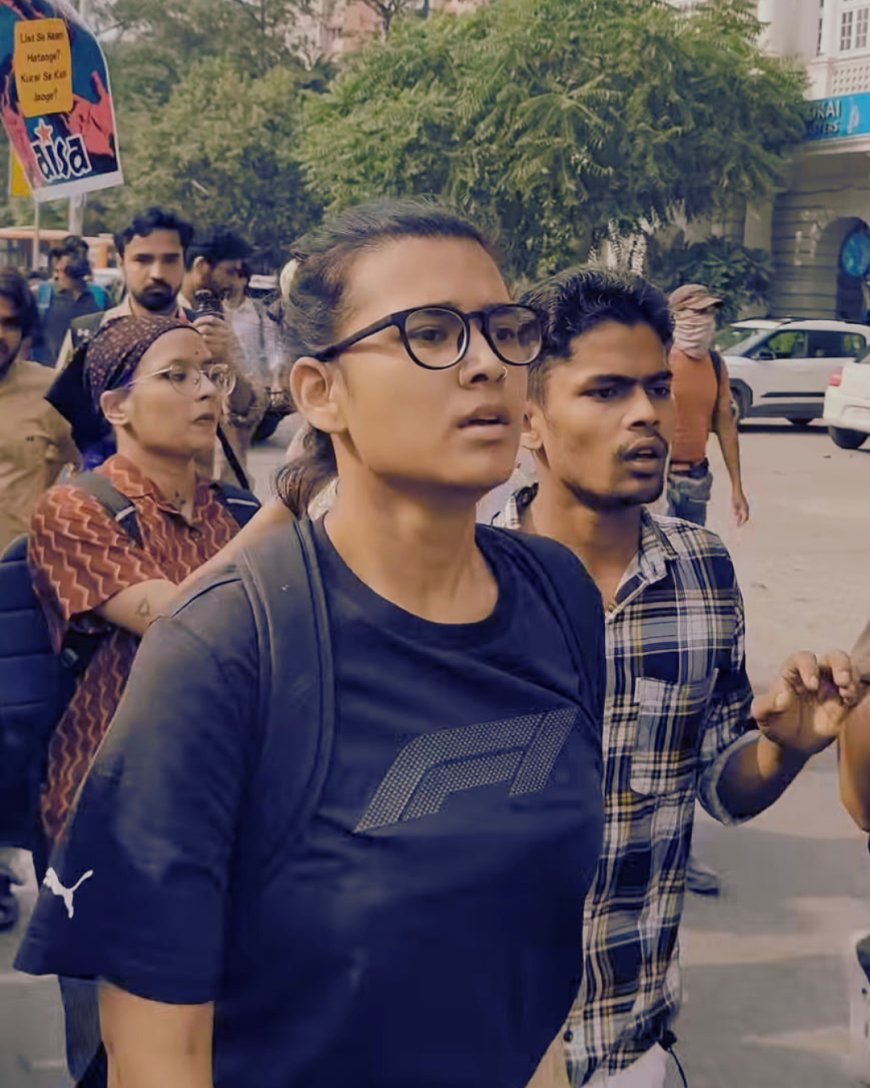
There is something revealing about the fact that Neha Bora has become a recognizable face of protest in India without holding public office, leading a mass political party or emerging from a conventional political family.
A PhD scholar at Jawaharlal Nehru University and national president of the All India Students’ Association, Bora has moved from campus politics to the centre of national protests with remarkable speed.
Her rise is not merely a story about one articulate student leader. It tells us something about the changing nature of political participation among young Indians.
Bora first came into wider public attention during the prolonged Jantar Mantar agitation over alleged examination irregularities. She spent 23 days on hunger strike, alongside other student activists and Sonam Wangchuk, during a movement led by the Cockroach Janta Party.
The protest eventually ended after the resignation of Union Education Minister Dharmendra Pradhan and government assurances on several demands.
That episode matters because it demonstrated that the politics of young Indians is not necessarily as apolitical as it is sometimes portrayed.
Students may be less interested in traditional party structures, but that does not mean they are indifferent to politics. Their political vocabulary may simply be changing. Employment, examinations, recruitment, education, voting rights and institutional accountability are not abstract ideological questions for them. They are questions that directly affect their futures.
This is perhaps the most important lesson from Bora's emergence. The new student movement is increasingly organized around lived insecurity rather than around a single ideological identity. A student who protests against an examination irregularity may subsequently march over electoral rights.
Another may become involved in questions of university autonomy, employment or women's safety. The issues appear different, but underneath them lies a common anxiety: Whether institutions that determine young people's futures can still be trusted.
Bora's political journey is particularly interesting because it does not fit neatly into the old assumption that political identities are inherited.
She has spoken publicly about coming from a family whose political preferences differ sharply from her own. She nevertheless developed an independent political identity after moving to Delhi for higher education.
That trajectory is important in a country where political affiliation is often treated almost as a family inheritance. Her story suggests that universities remain one of the places where young people can encounter ideas sufficiently different from those of their homes to reconsider what they believe.
There is another dimension to Bora's rise that deserves more attention: performance. Her academic field is theatre and performance studies, and her background in theatre has reportedly been part of her journey into activism.
That may help explain why her speeches circulate so effectively beyond the physical space of a protest.
Student politics has entered an age in which an argument made at a rally does not remain at the rally. It becomes a short video, a reel, a meme or a social-media debate within minutes.
This changes the nature of political leadership. Earlier student leaders needed organisational networks, campus committees and party structures to build influence.
Today they also need communicative presence. A protest leader is increasingly expected to be both organizer and performer, both political actor and media personality. The camera has become almost as important as the microphone.
That transformation has opportunities and dangers. Social media can take a local grievance to a national audience. It can connect students from universities that otherwise have little contact with one another. But it can also reduce complicated political questions to personalities, slogans and viral moments.
The recent online comparison between Bora and CJP founder Abhijeet Dipke is a good example. Instead of asking what the movement represents, social media quickly turned the discussion into a question of who was the more compelling young leader.
Bora herself pushed back against the comparison by framing the relationship in terms of collective struggle rather than individual competition.
That distinction is crucial. Movements built around personalities can become fragile when the personality disappears. Movements built around institutions and issues have a better chance of surviving their most visible leaders.
The challenge before India's student politics, therefore, is not simply to produce more charismatic faces. It is to convert visibility into organisation, enthusiasm into policy demands and protest energy into sustained civic participation.
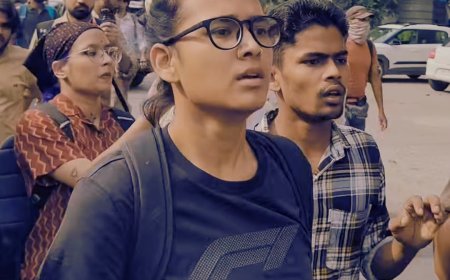
Bora's recent role in the protests over the Special Intensive Revision of electoral rolls illustrates how student politics is also moving beyond the campus. She was among hundreds detained during protests in Delhi demanding the resignation of Chief Election Commissioner Gyanesh Kumar over allegations concerning the voter-roll revision.
The Election Commission and the BJP have rejected the allegations surrounding the process, while critics have continued to raise concerns about its implications for voting rights.
Whether one agrees with the protesters or not, the development itself is significant. A student leader whose political identity was built around education and campus issues is now participating in a debate about the integrity of electoral institutions. That is precisely where student politics becomes democratic politics.
Universities are not isolated islands. Students eventually become voters, workers, professionals, researchers, journalists, teachers and citizens. The concerns they articulate on campuses often anticipate the concerns they will carry into society.
There is also a healthy contradiction in Bora's political position that deserves recognition rather than easy dismissal. She represents a clearly ideological organisation, AISA, associated with the CPI(ML) Liberation.
Yet some of the recent youth movements with which she has participated have brought together people who do not necessarily share the same ideological background.
The Jantar Mantar movement, for instance, attracted students, young professionals, parents and activists with different political affiliations. That broad coalition was one of its defining features.
The question for the Left, and indeed for every organized political tendency seeking relevance among young Indians, is whether it can participate in such broad movements without attempting to absorb them.
Young people may be willing to cooperate across ideological boundaries on a particular grievance while remaining unwilling to surrender their independence to a traditional political organisation.
This may be one of the defining characteristics of the emerging generation. It does not necessarily reject ideology, but it is suspicious of political ownership. It can march beside a socialist organization today, an independent activist tomorrow and a group with an entirely different political identity the day after.
The common denominator is increasingly the issue, not the organization.
That presents India's established political parties with a difficult challenge. They can recruit young people into their organizations, but they cannot assume that young people will automatically inherit their political loyalties.
They can attempt to control student movements, but they cannot fully control the digital networks through which those movements communicate. And they can dismiss student activism as youthful rebellion, but doing so risks missing the economic and institutional frustrations underneath it.
The more interesting question, therefore, is not whether Neha Bora will become a major political leader. That would turn a broader social development into a personality prediction. The more important question is why a student activist has become nationally visible at all.
The answer may lie in a growing gap between young citizens and the institutions they depend upon.
When examinations become uncertain, recruitment processes are questioned, universities become sites of political conflict and electoral procedures generate distrust, young people have little reason to remain spectators. They begin looking for ways to intervene.
Bora's story also reminds us that student politics is not necessarily a rehearsal for mainstream politics. It can be a laboratory for a different kind of politics, one in which the boundary between campus issues and national questions is increasingly blurred.
That makes the new generation of student politics both promising and precarious. It has greater reach but shorter attention spans, greater visibility but greater exposure to simplification, broader coalitions but weaker organizational permanence.
The real test will be whether the anger visible in these movements can mature into institutions, ideas and sustained civic engagement.
If it can, India's student politics may become more than a pipeline for future politicians. It may become one of the country's most important spaces for negotiating what democracy should mean to a new generation.
H. M. Nazmul Alam is an Academic, Journalist, and Political Analyst based in Dhaka, Bangladesh. Currently he teaches at IUBAT. He can be reached at [email protected]