































































Why BR Ambedkar Is the Battleground for Modern India's Soul
Ambedkar is not simply a historical figure. He is a living political question. The Republic of India today is built on his constitutional architecture -- and is increasingly governed in ways that undermine it.
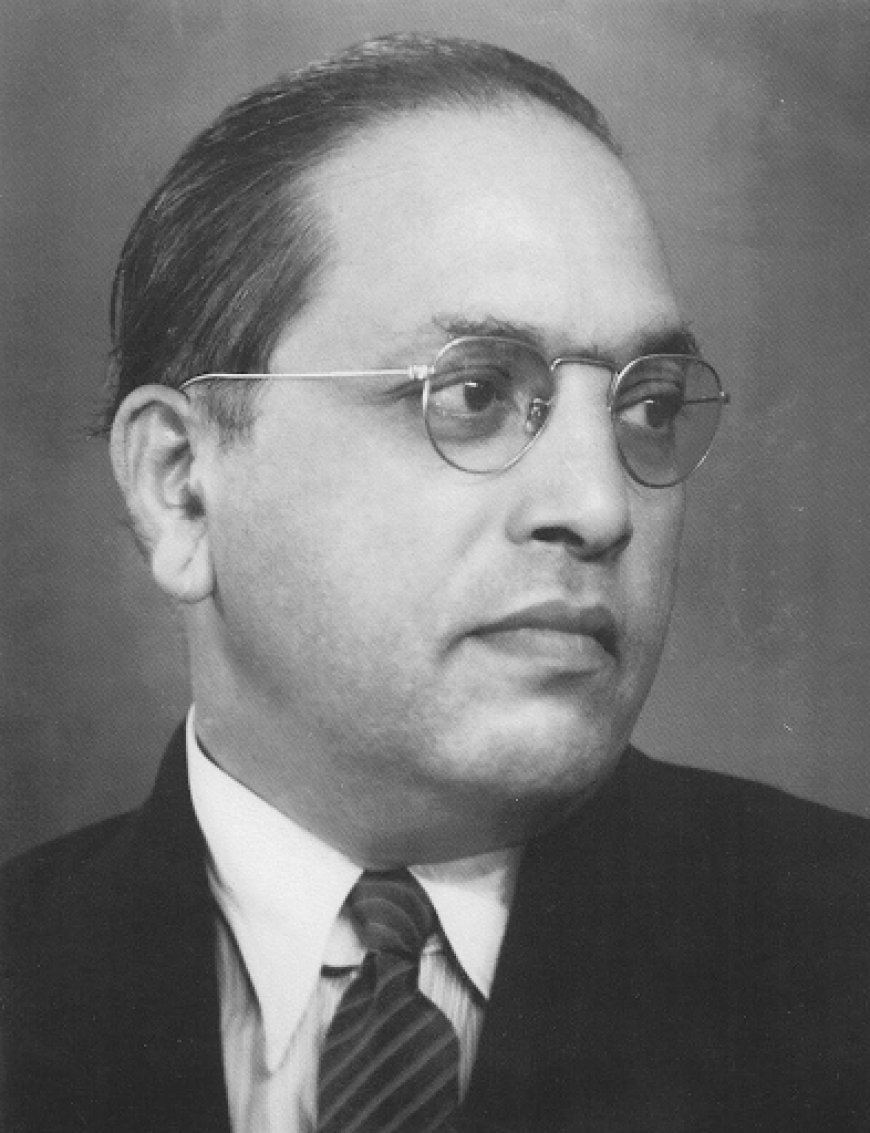
As India navigates its eighth decade as a republic, one image recurs across the subcontinent with unsettling consistency: The statue of BR Ambedkar blue-suited, Constitution in hand, finger pointing toward an unwritten future simultaneously garlanded by protesters and beheaded in the dark of night.
No figure in Indian history is both so ritually venerated and so viscerally despised. That tension is not accidental. It is the central political fact of contemporary India.
Born into the Architecture of Exclusion
Born in 1891 into the Mahar caste designated "untouchable" within the religiously sanctioned hierarchy of the varna system Bhimrao Ramji Ambedkar's early life was shaped by structural violence.
He was made to sit on a gunny sack in school, denied water from vessels used by dominant-caste children, and subjected to daily indignities designed to strip him of his humanity.
He defied every margin assigned to him by birth. With scholarships and a formidable intellect, he earned doctorates from Columbia University and the London School of Economics and was called to the bar at Gray's Inn becoming one of the most credentialed intellectuals of his generation. He returned to India not merely as a scholar but as a revolutionary.
Burning the Scripture of Oppression
Ambedkar's opposition to casteism was not political posturing, it was a comprehensive intellectual position. He understood that caste was not a social accident but a theological mandate, inscribed in the Manusmriti, the ancient Hindu legal text that assigned Brahmins divine superiority and consigned the "untouchables" to permanent degradation.
On December 25, 1927, at a conference of the Depressed Classes in Mahad, Maharashtra, he publicly burned the Manusmriti. It was among the most defiant acts of symbolic liberation in modern Indian history.
Two years earlier, he had written "Annihilation of Caste", a speech so radical that the organization that invited him to deliver it ultimately refused him the platform. In it, Ambedkar argued that untouchability could not be reformed away from within Hinduism because it was not a corruption of the religion but its doctrinal foundation.
A religion that sanctified human inequality could not be redeemed through manners or sentiment; the doctrine itself had to be annihilated. This was the intellectual fire that drove everything he would build.
'Caste is not a physical object like a wall of bricks. Caste is a notion; it is a state of the mind.' Ambedkar, Annihilation of Caste, 1936.
The Great Rupture between Ambedkar and Gandhi

No chapter in Indian history is more contested than the relationship between Ambedkar and Mahatma Gandhi. Gandhi believed that political independence from Britain was the primary objective and that social reform would follow moral transformation.
He condemned untouchability while defending the varna system as a workable division of labour calling untouchables "Harijans" (Children of God), a label Ambedkar found condescending, a softening of brutal reality.
To Ambedkar, independence without the destruction of caste would only transfer colonial power to dominant-caste Hindu elites.
"The old Indian village", he wrote, "is not a democratic republic but a sink of localism, a den of ignorance, narrow-mindedness, and communalism."
Their rupture climaxed in the Poona Pact of 1932. At the Round Table Conferences in London, Ambedkar had secured a landmark concession from the British: Separate electorates for Dalit communities, giving them structurally protected political representation independent of dominant-caste approval.
Gandhi, imprisoned in Yerwada Jail, responded with a fast unto death -- arguing that separate electorates would permanently divide Hinduism. Under the moral and political pressure of Gandhi's failing health, and fearing retaliatory violence against Dalit communities, Ambedkar capitulated.
He signed the Pact, replacing separate electorates with reserved seats in shared constituencies. Dalits gained more seats on paper; they lost structural independence in reality. Ambedkar never forgave himself or Gandhi for that day. It taught him the lesson he carried for the rest of his life: The political survival of the marginalized cannot depend on the goodwill of the majority.
Engineering a Social Revolution
When India gained independence in 1947, Ambedkar in a deep historical irony was appointed chairman of the Constitution's Drafting Committee. The greatest critic of mainstream Hindu nationalism became the principal architect of the Republic's supreme law.
What he built was not a bureaucratic rulebook; it was a revolutionary charter for social transformation. He introduced universal adult franchise, which was radical in a country with under 20% literacy.
He enshrined the abolition of untouchability in Article 17, making caste discrimination a constitutional crime. He designed the reservation system affirmative action in education and employment for Scheduled Castes and Tribes as a structural corrective for centuries of exclusion.

He championed minority protections, understanding that in a caste-hierarchical society, democracy without constitutional safeguards was simply a more efficient mechanism for majority tyranny.
In his final address to the Constituent Assembly on November 25, 1949, he delivered a warning that reads today as prophecy: “On the 26th of January, 1950, we are going to enter into a life of contradictions.
In politics we will have equality, and in social and economic life we will have inequality.
We must remove this contradiction at the earliest moment, or else those who suffer from it will blow up the structure of political democracy.” 75 years on, that contradiction has not been resolved. It has deepened.
A Nation Divided by a Statue
For India's 280 million Dalit and marginalized people, Ambedkar is not a historical figure. He is proof that the system could be defied the prototype of dignity in a world designed to deny it.
The rallying cry "Jai Bhim" (Victory to Bhim) echoes at university protests, Dalit rights marches, and labour strikes. When PhD scholar Rohith Vemula died by suicide in 2016 after writing of being "reduced to his immediate identity" as a Dalit, it was Ambedkar's image that mourners raised.
When Dalit communities mobilized around the Bhima-Koregaon anniversary, it was as Ambedkarites that they organized.

But for significant sections of upper-caste Hindu society, Ambedkar represents something to be minimized or erased. The evidence is concrete: Civil society groups and local press have documented hundreds of instances of Ambedkar statues being vandalized, beheaded, smashed, and desecrated across India annually, particularly in Uttar Pradesh and Maharashtra.
Multiple incidents have triggered riots. The statues, in this sense, are not stone. They are fault lines. The same constitution that protects the right to equality is used as a prop by politicians who quietly dismantle its guarantees.
'Jai Bhim' is not merely a slogan. It is a declaration that a man the system tried to destroy became the man who designed the system's highest law.
Secularism vs. Hindutva
The most consequential contemporary battle over Ambedkar is between the secular liberal left and the BJP-led Hindutva movement both of whom claim him and neither of whom can fully accommodate what he actually stood for.
Ambedkar's secular vision was explicit and unsparing. In his 1940 essay "Pakistan or the Partition of India", he wrote: "If Hindu Raj does become a fact, it will no doubt be the greatest calamity for this country. Hinduism is a menace to liberty, equality and fraternity. On that account it is incompatible with democracy."
This was not bigotry but analysis the argument that a theology organizing society around hierarchy is structurally incompatible with democratic equality.
The BJP's appropriation of Ambedkar is among modern India's most brazen contradictions. The RSS, the BJP's ideological parent, has historically defended the varna system. The Hindutva vision of a Hindu Rashtra is precisely the Hindu Raj Ambedkar called a 'calamity'.
Yet BJP governments have named institutions after him, garlanded his statues, and celebrated his birthday with official ceremony invoking the symbol while hollowing out the substance.
Ambedkar himself anticipated this: He wrote of "political untouchability", the ritual homage paid to Dalit causes while ensuring that no structural change disturbs the actual distribution of power.
The secular-liberal tradition has a more legitimate claim, but Ambedkar was always more radical than it was comfortable with. He was ferociously critical of the Congress Party as a vehicle for upper-caste interests.
He argued that Indian Marxists were blind to caste, reducing all oppression to class in a way that left the specific architecture of caste hierarchy untouched. "The Communists want class war," he wrote. "I want caste war." No mainstream political tradition has fully reckoned with what he was actually demanding.
The Final Defiance
Ambedkar's unfinished battles are as revealing as his victories. In 1951, he introduced the Hindu Code Bill a sweeping reform of Hindu personal law that would have given women the right to divorce, the right to inherit property, and abolished polygamy.
Orthodox resistance within and outside parliament killed it. He resigned from the cabinet in protest, the first person to suffer the contradiction he had warned about.
On October 14, 1956 six weeks before his death he led a mass conversion to Buddhism in Nagpur, followed by hundreds of thousands of followers. He called it Navayana: The New Vehicle, stripped of ritual, reduced to its core of equality, rationalism, and social liberation.
It was his final act of civil disobedience a declaration that the mind must be freed before the state can be transformed.
The Battleground Has a Name
Ambedkar is not simply a historical figure. He is a living political question. The Republic of India today is built on his constitutional architecture -- and is increasingly governed in ways that undermine it.
The majoritarian populism he warned against has consolidated. The bhakti, the hero-worship in politics which he called "a sure road to degradation and to eventual dictatorship" has intensified. Civil society is under systematic pressure. His statues are vandalized.
The most honest tribute India could pay Ambedkar is not another statue but the implementation of the constitution he wrote not as a ritual text but as a living commitment to the principle at its core: that every person, regardless of the circumstance of their birth, is equal in dignity and deserving of equal protection under law.
He earned two doctorates, built the Republic's supreme law, burned the scripture of his oppression, and resigned from government rather than betray the women whose rights he could not protect -- all while carrying the permanent wound of being treated, from birth to death, as less than fully human.
That wound, and the extraordinary intellectual fury it produced, is what makes Ambedkar not merely India's inheritance but the world's.
Arman Ahmed is the founder and president of DhakaThinks, a youth-led think tank in Bangladesh.