ART Is Not Perfect. But Bangladesh Must Stop Dreaming of a Permanent GSP.
Global trade politics are changing. Reciprocity now matters far more in Washington than it once did.
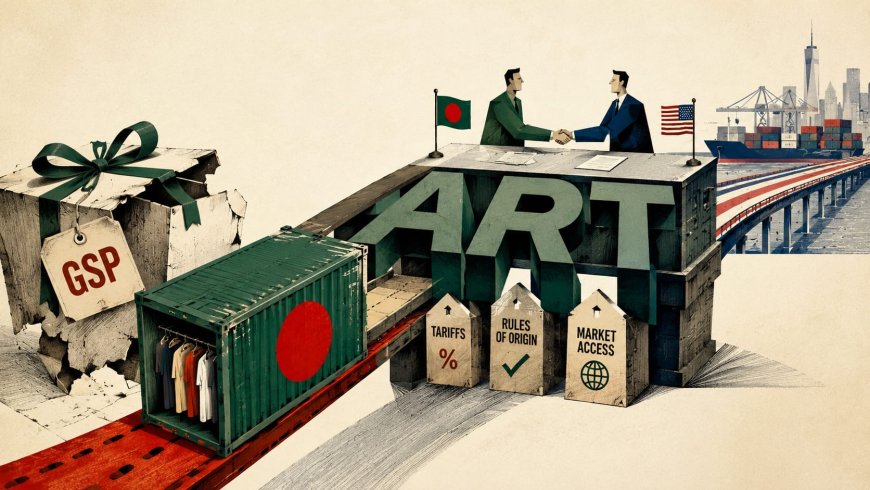
Like any other trade deal, Bangladesh’s 2026 Agreement on Reciprocal Trade (ART) with the United States is not perfect. It deserves scrutiny and debate. The agreement contains obligations on tariffs, standards, customs, labor, digital trade, and market access. It also reflects the reality of asymmetric bargaining between a developing country and the world’s largest economy.
But ART should not simply be dismissed as surrender. It should be understood as something Bangladesh has rarely had before: A formal, binding trade arrangement with the United States.
That alone is a major elevation for Bangladesh’s status in global trade.
Since independence, Bangladesh’s economic relationship with the US has been extremely important but structurally shallow. America became one of Bangladesh’s largest export destinations, especially for ready-made garments, but the relationship was never built on a proper trade agreement.
It relied on ordinary tariffs, unilateral preference programs, investment treaties, tax arrangements, and dialogue forums.
ART changed that. For the first time, Bangladesh is not merely asking for preference. It is negotiating terms.
ART was the first reciprocal US trade agreement in South Asia. That does not obviously make the deal fair or equal. But it does mean Bangladesh has moved from the waiting room of trade diplomacy into the room where actual trade rules are negotiated.
To understand why this matters, one must look at what came before.
Why GSP Was Never Enough
Bangladesh had several economic arrangements with the United States after 1971, but almost none were real trade deals. The 1986 Bilateral Investment Treaty protected investors. TICFA, signed in 2013, merely created a framework for trade discussions. But none of these neither directly reduced tariffs nor guaranteed market access.
The one framework that Bangladeshi policymakers and civil society became emotionally attached to was GSP -- the Generalized System of Preferences.
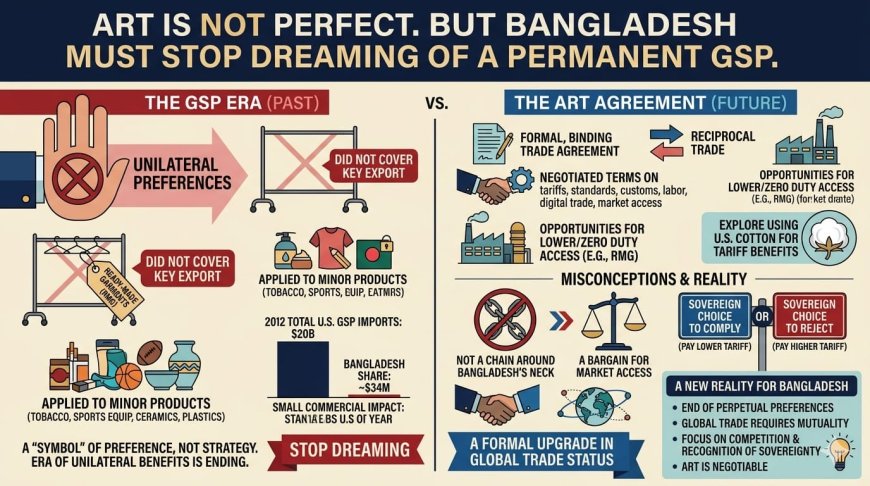
But GSP was not a bilateral trade deal either. It was a unilateral American preference program. More importantly, it did not even cover Bangladesh’s main export engine: Ready-made garments (RMG). The numbers tell the story. In 2012, total US imports under GSP were nearly $20 billion. Bangladesh accounted for only about $34 million of that.
Yet despite barely benefiting from the program, Bangladesh spent years chasing its restoration after Washington suspended it in 2013 over labor-rights concerns. Administration after administration treated GSP as the centerpiece of trade diplomacy.
A serious trading nation cannot permanently depend on rich countries granting unilateral preferences. Long-term trade power comes from negotiating terms, improving standards, diversifying exports, and engaging in truly reciprocal trade relationships.
That is where ART becomes important.
ART Is Not the End of Sovereignty
Many critics argue that ART undermines Bangladesh’s sovereignty. That criticism is misguided, as it misses the key point that ART honors both Bangladesh and America’s sovereign power to shape their own tariff destiny.
Under ART, Bangladesh remains free to trade with China, buy anything from Russia, protect domestic industries, or maintain its own standards and regulations. Dhaka can even reject American preferences altogether. Nothing in ART prevents Bangladesh from making any of these sovereign economic choices -- with just one catch.
The catch is that in order for Bangladesh to make all the sovereign choices, Bangladesh will acknowledge America’s sovereign power to impose higher reciprocal tariffs on imported Bangladeshi products in the US market.
That is the misunderstood part of the debate.
ART is not a chain around Bangladesh’s neck. It is a bargain. Bangladesh receives lower tariff treatment and potential zero-duty access for some products in exchange for commitments on reciprocal trade and market access.
If Bangladesh later decides the obligations are not worth it, it can walk away and pay the higher tariff instead. The alternative is not economic collapse. It is simply expensive access to the US market.
The agreement is currently valuable because the US still matters enormously to Bangladesh’s economy. It remains the single largest national destination for Bangladeshi RMG exports, with apparel exports reaching roughly $8 billion annually.
Bangladesh exports far more to America than it imports. Historically, this imbalance was tolerated. But global trade politics are changing. Reciprocity now matters far more in Washington than it once did.
So long as Bangladesh remains heavily dependent on a handful of export markets -- especially the United States -- agreements like ART will matter. But the real path to sovereignty will be building enough economic strength and diversification so that no single agreement becomes existential.
The Era of Permanent Preferences Is Ending
As Bangladesh is going to graduate from Least Developed Country (LDC) status at some point over the next three years, policymakers must recognize a broader reality: The age of permanent unilateral preferences is ending.
There are now basically two types of serious trade arrangements available to developing economies.
One path is pursuing full free-trade agreements with broad mutual tariff reductions and deeper obligations. The other is negotiating targeted reciprocal arrangements like ART that are tied to tariffs, standards, labor rules, supply chains, digital trade, and strategic alignment.
Developed economies will increasingly tie market access to labor standards, environmental rules, geopolitical alignment, digital governance, and reciprocity. This may feel unfair, but it is the direction global trade is moving.
Bangladesh should focus on learning how to compete within this new framework. One practical example would be exploring how Bangladeshi garments could qualify for lower or zero tariffs through greater use of US cotton as per the ART deal.
Bangladesh should recognize that agreements like ART are negotiable and adjustable over time as parties prove their reciprocal utility to each other.
But endlessly hoping for a permanent GSP-style arrangement is no longer realistic.
Those days are over.
Shafquat Rabbee is a geo-political columnist. You can follow him on Twitter @srabbee.