



































































A State Within a State
The political cost of holding Salimpur is carried by whichever party is in power. But the failure is not new. The Awami League, the interim government, and the current administration have all inherited and repeated the same failure. In that sense, it is the same failure under three different governments.

Around 2am on May 25, bulldozers were sent into the Alinagar area of Jungle Salimpur. They were used against a nearly finished training camp for RAB and the police. By the end of the night, about 70% of the structure had been destroyed. Roads leading into the area were dug up, and culverts were broken.
The officers who came had to leave their vehicles behind and continue on foot through the trenches in the dark. In a strange reversal, the same machinery usually used to remove illegal settlements was now being used to destroy the state's own camp before it could even be fully occupied.
The real question is what this incident tells us about how far state authority actually reaches.
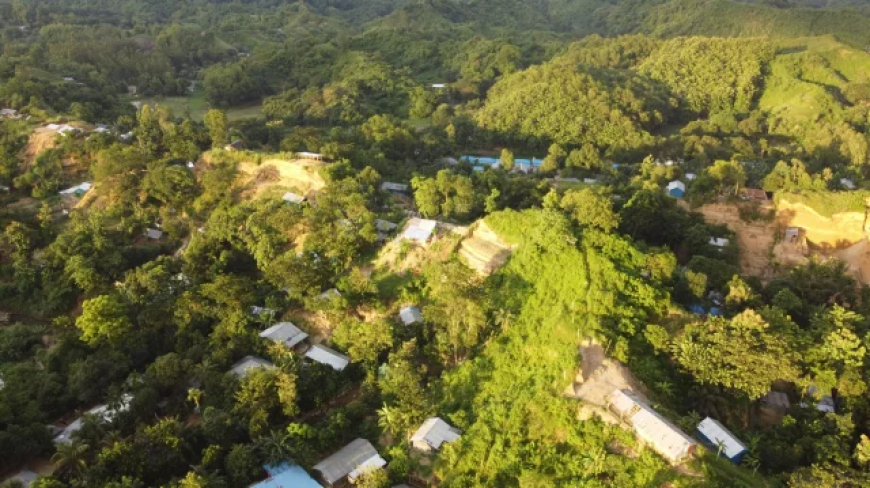
Salimpur is not a small or distant place. It covers about 3,100 acres of khas land in Sitakunda upazila, only five kilometres from Chittagong city. Around 150,000 people in 24,000 families live there on land worth an estimated 30,000 crore taka. The hills are covered with CCTV cameras. Iron gates block the entrances, and armed guards stop outsiders.
Residents use identity cards issued not by the government, but by an internal samiti. Auto-rickshaws need permits to go in and out. Five police jurisdictions meet across these hills, yet the paths between them are so narrow and hidden that police often do not know them and do not patrol them. This is not just a slum or a hideout. It is a territory controlled by another power, very close to one of the country's most important ports.
Salimpur did not become like this overnight. In the early 1990s, Ali Akkas began cutting the hills and selling khas land on non-judicial stamp paper. He also built an armed group around these settlements. After his death in a reported RAB operation, the system did not disappear. Instead, it broke into different factions, including the Yasin Bahini, Rokon Members Group, and Ridwan Group. These groups now control different parts of the area.
Over time, another layer of power also grew. In Bangladeshi politics, a group that can bring in around 20,000 votes is often seen as useful before it is seen as dangerous. According to a former BNP organizer from Chittagong North, the groups that worked with the Awami League for 15 years have now started reaching out to the new ruling party as well.
Meanwhile, the government's plans for the area remain only on paper. 11 projects were announced there, including a second central jail, a model mosque, a sports village, eco and safari parks, an IT park, and training centres for police, RAB, and Ansar. None of them has been built.
The reason is simple: The state cannot build on its own land because it cannot control its own land. Again and again, the pattern is the same. The state comes in, makes a declaration, pulls back, and the area returns to the same hands.
The phrase "a state within a state," used by the Deputy Commissioner after one of the operations, is not exaggeration. It describes Salimpur very well.
Visiting the area on May 31, Home Minister Salahuddin Ahmed used almost the same language, saying that over the past 17 years the politics of criminalization had tried to build a "state of miscreants" within the state, of which Jungle Salimpur was a direct manifestation.
The local samitis control violence through checkpoints and surveillance. They collect tolls from vehicles and protection money from residents and traders. They issue identity cards. They settle disputes through their own forums, where police involvement is often discouraged and many crimes are never officially reported. They even arrange secret medical treatment that leaves no record in hospital files. Most importantly, they can mobilize people quickly.
On January 19, when a RAB team entered to arrest Yasin Mia, mosque loudspeakers called residents to gather. Within minutes, an estimated 400-500 people arrived. Deputy Assistant Director Motaleb Hossain Bhuiyan was beaten to death, and three of his colleagues were taken hostage in front of a local party office. They were freed only after a three-hour joint rescue operation. This is how power actually works in everyday life there. Inside Salimpur, the Bangladeshi state does not have that kind of control.
What followed was a repeated cycle. The RAB Director General promised to dismantle the area. On March 9, 4,000 personnel from the army, RAB, police, and BGB entered after removing a truck blocking the road and filling the broken culvert.
Officials then said the area had been brought under control. But on the night of March 31, residents reported gunfire in Alinagar only hours after the Deputy Commissioner said the criminal stronghold had been removed. On April 22, Abul Kashem, the second-in-command, was arrested with a foreign pistol. Then on May 25, bulldozers were brought in again to destroy the camp.
The point is not that the state lacks force. Clearly, it can send thousands of troops there within hours. The real problem is whether it is willing to stay and bear the cost of keeping control. Holding the area means constant conflict with 150,000 landless residents, many of whom live there because they fear eviction and homelessness, or because they depend on the groups that rule the area.
This is why every eviction becomes tense and often violent. In 2023, videos showed women defending their homes with crude weapons when more than 100 personnel and a dozen magistrates came to clear the area.
The home minister appeared aware of this cost, saying the government had no immediate plans to evict people who had settled there and that a comprehensive rehabilitation plan would be prepared for legitimate residents.
The political cost of holding Salimpur is carried by whichever party is in power. But the failure is not new. The Awami League, the interim government, and the current administration have all inherited and repeated the same failure. In that sense, it is the same failure under three different governments.
Salimpur is not only a local problem in Sitakunda. It is next to Chittagong Cantonment, Faujdarhat Cadet College, and the Bangladesh Military Academy. The port just five kilometres away handles more than 90% of the country's seaborne trade.
The Bay Terminal project, which is central to Bangladesh's industrial future, also passes through this security zone. So when the state cannot govern 3,100 acres only five kilometres from its main economic gateway, this is not a small administrative issue. It is a measure of national weakness.
The state can send 4,000 soldiers into Salimpur for a day. What it has never managed is to keep 50 there for a year. That is what sovereignty really means. Not the capacity to enter, but the capacity to remain.
Whether the latest pledge breaks that pattern remains to be seen: The minister said authorities were reviewing drone imagery and road maps to build permanent infrastructure for the police, BGB, RAB and other agencies, with provision for military deployment if needed in other words, an attempt to finally stay rather than simply enter.
Minhazul Abedin Rahat is an International Relations Graduate from Jahangirnagar University.