












































![A Ledger of the Soul: Navigating the Allah-Bhagavant Nexus in a 19th-Century Puruṣākāra Jñāna Caupara [Gyan Chauper]](https://counterpointbd.com/uploads/images/202608/image_430x256_6a93baa3b09a7.jpg)





















The Case of the Garo Community
Bangladesh cannot claim to protect cultural diversity while systematically demolishing the indigenous land system that supports that culture.

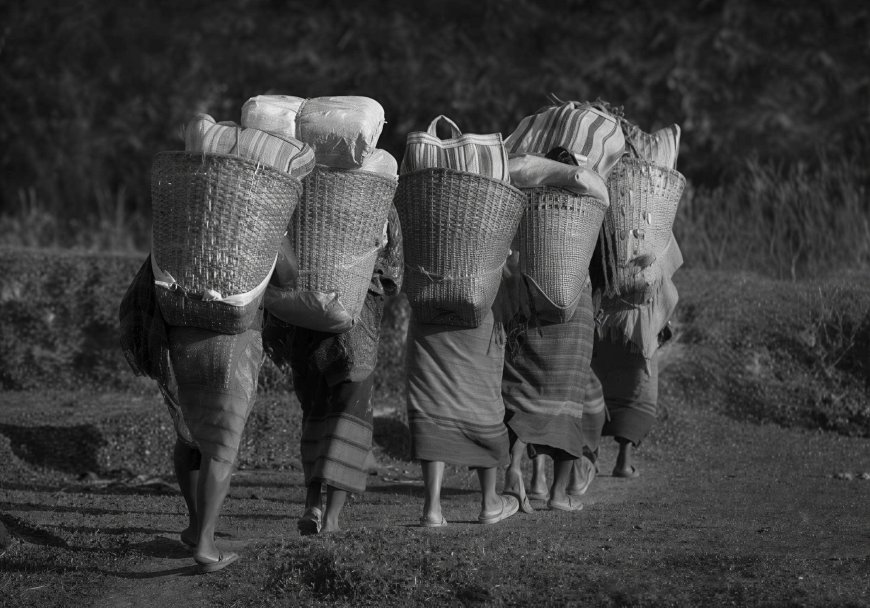
On March 6, hundreds of Garo and Koch peoples marched in Madhupur, Tangail, to protest the revival of an eco-park project dispossessing them of their ancestral land. Piren Snal, a member of the Garo ethnic community, was reported to be shot dead by the police when he protested the construction of the same eco-park in 2004.
These recurring events shed light on the long-term core conflict between Garo’s land ownership system and a state that does not recognize it.
Under the Garo’s Nokma system, land is collectively owned by the community, not the state. It is a matrilineal custodianship that predates the formation of a nation-state, a constitution, and a colony.
Researchers and ecologists have attributed much of Madhupur’s surviving forest bio-diversity to this system of collective stewardship, while unregulated private acquisition has been linked to its degradation.
When the British arrived, the colonisers did not recognize this community stewardship; instead, they were driven by the pursuit of profit through the timber trade. Although the colonial era ended long ago, the colonial system of violence and discrimination remains unchanged even today, not only in Madhupur but also in other parts of the country. About 400 acres of land have been allegedly grabbed and evicted from Lama, Bandarban, by a company called Lama Rubber Industries Limited.
This company has also been suppressing the land protests by filing court cases against the indigenous community in the area. In a separate incident, the Kapaeeng Foundation documented 17 indigenous land rights violations, including evictions, land grabs, and displacement in 2023 alone, which took the Nokma away from the Garo, along with the ecological and cultural systems connected to it.
Indigenous women were made victims of at least 21 cases of violence, according to the 2022 report of the Kapaeeng Foundation. It was around the same time that the Ministry of Information and Broadcasting in Bangladesh issued an official notice instructing all government officials, academicians, and news media to avoid using “Indigenous” as a term entirely.
The pattern documented above reflects a systematic failure to protect indigenous rights, one that goes beyond individual incidents. It reveals persistent legal violations of minority rights in Bangladesh and a direct threat to indigenous communities’ physical and cultural security.
While the state selectively glorifies indigenous culture or appropriates it for tourism, it leaves socio-economic needs, political grievances, and land rights unaddressed. This op-ed argues that Bangladesh must end the dispossession of Garo land and resolve outstanding disputes through genuine dialogue and legislative recognition of the Nokma system.
What makes it particularly difficult for the Garo to challenge this dispossession of land is that these indigenous land rights violations are not perceived as acts of injustice. Land grabbing and threats of eviction are routinely reframed as conservation, tourism, or economic development. The eco-park in Madhupur, for instance, is not characterized as illegal land grabbing; it is presented as a tourism project.
The Forest Act of 1927, a colonial law enacted under the British Raj, continues to criminalise indigenous land stewardship in postcolonial Bangladesh. It simply vests authority over forest land in the Forest Department, effectively recasting centuries of stewardship as trespassing through bureaucratic reclassification.
The Social Forestry Rules 2004, also enacted under this same Act, contain provisions that the ILO Committee of Experts on the Application of Conventions and Recommendations has identified as conflicting with the customary land rights of indigenous peoples.
The legal and administrative framework governing indigenous land tenure and land administration in Bangladesh further complicates the problem. Technically, there is a provision in the East Bengal State Acquisition and Tenancy Act of 1950 that limits the transfer of aboriginal castes and tribes’ lands to non-aboriginal people.
In practice, it is, however, largely ineffective. The land title system based on individual, registered, patrilineal ownership is constitutionally incompatible with the Nokma, which passes land matrilineally, and holds it in collective trust. Land that is not individually registered is not recognised by the state.
When Garo families approach the courts, they arrive without the required documentation and often lose cases, not because their claims are illegitimate, but because the evidentiary standards were designed for a different society.
The Nokma system faces a second, internal threat that is distinct from state dispossession. Recent studies show that Garo men who marry outside the community or migrate to urban areas have begun adopting mainstream Bengali practices of patrilineal inheritance.
Sons and husbands are increasingly claiming property, breaking the matrilineal structure that has governed Garo land for generations. If this assimilation continues, the state will not need to formally abolish the Nokma; it will erode through cultural displacement alone.
What is lost in that process is not merely a tradition: the Nokma is also an ecological management system, and researchers have attributed much of Madhupur’s surviving biodiversity to the governance arrangements it sustains.
Notably, Bangladesh is bound by international obligation. The country ratified the ILO Convention No. 107 on Indigenous and Tribal Populations in 1972 as part of one of its earliest legal commitments as a new state. Convention 107 requires the protection of indigenous land rights and prohibits displacement without consent and adequate remedy.
Yet in 1986, the ILO’s own expert committee concluded that the integrationist assumptions of Convention 107 were obsolete and harmful. Bangladesh has not upgraded to Convention 169, which replaced the previous one and explicitly rejects forced assimilation as a policy. It remains bound by a treaty that the ILO has declared outdated.
On the United Nations Declaration on the Rights of Indigenous Peoples (UNDRIP), Bangladesh was among the eleven states that abstained from the September 2007 General Assembly vote, declining to endorse the principle of Free, Prior and Informed Consent, which requires states to obtain genuine community agreements before projects affecting indigenous land proceed.
The Bangladeshi delegation cited ambiguity in the definition of “indigenous peoples” as its stated reason, but the practical consequence is the same: the eco-park project in Madhupur is precisely the kind of intervention FPIC is designed to regulate, and Bangladesh is proceeding without it.
Despite the pervasive nature of the issue, Bangladesh does not need to start from scratch. It only needs to honour the existing obligations and address the legislative gaps created by decades of ambiguous interpretations.
What is required is a set of clear, enforceable steps: a postponement of the Madhupur eco-park project until structured, good-faith dialogue with the Garo and Koch communities takes place; legislative recognition of the Nokma as a legitimate land governance institution.
Alongside amendments to the 1950 Tenancy Act to permit communal and matrilineal tenure; ratification of ILO Convention 169; and reactivation of the CHT Land Dispute Resolution Commission, the statutory body established under the 1997 Chittagong Hill Tracts Peace Accord to adjudicate indigenous land claims, which remains non-functional despite a legal mandate, with credible authority and adequate resources.
These are not concessions; they constitute the minimum that international law and basic constitutional standards require.
The Garo community do not need a tokenistic celebration of their weaving or promotion of cultural festivals in tourism brochures; they need the state not to violate their fundamental human rights, and above all their land, which is the material basis of their livelihoods, their culture, and their survival.
Bangladesh cannot claim to protect cultural diversity while systematically demolishing the indigenous land system that supports that culture. The excavators are already in the forest. The question is whether the law will arrive before the damage becomes irreversible.
Dr. Muhammad Asadullah is visiting Professor & Director, Daffodil Legal Research Centre (DLRC) at Daffodil International University & Associate Professor of Criminology, University of Regina, Canada. Mohammad Azizur Rahman is Assistant Professor of Criminal Justice. Mohammad Azizur Rahman is Assistant Professor of Criminal Justice, Department of Social Sciences, Texas A&M International University. Ritu Sen Gupta is Monitoring, Evaluation, Accountability and Learning (MEAL) Officer & Researcher, Human Rights Development Centre (HRDC) & Fateema Tuz Zahra is Research Intern, Daffodil Legal Research Centre (DLRC).