









































































How Satchari’s Tipra Community is Caught in a Legal Vise
The silence at dawn in Tipra Para is not the silence of an empty forest. It is the quiet of a community whose presence has survived successive rounds of leases, surveys, forest classifications and conservation measures.

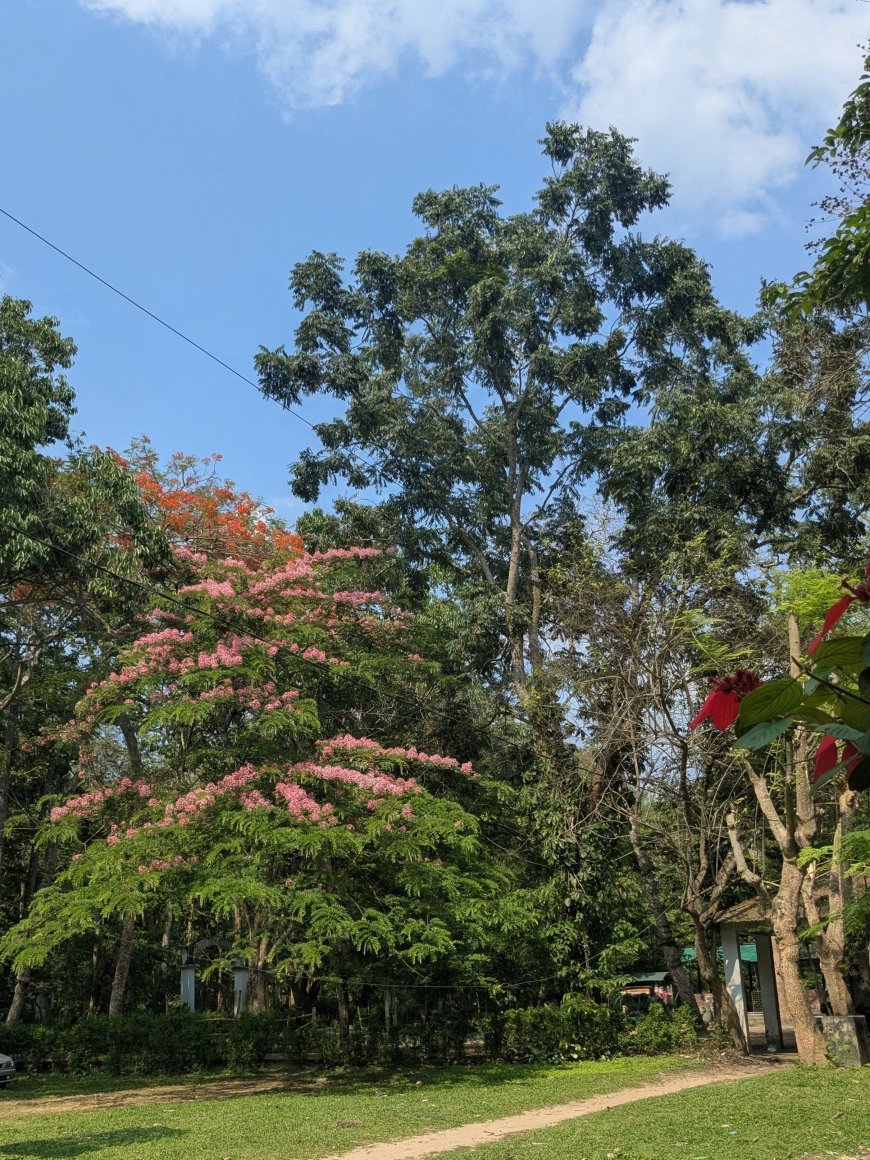
At the heart of Satchari, in northeastern Bangladesh, lies a community whose longstanding relationship with the land remains difficult for the law to recognise.
Approximately two dozen Tipra families live between Satchari National Park and neighbouring tea estates, on land they are described as having occupied long before the park, the relevant tea leases, and subsequent forest restrictions were established.
Yet generations of occupation have not translated into formal legal title. The central question, therefore, is whether Bangladesh’s legal framework can recognise customary occupation that was never formally documented.
This short article examines how colonial tea and forest laws, followed by postcolonial land and conservation regimes, produced this gap between historical occupation and legal recognition, and how that legal legacy continues to shape the Tipra community’s position in Satchari today.
Colonial Maps, Modern Consequences
When British administrators began surveying Sylhet in the nineteenth century, the primary administrative concern was not the documentation of indigenous settlement but the organization of land and revenue.
In the 1850s, large tracts were brought within the emerging tea economy through leases to tea companies. Boundaries were often identified by physical features such as rivers, ridges and hills.
The same landscape features later became useful reference points for forest administration. A boundary drawn for one administrative purpose could therefore become the basis for another, without a corresponding record of the communities whose lives were organised around the land.
The Bengal Eastern Frontier Regulation of 1873 formalized an ‘Inner Line’ system governing movement between designated areas. Whatever its broader administrative purposes, such regulation reflected a colonial approach that divided territory according to administrative categories rather than beginning with the customary relationships of communities to land.
The Forest Act 1927 subsequently provided statutory force to the creation and administration of reserved forests. Boundaries that had first served administrative or commercial purposes could thus acquire the authority of forest law.
The result is a historical layering of boundaries. The problem is not merely that different maps were produced at different times; it is that the legal system repeatedly converted those maps into enforceable categories without necessarily recording the people already living within them.
The Forest Department’s own materials have recorded substantial areas of Satchari affected by overlapping or contested claims, illustrating how a boundary problem created over generations can become a contemporary question of legal entitlement.
When Documents Outweigh Custom
Walking west from Tipra Para leads towards Satchari Tea Garden, while Chaklapunji lies in the opposite direction. The estates trace their legal history to 19th century leases, while Satchari National Park was formally established by gazette notification (Gazette Notification No. PBM (S-. 3)/31/2004/1125) in October 2005 under the Wildlife Preservation Order, 1973.
The park’s boundaries were drawn in relation to the surrounding tea estates and the Reserved Forest.
The legal designation protected the land within those boundaries, but it did not expressly resolve the position of families who already lived there.
This produces an unequal evidentiary landscape. Tea estates possess documentary claims in the form of historical leases. The state possesses statutes, gazette notifications and administrative records.
The Tipra community, by contrast, has its continuing presence, family histories, ancestral graves and evidence of customary use. Also, one of the important aspects is generations of local reliance on the forest for firewood, medicine and fruit.
These practices may establish a history of occupation and resource use, but they do not necessarily translate into a proprietary interest under a statutory system built around formal documentation.
The deeper issue is therefore one of legal visibility. A legal order designed first to facilitate colonial land administration and commercial investment, and later to advance state conservation objectives, does not automatically recognise customary tenure.
When the law provides no accessible mechanism for registering a customary claim, the absence of a document can be mistaken for the absence of a right.
Recognition Without Tenure
The Tipra, or Tripuri, have historical connections to the former Kingdom of Tripura, and Kokborok continues to be spoken within the community. Materials produced through the Nishorgo conservation programme describe Tipra Para as a settled Tipra community within Satchari. Yet recognition of a community’s presence is not the same as recognition of its tenure.
The difficulty becomes particularly apparent when the community’s position is assessed through the State Acquisition and Tenancy Act, 1950.
Like other land laws, the statutory framework places considerable weight on records, title and official documentation. For a community whose occupation predates the administrative processes that produced those records, documentary requirements can reproduce the very disadvantage they appear designed merely to measure.
In 2006, the establishment of the Satchari Co-Management Committee created an institutional mechanism through which the Forest Department, local government and representatives of surrounding villages could participate in park management. The Satchari management plan for 2016–2025 also identifies the Tipra as the only ethnic community living within the park.
These measures are significant because they acknowledge the community as a stakeholder in conservation. However, participation in management does not by itself confer a proprietary or secure possessory interest.
The distinction matters in practical terms. A community may be consulted about conservation while remaining uncertain about the legal security of its homes, cultivation or ordinary use of surrounding resources.
Where forest legislation treats unauthorised occupation as encroachment, the absence of recognised tenure can expose residents to enforcement even when their presence substantially predates the protected-area designation.
Co-management can therefore produce participation without resolving the underlying question: On what legal basis may the community remain?
Living in Legal Limbo
Satchari’s predicament also reflects a wider South Asian tension between conservation and customary tenure. Comparable disputes elsewhere in the region demonstrate the consequences of requiring forest-dependent communities to establish their claims through evidentiary standards that may not accommodate customary occupation.
For the Tipra, that regional experience makes the uncertainty surrounding tenure more than an abstract concern.
Bangladesh’s protected-area policy documents have themselves identified land-tenure disputes as a major challenge in Satchari.
For residents who lack a formally recognized claim, however, the problem is more fundamental than a management ‘challenge’: it is continuing exposure to uncertainty about the legal security of their homes and customary relationship with the land.
The position of the tea estates presents the reverse problem. Historical leases remain part of the documentary record through which land is legally understood.
That does not mean every historical lease automatically determines the validity of every contemporary boundary or expansion, but it does demonstrate the structural advantage enjoyed by claims that can be expressed in documents.
The result is a striking asymmetry: The community must establish its relationship with land in a legal language that was not designed to record it, while older commercial claims already exist within that language.
Conservation creates another layer of tension. Protected-area law can be justified by the ecological importance of Satchari, yet conservation does not require pretending that the landscape was uninhabited before it became protected.
The available field research and management materials indicate the continuing presence of the Tipra. The legal challenge is therefore not simply how to protect the forest, but how to protect the forest without treating the people who have historically lived within it as though their presence were itself an intrusion.
The Satchari dispute illustrates a broader problem across Bangladesh and South Asia: Statutory systems often privilege state control, formal title and documentary proof, while indigenous and forest-dependent communities may hold land through customary practices that were never converted into registered interests.
That mismatch can persist even when government institutions acknowledge the communities concerned as legitimate stakeholders.
One immediate opportunity lies in the next generation of Satchari’s management planning. The existing Satchari National Park Management Plan 2016–2025 provides an institutional foundation for co-management.
The next plan could move beyond consultation and expressly address tenure security, customary use, community participation in boundary decisions, and procedures for documenting long-standing occupation.
Such measures would not necessarily require the wholesale rewriting of the Forest Act or the Wildlife Preservation Order.
They would require the legal system to recognise evidence of occupation that is broader than a deed.
The central lesson from Tipra Para is consequently a simple but consequential one: conservation and tenure security should not be treated as mutually exclusive.
A protected forest does not become less valuable because people live within or around it, and a community does not become less entitled to legal security because its relationship with the land was historically customary rather than documentary.
The challenge is to build a legal framework capable of recognising both realities at the same time.
The silence at dawn in Tipra Para is therefore not the silence of an empty forest. It is the quiet of a community whose presence has survived successive rounds of leases, surveys, forest classifications and conservation measures.
For more than a century, new legal boundaries have been drawn around land that the Tipra did not necessarily leave. The question now is whether the next boundary will merely regulate their presence or finally recognize that they were there before the boundary was drawn.
Kazi Ayman Awsaf is an Undergraduate Teaching Assistant at East West University.