



































































The Gothfather and the Deranged Mind
It is more important than ever now to understand the protagonists of Poe’s stories. In an age when the topic of mental disorders is slowly being destigmatized, we need to try even harder to normalize the understanding of one’s mind, especially if it is volatile and potentially harmful.

"I have, indeed, no abhorrence of danger, except in its absolute effect — in terror. In this unnerved — in this pitiable condition — I feel that the period will sooner or later arrive when I must abandon life and reason together, in some struggle with the grim phantasm, FEAR."
These were the words uttered by Roderick Usher in one of the seminal works of Edgar Allan Poe, “The Fall of the House of Usher”. With these words, Poe, through Roderick, gives the very essence of his own style of writing.
Roderick isn't afraid of physical harm or pain. What truly terrifies him is the crippling psychological dread that the prospect of danger creates in him. He is consumed by anxiety. He knows that fear will eventually destroy his mind. And thus, he describes fear as a monster, “the grim phantasm”.
Such was Edgar Allan Poe’s style. He was a master at describing the psychology of fear. Was there ever a monster under the bed? Hiding in the closet? Sitting on the ceiling like a spider, staring down at their unsuspecting victim? No.
“The Masque of Red Death” shows the dread that comes every hour as the massive ebony clock lets out deep, tolling clangs, loud and unsettling. That sound cuts through the merriment and momentarily freezes all dancing, music, and conversation.
“The Cask of Amontillado” is a claustrophobe’s worst nightmare as we see Fortunato slowly becoming trapped by Montresor, who is walling up the entrance to the crypt that shall become his enemy’s tomb. Fortunato is rendered not so fortunate.
“The Tell-Tale Heart” takes us through the mind of a deeply disturbed unnamed man. He addresses us directly as he makes a plea for his case, saying that it was a fear of the old man’s “pale blue eye, with a film over it” that drove him to commit murder.
We hear his story as he admits to his own crimes and insists that fear was his motivator. Why did those blue eyes scare him so? Poe never tells us. But the author shows us an admission of guilt from the unnamed narrator who can still hear the beating of the dead man’s heart. The beating swells to an unbearable volume, and the narrator rips off the boards under which he buried his victim.
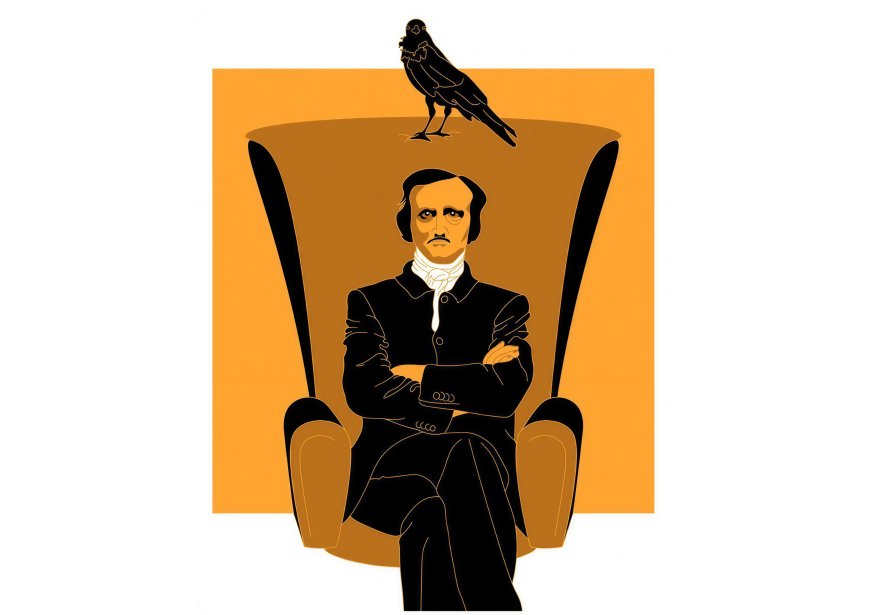
In other words, he succumbed to his guilt. Pluto, the black cat, did not do anything discernibly evil to yet another unnamed narrator, but we are left seeing the horror felt by him to the point where he kills an innocent animal. Perhaps there was no raven at all. But in the poem, the grief-stricken narrator claims that the Raven “never flitting, still is sitting, still is sitting on the pallid bust of Pallas just above my chamber door”.
This is the nature of Gothic fiction, a genre which does not need any supernatural creatures to scare us but rather is a literary aesthetic of fear and haunting. Poe knew this all too well. He created horror by exposing the machinations of a troubled mind.
He had the talent to take his reader into the psychosis of the deranged, the grief-stricken, the vengeful ones. Often, his protagonists make the twisted logic of their own thoughts appear strangely reasonable.
Poe’s brand of horror does not rely on ghosts, demons, ghouls or other nightmarish creatures. He had the unique gift of creating monsters in his stories which were manifestations of an individual's guilt, loneliness, obsession, and the gradual unraveling of a rational mind.
The hint of supernatural powers that act upon his characters is simply a red herring. It is always the mind of the protagonist that turns against themselves. The collapse of their psyche manifests into a beating heart under the floorboards, a black cat's eye, or the sound of a clock turned sinister as it foreshadows death.
The destruction of Roderick Usher’s house happens not because it is haunted by some ghost or gargoyle; it is simply the product of the decay of the family living inside.
That is what makes Poe's horror psychological. He shows us how fear is constructed not from outside, but by the mind of the human being filled with torment. It is not the shape behind the door that scares us; it is our imaginations running wild in trying to decipher what is behind that door. That is Poe’s unique brand.
His own life was beset with tragedy, as his biological father abandoned him and his mother, who died of tuberculosis when he was only 2 years old. This orphaned child then went on to live with John Allan, presumed to be his godfather, with whom he led a most unhappy life.
Poe’s love life was also a tragic one as well since he could not be with his first love, Sarah Elmira Royster. Her father did not recognize their love and hyper-focused on Poe’s identity as a poor, orphan boy. So, as we learn more about his own story, we begin to see where he drew inspiration from.
As mentioned by biographers like Maria Bonaparte, there is a similarity between the old man in "The Tell-Tale Heart” and John Allan, as well as that of the narrator and Poe. Like the old man with his blue eye, Allan also had a pale blue eye. This comparison indicates that "The Tell-Tale Heart" was a way for Poe to vent his hidden rage at his adoptive father.
Poe endeavoured to learn about the mind, stable or deranged. Through self-examination, objective examination, and studies of contemporary scholars, Poe developed an excellent understanding of psychology, as well as good knowledge of phrenology and mesmerism, which were pseudosciences of the time.
Poe’s works show that he was profoundly interested in psychology as a subject, which is reflected in his characters with their lack of sanity and mental breakdowns. More than 20 stories, several poems, and many of his essays address human psychology and psychosis.
Being an observer of scientific developments and having a sharp and perceptive mind, Poe kept himself abreast of psychological studies of his time. Because of this, Poe's works remain highly relevant and prevalent even now. Even after all the scientific advances that happened centuries after his death, we are still very far away from unravelling the mysteries of the human psyche.
His characters provide an open invitation to diagnose unique mental health conditions. They can be treated like case studies, even though the author himself created them out of sheer instinct and observation.
For instance, one could say that the main character of “The Tell-Tale Heart” shows symptoms of schizophrenia. Montresor could have had a different mental disorder. His cruel intentions, lack of remorse, manipulation skills, and his need for control could easily be attributed to APD (antisocial personality disorder), which was characteristic of notorious serial killers like Ted Bundy and Robert Black.
One could also say that the narrator of “The Raven” was suffering from hallucinations or delusions brought upon him by grief and depression. Poe knew how to create a tortured protagonist because he himself was a tortured soul for the entirety of his life -- unlucky in love, unlucky in life.
It is more important than ever now to understand the protagonists of Poe’s stories. In an age when the topic of mental disorders is slowly being destigmatized, we need to try even harder to normalize the understanding of one’s mind, especially if it is volatile and potentially harmful.
We must attempt to know how a person with some form of psychosis thinks, because more so than ever before, we need kindness, we need love, we need empathy. The actions of these protagonists that horrify us should not alienate us from them.
Rather, it should be treated as a gateway to understanding the complexity of the human mind. There are no ghosts or ghouls. There is no monster waiting in the closet. The monster has always existed, intangible, unfathomable, comfortably nested in our minds.
Tabeen Siddiki majored in English Literature from Independent University, Bangladesh and is currently completing his Masters in English Literature and Creative Writing from University of Liberal Arts Bangladesh.