

























































The Sheikh Mujib Paradox
To be exact about what happened and what didn't: Bangladesh was not reborn in August 2024. A country is born once. What happened in 2024 was not a second birth but a reckoning.
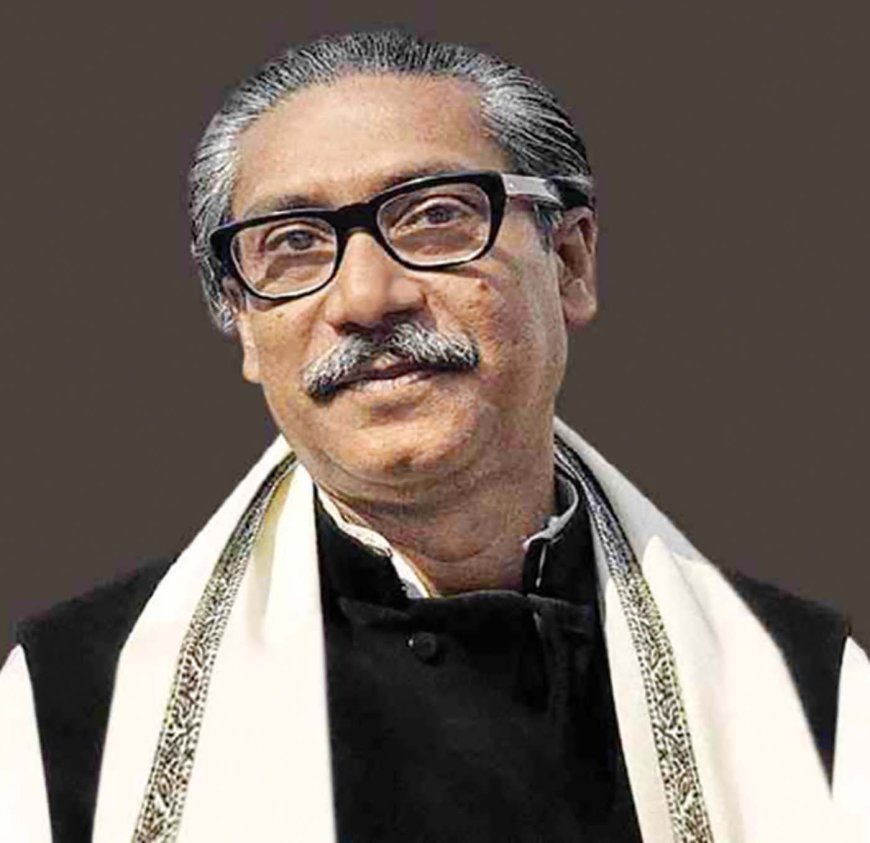
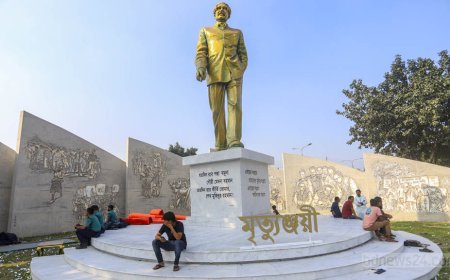
In August 2024, a golden statue came down at Bijoy Sarani.
Crowds that had just watched a 15-year government collapse in a single week found, in that statue, a shape their anger could hold -- Sheikh Mujibur Rahman, Bangabandhu, father of the nation, father of the fleeing prime minister, both at once, indistinguishable in that moment.
Global cameras caught it as the fall of a personality cult. It was that. It was also something narrower and more revealing: A country discovering that it could destroy an image faster than it could answer the question the image had been standing in for.
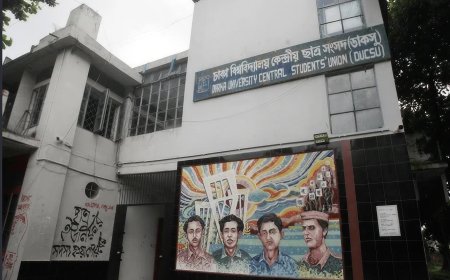
Six months later, in February 2025, a crowd came back to finish the job at Dhanmondi 32 -- the house itself this time, not a statue of the man but the site where he had lived and where he was killed, converted decades earlier into a memorial museum.
They came with bulldozers, hammers, an excavator hired in shifts when the first ran out its contracted hours. They set it alight, let it cool, and returned to burn it again.
The timing was almost incidental -- a call to disrupt an online address by the exiled former prime minister -- but the target was not incidental at all.
A statue is an image of a man. A house is where a family actually lived, where an actual body fell.
To tear down the first is iconoclasm. To tear down the second is an attempt to unmake a fact.
Between August and February, Bangladesh had moved from denouncing a myth to trying to erase a memory, and it is worth sitting with how fast that escalation happened, because it tells you the statue was never going to be enough.
What makes Mujib impossible to settle is that no two of his major claimants want the same thing done with him, and none of the three positions is really about history at all.
Jamaat-e-Islami's constituency has never fully accepted the founding premise -- a party whose leadership opposed the Liberation War in 1971 cannot easily concede its central hero without conceding the war's legitimacy, so for that current, diminishing Mujib is not revisionism, it is doctrine.
The Awami League's position is the mirror image: Mujib is not a historical figure to be assessed but the party's entire claim to exist, inherited literally through blood into his daughter's premiership, so any criticism of him was treated for fifteen years as treason against the state itself.
And then there is BNP's more interesting, more cynical middle position -- accepting Mujib as a genuine leader of the liberation struggle, unwilling to hand Jamaat's argument any ground, while simultaneously having spent decades rehabilitating the men who killed him.
Ziaur Rahman's government granted the assassins' indemnity from prosecution and later gave some of them diplomatic postings abroad.
That is not ambivalence. It is a party holding both halves of the paradox on purpose, honoring the founder and protecting his killers, because the goal was never a coherent verdict on Mujib -- it was denying Awami League a monopoly on the birth of the country.
Three parties, three uses for the same dead man, and not one of them primarily interested in what actually happened.
There is a fourth actor in this argument that is not a party at all and deserves at least as much scrutiny as the three that are: The interim government itself, which governed Bangladesh for the eighteen months between Hasina's fall and the return of an elected government in February 2026.
Muhammad Yunus arrived with a profile no domestic politician could match -- a Nobel laureate, globally credible, acceptable in exactly the vacuum the student movement needed filled.
What he delivered was considerably thinner than the introduction promised.
Foreign investment, repeatedly announced as a governing priority, stayed largely stalled through the interim period, by the admission of economists sympathetic to the government itself.
Transparency International Bangladesh's own indicators showed corruption deteriorating rather than improving under an administration that had made clean governance its founding claim.
And Jamaat-e-Islami -- banned by the outgoing Awami League government days before it fell, unbanned by Yunus within a month of taking office -- moved over 18 months from opposition to something closer to a governing partner, allied with the student-led National Citizen Party; by late 2025 even Jamaat itself was accusing named advisers of steering public-administration appointments toward one faction, while independent reporting separately concluded that Jamaat and the NCP had expanded their reach inside the bureaucracy during exactly the period the government promised neutral, technocratic caretaking.
None of that required a coup or a decree. It required only the ordinary, unglamorous tool every faction in this essay has already been shown using: Control the appointment, not the argument.
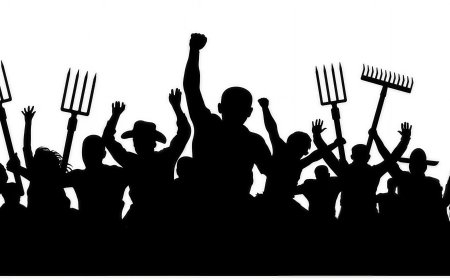
The interim period also normalized something Bangladesh had not fully tolerated even under Hasina's more authoritarian years: Crowds acting as law.
The Dhanmondi 32 demolition was not a rogue incident cleaned up afterward -- it ran across two nights, with law enforcement present and passive, following an open social-media call to arms, and it was only the most photographed instance of a broader pattern reporters and rights groups described through 2025: Minority communities attacked with little consequence, cultural and academic figures describing a shrinking space to speak freely, property and history alike left to whichever crowd arrived first with the loudest justification.
A government that arrived promising the rule of law ended up, in practice, frequently governing by whoever showed up with the bulldozer.
And the honest answer to whether an election would have happened at all, absent the army, is: probably not on any fixed schedule.
Yunus's own timeline slid for the better part of a year -- a vague window from "December 2025" drifting toward "the first half of 2026," committed to no earlier than it had to be.
It was General Waker-uz-Zaman, the army chief whose refusal to fire on protesters had put Yunus in office in the first place, who spent much of 2025 publicly and repeatedly forcing the question, warning serving officers that the country was "passing through a chaotic phase" and that continued drift put its sovereignty at stake.
Observers who study the military's role in Bangladesh credit that pressure, more than any initiative from the chief adviser's office, with the date that finally landed on the calendar.
An unelected caretaker government, holding a mandate with no fixed term of its own, proved no readier to return power on schedule than any of the elected governments that came before it.
The army did not seize power in 2026. It did something quieter, and in its own way just as telling: It made unmistakably clear that if the interim government kept postponing, someone eventually would stop it from doing so.
Which brings us to the harder question, the one the statue was supposed to answer and didn't: If 2024 tore down the cult, what happened to the oligarchy that the cult, and the caretaking that followed it, had both been sitting on top of?
Follow one thread. Weeks before Sheikh Hasina's government fell, in June 2024, the Bashundhara Group -- one of Bangladesh's largest conglomerates and among the Awami League era's most favored business houses -- received a letter from the Energy and Mineral Resources Division granting its oil and gas arm permission to import unrefined fuel oil and sell it through its own distribution network, breaking a monopoly the state-run Bangladesh Petroleum Corporation had held for decades.
It was, on its face, exactly the kind of last-minute, single-beneficiary favor that critics said defined the old settlement. The government fell before the policy could be fully implemented.
In 2025, under Yunus's own interim administration, an Anti-Corruption Commission petition led a Dhaka court to freeze billions of taka in Bashundhara shares and accounts belonging to the family -- an apparent signal, however brief, that the new order intended to examine what the old one had handed out.
And yet by August 2026 -- under a third government now, the elected BNP administration of Prime Minister Tarique Rahman that took office that February -- Bashundhara is not retreating from the energy sector. It is expanding its position within it.
Separate arms of the group have filed fresh applications to import LPG and LNG. The government has instructed the Petroleum Corporation to draft an entirely new private-sector fuel policy explicitly prompted by Bashundhara's proposal to import up to 3.35 million tons of fuel a year -- a policy shift so abrupt that the Corporation's own chairman was replaced days beforehand, reportedly over resistance to the plan, while labor unions now warn of a strategic sector sliding into private monopoly.
Three governments in three years -- an Awami League that granted the favor, an interim administration that froze the family's accounts, and an elected BNP government now drafting the very liberalization the family asked for -- and the position keeps getting stronger, only ever pausing, never once actually reversing. The frame has changed from cronyism to competition. The beneficiary has not changed at all.
This is the fact a fallen statue cannot answer for. Regimes in Bangladesh have specialized, across 50 years, in changing who stands at the podium while the architecture behind the podium goes untouched -- the land syndicates, the banking sector's unresolved bad loans, the energy conglomerates that seem able to metabolize any government's stated ideology, whichever one is currently in fashion, into their own advantage.
A personality cult is expensive to build and, it turns out, cheap to demolish: It needs only a crowd and a few hours with an excavator.
An oligarchy is the opposite -- invisible to a crowd, built out of contracts and regulatory letters and quiet boardroom continuities, and it survives regime change precisely because no bulldozer knows where to point.
To be exact about what happened and what didn't: Bangladesh was not reborn in August 2024. A country is born once. What happened in 2024 was not a second birth but a reckoning -- the closest the nation had come, in half a century, to being made to look directly at the settlement it had allowed to calcify around its own founding myth.
A reckoning is not a small thing. It removed a 15-year government that had ruled continuously since 2009, on top of an earlier term in the 1990s, making Sheikh Hasina the longest-serving head of government in the country's history by any count.
It opened files, froze accounts, put a former prime minister under an arrest warrant, and handed down a death sentence in absentia.
None of that is nothing. But a reckoning that stops at the level of image -- a fallen statue, a burned house, a renamed avenue -- is not the same as a reckoning that reaches the level of structure.
And the Bashundhara timeline is the clearest evidence available that this one, so far, has mostly stopped at the first level.
So the child born in 1971 is not a newborn anymore. It is 55 years old, has lived through a war of independence, a father's assassination, 15 years of military rule, three decades of alternating civilian governments each accused by the other of the same crimes, a mass uprising, an 18-month caretaking that promised neutrality and delivered a new patronage network instead, and now an elected government that has picked up, almost without a pause, exactly where the last two left off.
That is not the profile of a child. It is the profile of someone who keeps having the same argument with themselves at every family gathering and calling each one a fresh start.
Should Bangladesh grow up? The question barely needs asking, and answering it is really just naming what growing up would consist of: A state whose institutions do not depend on which family currently occupies them, an economy whose strategic sectors are allocated by transparent process rather than by proximity to whoever is in power this decade, a politics in which a change of government is a change of policy rather than a change of victim and beneficiary.
Nobody serious argues against that description. The disagreement, when it comes, is never really about the destination.
Can it grow up? That is the only question actually still open, and it is a much colder one than the first.
It is not a question about intention, since intention is cheap and every government arrives with plenty of it. It is a question about whether the machinery that keeps reproducing the same outcome under different management can be dismantled by the very actors who benefit from it remaining intact -- the parties, the conglomerates, the bureaucracies, the courts -- none of whom have ever had to build a Bangladesh that doesn't run on patronage, because none of them have ever seen one.
Growing up, for a person, means acquiring the capacity to act against your own immediate impulse for the sake of a longer-term good you can actually picture.
Bangladesh's difficulty may be narrower and more specific than immaturity: It may be that no generation here has yet lived inside an alternative arrangement long enough to be able to picture it at all. You cannot grow into a shape you have never seen.
That is why the answer will not arrive as an event. It will not arrive as a statue coming down, or a trial verdict, or an election, however consequential each of those is in its own right.
It will arrive, if it arrives, as an accumulation of unglamorous refusals: A regulator who does not sign the letter; a court that does not let a freeze order quietly lapse once the news cycle moves on; a newly popular movement that writes internal term limits into its own charter before it has any power worth limiting; a fuel policy debated in parliament instead of drafted in ten days after one conglomerate's proposal.
Each of those, alone, is invisible next to a burning house on the evening news. All of them together, sustained past the point where they are still exciting, would be the actual event -- the one with no bulldozer, no crowd, and no statue to mark it, which is exactly why it is so much easier to skip.
The country tore down an old answer in 2024 and again in 2025.
It has not yet shown that it can sit with the newer, quieter question underneath both of those demolitions: Not who deserves the statue, but who gets to keep the contract.
That is the question with no rope to pull it down by -- and, 51 years after Dhanmondi 32, still no clear sign of who intends to try.
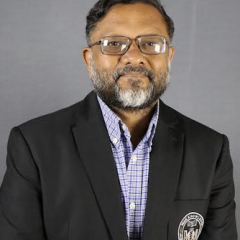
Sujaul Khan is an Assistant Professor at North South University.