





































































Carcosa is Calling
In Bierce's world, Hastur watches over the shepherds. In Chambers' world, the same name is bound to the Yellow Sign, a mark that spreads corruption to anyone who looks at it for too long.

Along the shore the cloud waves break,
The twin suns sink behind* the lake,
The shadows lengthen
In Carcosa.
Strange is the night where black stars rise,
And strange moons circle through the skies
But stranger still is
Songs that the Hyades shall sing,
Where flap the tatters of the King,
Must die unheard in
Dim Carcosa.
Song of my soul, my voice is dead;
Die thou, unsung, as tears unshed
Shall dry and die in
Lost Carcosa.
-- Cassilda’s Song
What if there were a story where simply reading it would drive you mad? What if this story disguised itself as a play, only to lure in new readers and make them succumb to its evil? And what if this story went on to affect the stories around it, eventually changing art, people, and the world as a whole?
I’m here to tell you that such a story doesn’t exist.
But for some reason, we keep talking about it.
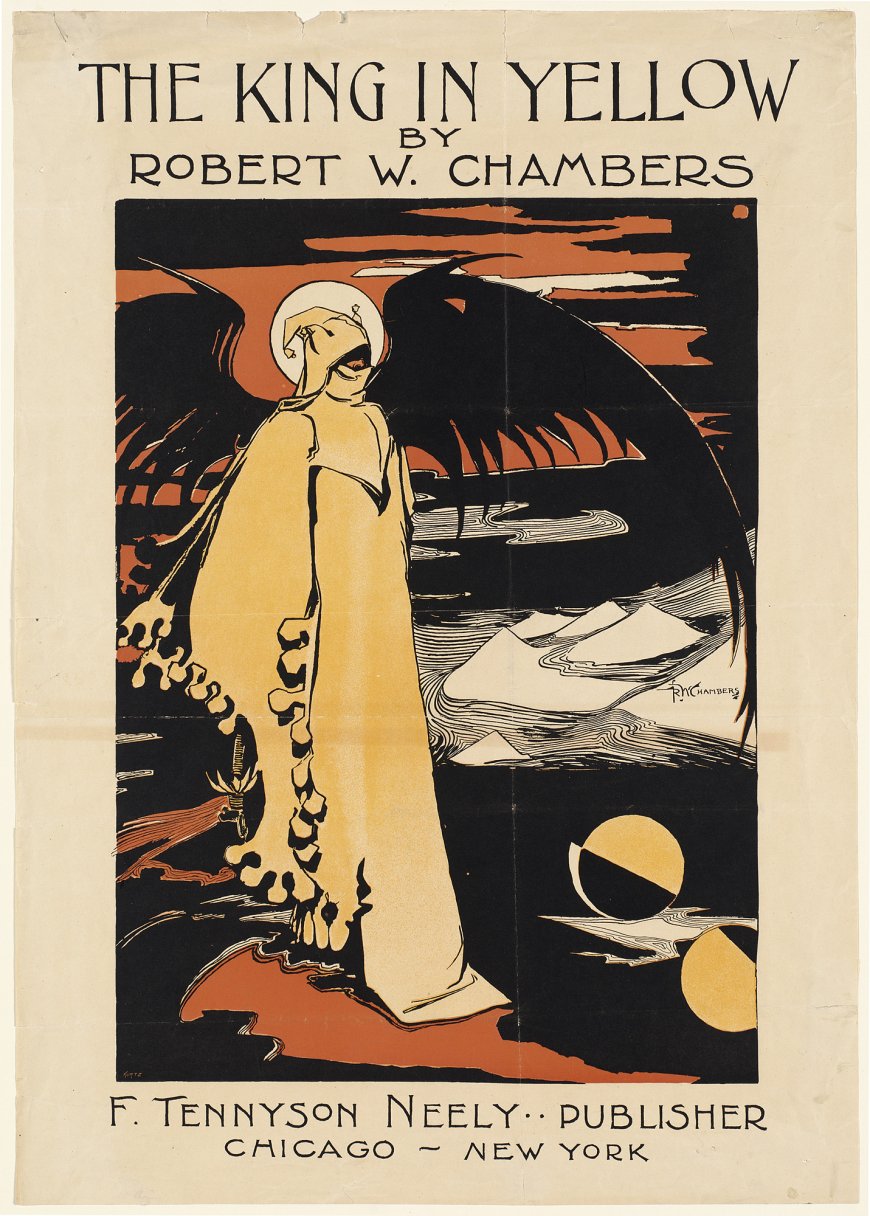
The King in Yellow is a collection of short stories that was published by R. W. Chambers in 1895. Across these short stories, we see how the King in Yellow is a forbidden memetic entity that infects the mind of anyone who comes across it.
However, you’ve probably encountered the King in Yellow before. You just didn’t know it.
Chambers’ book went on to inspire many early horror writers, such as H. P. Lovecraft. And the concepts Chambers mentions in his stories were way ahead of their time in 1895. So, of course, Chambers’ writing went on to inspire a ton of media that came after him.
But it’s not only Chambers’ book that has outlived the author himself. It is the King in Yellow, within The King in Yellow, that has lived on as well.
This unspeakable entity has shown up in dozens of stories over the past several years, all of which reference the same forbidden story that Chambers wrote about all the way back in 1895.
So, so many pieces of art -- pieces of art I guarantee you’ve come across before reference the same monster in a story that’s never been told before.
So why is a story that has never existed behind so many stories that we know today?
Before he was feared, Hastur was worshipped.
In 1891, American writer Ambrose Bierce published a short story titled Haïta the Shepherd. It's a quiet, almost dreamlike tale about a young herdsman who lives in an idealized countryside. His world is pure, untouched by suffering, and his days are spent tending animals and offering devotion to a god named Hastur.
This version of Hastur is a serene, divine figure, never seen or described, but always present in the boy's thoughts. He represents patience, goodness, and the promise that joy will come to those who wait for it.
However, something changed.
The name lived on, but the meaning did not. Within just four years, another author would take that name and twist it into something entirely different.
In The King in Yellow, among the ten stories R.W. Chambers wrote, only the first four -- The Repairer of Reputations, The Mask, In the Court of the Dragon, and The Yellow Sign -- actually deal with the cursed play at the heart of the mythos. The rest of the collection wanders into war fiction and romance, with little connection to the eldritch horror.
Chambers borrowed his terminology from Bierce -- Hastur, Carcosa -- but stripped away the benevolence. In Bierce's world, Hastur watches over the shepherds. In Chambers' world, the same name is bound to the Yellow Sign, a mark that spreads corruption to anyone who looks at it for too long.
Part of what makes this concept so unsettling is that Chambers himself never wrote the play. He only gives you fragments of it, some stage directions, and lets your mind imagine the whole nightmare: The Black Stars, the City of Carcosa.
The play's second act is said to be so devastating that no one who finishes it remains sane. Characters who read it are already ruined by the time we meet them. We never see the moment of exposure, only the wreckage left behind.
That's the part that outlived the story, both in media and in popular culture.
Chambers took those names from Bierce, and Lovecraft did the same thing. Countless writers after Lovecraft followed suit. Nobody sat down and decided to create a shared universe around The King in Yellow. It simply kept getting picked up, reinterpreted, and passed on.
Some examples include The Dark Tower series, HBO's True Detective, Dark Souls, which features an enemy called "Xanthous King Jeremiah" -- essentially, "Yellow King Jeremiah" -- as well as Demon's Souls and Bloodborne, from the same developer, which feature bosses and characters draped in yellow as looser references.
The influence even appears in Fear & Hunger (2018), while Marvel's Venom villain Knull is titled "The King in Black," a character concept modeled in part on The King in Yellow.
However, the main source of dread in the book is not the King in Yellow himself. It's exposure.
The moment you read the play, you change. You are no longer your previous self. You can't unknow what you've learned. The knowledge begins working on you from the inside.
Knowledge doesn't chase you. It waits for you to come to it.
That's not so different from how we describe our relationship with feeds and headlines, how we endlessly doomscroll on our phones. It's something we know is bad for us, yet we keep returning to it anyway.
Nobody forces you to open the app. You open it willingly, just like Chambers' characters opened the book, even knowing what it would cost them.
Hastur is an all-powerful entity, an eldritch horror, a King. He ruled Carcosa.
He never needed followers. He just needed people who couldn't put the book down.
Turns out, neither can we.
Zafir Tahsin is a student at Chittagong Grammar School.