
























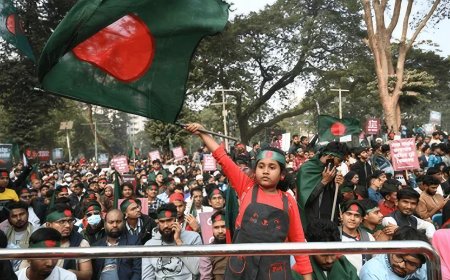










































From the Politics of Power to the Politics of National Service
What Bangladesh needs now is nothing less than a new social contract between the state and its citizens.
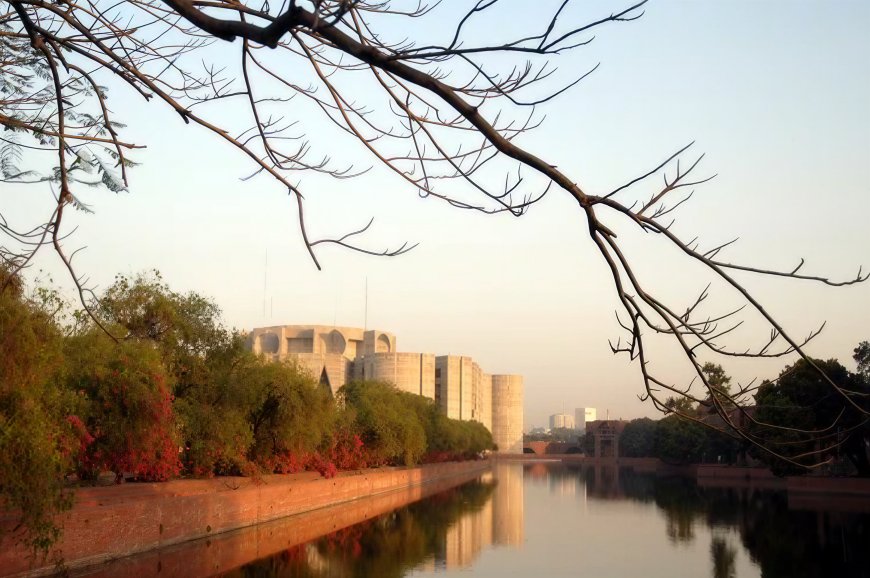
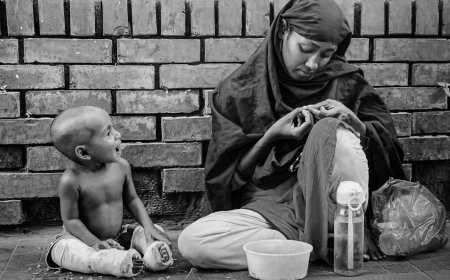
Bangladesh is a country of extraordinary possibilities. Its people have demonstrated resilience in the face of poverty, natural disasters, political turbulence and economic uncertainty.
Its entrepreneurs, farmers, workers, professionals and young people have repeatedly shown that, when given opportunity, they can achieve remarkable things.
Yet today, the country faces a question that goes far beyond the success or failure of any particular government or political party: Can Bangladesh build institutions strong enough to protect its enormous potential from being consumed by the politics of power?
This is the fundamental challenge of our time.
Politics is meant to be a means of serving the people and advancing the national interest. But when political power becomes a pathway to wealth, influence, protection or privilege, politics loses its essential purpose.
Public office becomes private opportunity. Loyalty becomes more valuable than competence. Political connections become more important than merit. And gradually, institutions that should serve citizens begin serving those who control them.
The consequences are profound. The damage is not confined to politics. It spreads into administration, law enforcement, business, education and virtually every aspect of national life.
A country cannot prosper indefinitely when its institutions are weakened by political interference and its citizens lose faith in the fairness of the system.
But Bangladesh is not condemned to this fate.
The country can change course. Indeed, it must.
Rule of law must become the foundation
The starting point must be the rule of law.
There can be no genuine democracy, investment confidence, social stability or sustainable development when citizens believe that justice depends upon political identity, wealth or personal connections.
An independent judiciary is therefore not a luxury. It is a fundamental pillar of the state. Judges must be able to make decisions without political pressure. Courts must operate transparently and efficiently.
Citizens should be able to see that cases are determined by law and evidence rather than influence. Most importantly, justice must not become an instrument of political revenge.
The answer to the politics of power is not the criminalization of political opponents. The law must be applied equally -- to the powerful as well as the powerless.
Leadership must begin with integrity
Institutional reform will remain incomplete unless political leadership itself changes. The people of Bangladesh need to see honesty, integrity and personal restraint at the highest levels of government.
Ministers and senior officials should regard public office as a sacred responsibility, not as an entitlement. Their conduct should demonstrate that public money is not personal money, government vehicles are not personal property, and political authority is not a licence for privilege.
Leaders cannot convincingly ask citizens to make sacrifices while failing to demonstrate sacrifice themselves. The most powerful anti-corruption message a government can send is not a speech. It is the personal example of its own leaders.
Politics must become a profession of service
Bangladesh needs a fundamental change in political culture.
Politics should once again be understood as service to the nation.
Political parties are necessary to democracy, but political parties themselves must become more democratic. Internal debate, merit-based leadership, transparent financing and regular accountability should become normal features of political life.
No political party should depend entirely upon one individual or a small circle of individuals. Strong democracies are built on strong institutions, not political personalities.
The country also needs a political culture in which disagreement is considered legitimate. An opponent is not necessarily an enemy. Criticism of the government is not treason.
A different political opinion does not make someone anti-national. Democracy becomes meaningful only when people are free to disagree without fear.
The state must welcome criticism
One of the great tests of a confident government is how it responds to criticism.
A government that is constantly praised learns very little. A government that permits honest criticism has an opportunity to correct its mistakes.
Bangladesh therefore needs an environment in which journalists, academics, professionals, civil society organizations and ordinary citizens can question government policies freely and responsibly.
Criticism should be viewed as an early-warning system for government.
If a ministry is failing, citizens should be able to say so. If a public project is wasting money, people should be able to ask questions. If an administrative procedure is creating unnecessary suffering, officials should be able to hear about it without political consequences.
The purpose of criticism should be to improve the machinery of government, not to weaken the state.
Technology can help break the cycle
Bangladesh should make a much more aggressive transition toward technology-driven government.
Every government service should be examined with one question in mind: Can this process be made simpler, faster, more transparent and less dependent on individual discretion?
Automation can reduce opportunities for bribery. Digital records can improve accountability. Online procurement can make public spending more transparent.
Data systems can help measure performance. Artificial intelligence and modern analytical tools can eventually help government identify inefficiencies and improve decision-making. Technology is not a substitute for integrity.
But good systems can make dishonesty considerably more difficult. Bangladesh should aspire to a government in which a citizen does not need a personal connection merely to receive a service to which he or she is legally entitled.
Reform the civil service
No country can be governed effectively without a professional, capable and politically neutral civil service. Bangladesh needs public officials who feel accountable to the Constitution and the people, not primarily to whichever political authority happens to be in power.
Appointments and promotions should increasingly reward competence, integrity and performance. Officials should have clear responsibilities and measurable targets.
Poor performance should have consequences, while outstanding public service should be recognized. A professional civil service would strengthen every government, regardless of its political identity.
Reform law enforcement
The same principle applies to policing and other law-enforcement agencies. Citizens must believe that the police exist to protect them and enforce the law—not to serve political interests.
Law enforcement should be professional, evidence-based and accountable. Political interference must be reduced, while mechanisms for investigating misconduct must be strengthened.
A police officer should not have to ask who a suspect knows before deciding how the law should be applied. That is what equal citizenship means.
Zero tolerance for corruption -- and selective justice must end
Bangladesh cannot afford to treat corruption as an unavoidable feature of public life. There must be zero tolerance for corruption, but this principle must be applied consistently.
Selective anti-corruption campaigns merely replace one form of political influence with another. Genuine reform requires independent institutions capable of investigating allegations regardless of the political or economic status of those involved.
At the same time, government should simplify procedures that unnecessarily create opportunities for corruption. The best anti-corruption strategy combines strong enforcement with better systems.
Economic development requires clean governance
Economic growth cannot be sustained indefinitely by infrastructure spending, cheap labour or remittances alone. Bangladesh needs an environment in which entrepreneurs succeed because they are competitive -- not because they have political connections. Public procurement must be transparent.
Major projects must be evaluated on economic value rather than political visibility. Cost overruns and delays must be investigated. Government expenditure must be subjected to rigorous scrutiny.
Every taka of public money should be treated as money entrusted to government by the citizen. That simple principle could transform public administration.
Give the young a reason to believe
Perhaps the greatest responsibility of today's leaders is toward the younger generation. Young Bangladeshis should not grow up believing that success requires political patronage, family connections or leaving the country.
They should believe that education, competence, creativity, entrepreneurship and hard work matter. That requires better education, stronger universities, vocational training, research opportunities, access to technology and an economy that rewards innovation.
A young person should be able to look at Bangladesh and say: “I can build my future here.”
That would be one of the greatest indicators of national success.
Measure the country -- and tell the people the truth
Bangladesh also needs a culture of measurable performance.
Governments should establish clear national and ministry-level targets and regularly publish progress against them.
How much was budgeted?
How much was spent?
What was achieved?
What remains unfinished? Why? Who is responsible?
Citizens have a right to know. Transparent performance reporting would change the nature of politics. Governments would increasingly be judged not by slogans but by results.
Patriotism must become practical
Bangladesh does not need more empty declarations of patriotism. It needs practical patriotism. A minister who rejects unnecessary privilege is patriotic.
An official who refuses a bribe is patriotic. A doctor who serves patients conscientiously is patriotic. A teacher who educates children with dedication is patriotic.
A businessperson who pays taxes honestly is patriotic. A citizen who protects public property and obeys the law is patriotic.
Patriotism is ultimately a behaviour, not a slogan. And once again, the example must begin at the top.
Citizens must become partners in national development
Government alone cannot build the Bangladesh we want. Citizens must be encouraged and inspired to contribute to the country in whatever capacity they can.
Businesses, professionals, universities, farmers, workers, young people and members of the Bangladeshi diaspora all have important roles to play. But citizens are more likely to make that contribution when they believe that government itself is honest, fair and accountable.
National development should therefore be presented not merely as a government programme, but as a shared national mission.
The government must lead -- but the nation must participate.
A new social contract
What Bangladesh needs now is nothing less than a new social contract between the state and its citizens.
The government must guarantee justice, security, competent administration, economic opportunity and the fundamental freedoms of its people.
Citizens, in return, must accept their own responsibilities: Obeying the law, paying legitimate taxes, rejecting corruption, protecting public property and contributing to their communities and country.
Government and citizens cannot remain on opposite sides of an imaginary divide. They are partners in the same national enterprise.
The choice before Bangladesh
The challenges are formidable. But Bangladesh has never been a country that should be underestimated.
The greatest national resource of Bangladesh is not its natural gas, its rivers, its factories or even its strategic geography.
It is its people.
The question is whether the country's institutions will allow those people to realize their potential. Bangladesh does not need another generation trapped in cycles of political confrontation, corruption, retaliation and institutional decay.
It needs a new political culture -- one in which power is temporary, public office is a responsibility, criticism is welcomed, institutions are respected and national interest comes before personal advantage.
The country needs leaders who understand that political victory is temporary, but the institutions they build -- or destroy -- can affect generations.
The real measure of a government should therefore not be how powerful it becomes, how many opponents it defeats, or how loudly it celebrates its achievements.
It should be measured by something much simpler: Did it leave the country stronger than it found it?
If Bangladesh can restore the rule of law, strengthen its institutions, embrace technology, confront corruption, professionalize government, protect freedom of expression and inspire citizens to serve the national interest, the country can still unlock the enormous potential that lies within it.
The future need not be a continuation of the past. There is still time to choose a different path. And perhaps the most patriotic act of all is to begin that journey now -- not for the politicians of today, but for the generations of Bangladeshis who will inherit the country we leave behind.
The time has come to move from the politics of power to the politics of national service.
A Gafur is a Private Sector Professional and Writer, and Former Executive Director, The American Chamber of Commerce in Bangladesh (AmCham Bangladesh)