


























































The Curious History of the China Corridor
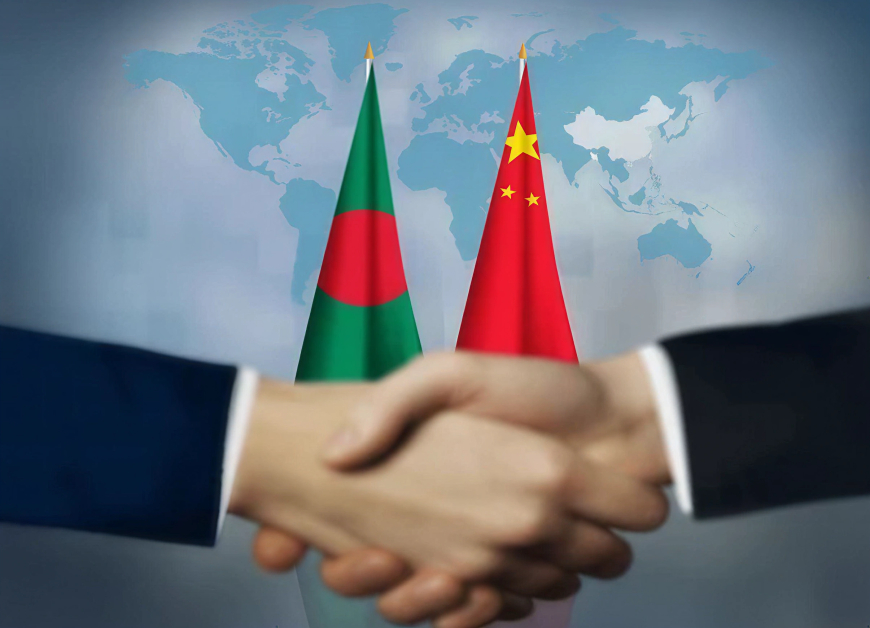
This history matters for one simple reason -- the corridor China proposed in Beijing in June to the Bangladeshi Prime Minister is the same idea, with the same starting point in Kunming, with the same logic, but without India.

In the early 1990s, a small group of economists and policy researchers in Kunming -- the capital of China’s Yunnan province -- started talking about a simple idea: What if China’s landlocked southwest, Myanmar, Bangladesh, and eastern India were connected by road and rail, so goods could move between them without going all the way around through ports thousands of kilometers away? This would be cost-effective and time-efficient for the region.
At that time, one of the people pushing this idea from the Bangladesh side was the economist Rehman Sobhan, who proposed a "multi-modal transport network" linking the four countries. Nobody called it a mega-project back then; it was just an idea, discussed by academics, not yet by governments.
That idea is the great-grandparent of the corridor China just proposed to Bangladesh’s new Prime Minister Tarique Rahman in Beijing during his first foreign visit after taking office.
To understand whether this new offer is worth taking seriously and what Bangladesh should watch out for, it helps to know where it actually came from, because this is not the first time this corridor has been the talk of the town.
From Seminar Room to Six-Lane Highway
The 1990s conversations about the corridor became known as the Kunming Initiative. In August 1999, it was formalized as the BCIM Forum for Regional Cooperation -- BCIM standing for Bangladesh, China, India, and Myanmar. It brings together Bangladesh’s Centre for Policy Dialogue (CPD), India’s Centre for Policy Research (CPR), China’s Yunnan Academy of Social Sciences (YASS), and Myanmar’s Ministry of Commerce (MOC). For over a decade, it stayed exactly as a forum, where researchers and former officials met to talk, with no government actually committing money or signing anything.
That changed in 2012, when then-Chinese Premier Wen Jiabao raised the idea directly with India’s former Prime Minister Manmohan Singh. The following year, in May 2013, Wen’s successor, Li Keqiang, formally proposed building a Bangladesh-China-India-Myanmar Economic Corridor (BCIM-EC) during an official visit to India, and both countries jointly announced it in a signed statement. For the first time, this was a government-to-government project, not just an academic one.
On paper, it was an ambitious plan -- a corridor running from Kunming through Mandalay in Myanmar, across Bangladesh through Dhaka, Chittagong, Sylhet and Jessore, into India’s northeast through Silchar and Imphal, and ending in Kolkata, covering roughly 1.65 million square kilometers and around 440 million people. With that plan in mind, in 2014 and 2015, Chinese President Xi Jinping raised the matter with Indian Prime Minister Narendra Modi multiple times -- at a BRICS summit in Brazil, then in New Delhi, then in Beijing.
In a meeting in 2017, they produced a list of 11 sectors for cooperation, but with no real detail attached. Later in 2018, a meeting in Myanmar also yielded nothing. By 2019, another attempt was made to revive it in Kunming, but the project had quietly died. Not because Bangladesh or Myanmar lost interest, but because India and China did not trust each other enough to build a shared corridor. Sometime after that, Beijing dropped the four-country corridor vision from its official list of Belt and Road altogether.
This history matters for one simple reason -- the corridor China proposed in Beijing in June to the Bangladeshi Prime Minister is the same idea, with the same starting point in Kunming, with the same logic, but without India. It is the clearest signal in this whole story of how China now sees its position in the Global South and its access to the Bay of Bengal.
A Relationship That Has Grown Faster Than the Corridor
China is already deeply tied to Bangladesh’s economy. The two countries trade nearly $25 bn worth of goods a year, making China Bangladesh’s single largest trading partner. The relationship was deepened in 2016, when Bangladesh signed on to China’s Belt and Road Initiative (BRI) under the Awami League (AL) government led by Sheikh Hasina -- a government widely seen as one of the closest regional allies of India.
However, after Hasina’s ousting in 2024 following a student-led uprising, much has changed in the historical ties between Dhaka and New Delhi, leaving a vacuum for Beijing to fill by economic, strategic, or people-to-people diplomacy.
A study by the Centre for Alternatives shows that, after the uprising of 2024, 61percent of Bangladeshis of different ages, occupations, or genders saw the Bangladesh-China bilateral relationship as very positive. They remained a steadfast partner through the transition period.
At the latest meeting between China and the new Bangladeshi government led by Prime Minister Tarique Rahman, the two countries agreed to call their relationship a ‘community with a shared future’ where Bangladesh is expected to join China’s Global Development Initiative formally, and also they agreed to build an economic zone near Mongla port by the help of China -- on land that had originally been promised to an Indian-backed project during the AL regime which was dropped by Yunus-led interim government in 2025 after her fall.
Separate MoU agreements covered the Teesta River management project, flood control, and cooperation on green energy, digital technology, healthcare, and education. Not only that, Bangladesh seeks support from Beijing to get BRICS membership, and Beijing gives it a positive signal.
Also, a few days back, they provided broad diplomatic backing and strong endorsements to Dr. Khalilur Rahman, the Foreign Minister of GOB, to be elected as President of the 81st session of the UN General Assembly (UNGA).
Despite all that, what’s notable is how Dhaka itself is framing the visit. They are framing this trip as driven primarily by Bangladesh’s domestic economic needs rather than a geopolitical tilt toward Beijing. The real constraint isn’t which allies it partners with, but rather whether Dhaka’s own bureaucracy can turn signed agreements into delivered agreements at all, with its balance in foreign policy with all its counterparts.
A Relationship of Refugee Crisis
Here is where the plan runs into its hardest problem. Bangladesh doesn’t really have a normal working relationship with Myanmar as a single, stable country. It has a diplomatic relationship with the Myanmar Military Junta government, which controls nearly 20 percent to 35 percent of its territory. The rest of the territory is controlled by different non-state actors.
Especially in Rakhine State, along the Bangladesh–Myanmar border, the Arakan Army (AA) has emerged as the de facto governing authority, exercising control over approximately 90 percent of the state’s territory, including the border town of Maungdaw. Any road or rail line that China and Bangladesh want to build through this area will, in practice, need the cooperation of an armed group that has no official seat at the negotiating table to date.
More importantly, almost everything Bangladesh actually feels about Myanmar today comes from one unresolved crisis -- the Rohingya refugee crisis. Nearly nine years after roughly a million Rohingya fled into Bangladesh due to massive ethnic violence. They are still sheltering around 1.2 million refugees in 34 different camps, and it is getting very complicated to repatriate them to Myanmar as the fighting in the Rakhine does not stop yet. This prolonged presence of over a million Rohingya refugees in Bangladesh poses significant security, economic, and environmental threats to them.
Additionally, in 2025, the proposal for a UN-backed humanitarian corridor to deliver aid to Rakhine via Chittagong blew up badly.
Within weeks, Bangladesh’s Army Chief publicly rejected it as a threat to their sovereignty, and the man who is now Prime Minister argued that a decision of that scale should never be made without Parliament’s approval. Whatever the new economic corridor becomes, it will be built on top of that same fragile, crisis-shaped relationship between Bangladesh and Myanmar, not on calm.
Where Others Stand For
The proposed corridor is unfolding within a broader geo-political landscape in which India and the United States are closely monitoring the deepening China–Bangladesh partnership.
India has the longest memory of all. It was a part of the very same corridor idea back in 2013, only to walk away from it once the project was included in China’s Belt and Road Initiative. New Delhi is already concerned about the China-Pakistan Economic Corridor (CPEC) as they claimed that the corridor violates their sovereignty and territorial integrity, as it runs through Gilgit-Baltistan and the Pakistan-administered Kashmir region, which they believe is illegally occupied by Pakistan.
Also, they have existing worries about Chinese-financed ports near their Andaman and Nicobar Islands, the loss of the Mongla port deal and the Teesta River management project in Bangladesh to China, and a broader cooling in Dhaka-Delhi relations since 2024. It is easy to see why Indian strategists are paying close attention to this announcement, even though they weren’t in the room for the corridor.
The United States hasn’t issued any clear, confirmed reaction to this specific proposal yet. But the backdrop is hard to ignore: The rejection of the Bangladesh-Myanmar humanitarian corridor in 2025, proposed by the UN as a Western-aligned scheme.
There’s a real irony in the fact that Bangladesh said no to the corridor associated with the West at that time, but a year later, they are now evaluating the Chinese corridor proposal -- though both would run through roughly the same unstable Myanmar border region.
However, some reasons make sense given the prolonged Rohingya refugee crisis and Bangladesh's fragile economic situation, which creates a need for trade, investment, and funding, in which an economic corridor can be beneficial for them.
Myanmar’s military government and the Arakan Army, finally, want different things from this. The junta needs investment and the international legitimacy that comes primarily from China and India, as it is not in a good position with the West, most of which are on the sanctions list. They are maintaining good ties with China and India -- both have significant investment in Myanmar.
Even in April 2026, Myanmar’s President Min Aung Hlaing (formerly the military junta chief) visited India for five days as his first foreign trip since assuming the presidency after the election. Also, the Arakan Army -- a non-state rebel actor -- controls much of the territory the corridor would need to pass through, but has no formal role in talks between Beijing, Dhaka, and Naypyidaw.
Bangladesh’s Strategic Choices
None of these external concerns should prevent Bangladesh from evaluating China's corridor proposal because of its own national interests.
A functional corridor would give Dhaka more direct access to markets in southwestern China, easing its dependence on other trade routes and expanding economic opportunities.
Moreover, several benefits are already locked in, regardless of whether the corridor itself is eventually completed: The Mongla economic zone, the Teesta River management understanding, and new cooperation on flood control, green energy, digital technology, healthcare, and education.
Bangladesh’s expected membership in China’s Global Development Initiative opens another channel for financing and technical support, and Beijing promises to back Dhaka’s BRICS bid, strengthening further bilateral relations.
Beyond this, the proposal also provides Bangladesh with a greater strategic space to balance its relations with China, India, and the United States rather than leaning too heavily on any one of them.
It provides Dhaka with a negotiated space, with far more transparency than before. At the same time, while evaluating the new corridor proposal, Dhaka should approach the corridor with measured expectations.
The history of the Kunming Initiative tells us an important lesson: It took 14 years to move from a seminar room to a government-level agreement, and another 6 years to collapse quietly. Also, China’s own corridor record in Myanmar shows the same pattern -- announced, renegotiated, shrunk, delayed, repeated.
Ultimately, whether the corridor becomes a reality will not only depend on Bangladesh’s ability to maintain its Bangladesh First doctrine while maintaining balanced relations with all the major counterparts, but also on Beijing’s willingness to play a more constructive role in resolving the Rohingya refugee crisis.
As long as Bangladesh-Myanmar relations are understood more in terms of refugee camps in Cox’s Bazar than of cross-border connectivity, any corridor linking Dhaka to Kunming will face political and strategic constraints that infrastructure alone cannot overcome.
Ahamed Jobayer is a recent postgraduate in International Relations from South Asian University, New Delhi.