



































































The Rise of India’s Cockroach Janta Party
Gen Z is winning the internet through a combination of genuine grievance, cultural fluency, and the particular humor of people who have been told they are useless and decided to make art out of it.

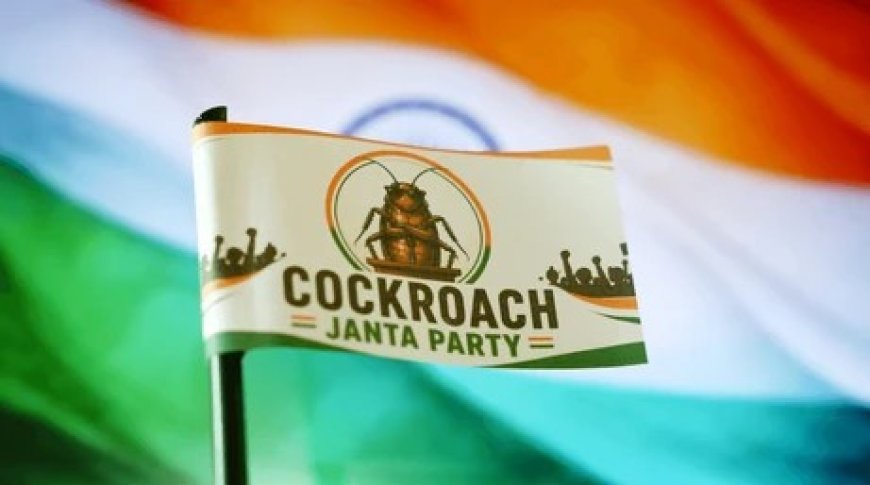
There is something almost poetic about the fact that it took a senior judge of the Supreme Court of India, the highest temple of constitutional democracy, to accidentally spark one of the most electric youth movements the country has seen in years.
On the May 15, Chief Justice Surya Kant, during a hearing, reportedly compared unemployed young people to "cockroaches" -- parasites without purpose, clogging the arteries of a productive nation.
He later clarified that he was targeting those with fraudulent degrees, not the country's restless youth. Yet, within twenty-four hours, Abhijeet Dipke, a thirty-year-old communications student at Boston University and former Aam Aadmi Party worker, had set up the Cockroach Janta Party (CJP) with a deliberately absurdist manifesto: Secular, Socialist, Democratic, Lazy. Its eligibility criteria? Be unemployed. Be chronically online. And rant professionally.
Within five days, the CJP had amassed nearly fifteen million followers on Instagram, surpassing the nine million of the ruling Bharatiya Janata Party, an organization that calls itself the world's largest political party.
There is a brilliant, dark poetic justice to the metaphor. The cockroach is the ultimate survivor -- unlovely, ubiquitous, impossible to entirely eradicate, and capable of thriving in the ruins of grand structures. By adopting this identity, India's youth sent a clear message to the political establishment: You have made the economy unlivable for us, yet you expect us to disappear. We will not.
The question worth sitting with is not simply how this happened, but why now, and what it means for the country amid the relentless march of right-wing hegemony, which continues to breach historically resistant bastions, even West Bengal, long a fortress of left and regional identity, finds its political soil shifting radically toward the cultural right.
The Paradox of Two Indias
On May 4, barely two weeks before the CJP went viral, the BJP completed what had once seemed almost unthinkable by winning West Bengal from Mamata Banerjee's Trinamool Congress, gaining over 200 seats in the 294-member assembly.
A state once defined by three decades of Left intellectualism, trade union culture, and what scholars of South Asian politics often call "Bengali exceptionalism" had finally given way. So, the politics of Bengal was steadily displaced by a new coalition built around Hindu consolidation and identity politics.
And yet, simultaneously, a satirical youth movement calling itself after a pest and doing so with pride was breaking every internet record in the country.
How does one reconcile these two Indias?
The answer, I think, lies in understanding that they are not opposites. They are different registers of the same underlying crisis of generational reckoning with a system that has not delivered.
The BJP's success in West Bengal tapped into frustration with economic stagnation under TMC, a fractured Muslim vote, communal anxieties amplified by events across the border. The CJP, born in the same week, tapped into the identical frustration but routed it through irony, satire, and digital solidarity. Both are responses to a society under pressure.
Another answer lies in a stark spatial segregation. The right wing dominates physical territory: the streets, the state machinery, the traditional newsrooms, and the corporate boardrooms. But Gen Z has retreated into a decentralized digital public sphere, constructing a borderless counter-culture that the state struggles to govern through traditional means.
The Economics of Outrage
The structural conditions feeding this discontent are not difficult to identify, even if governments prefer not to dwell on them. India produces over eight million graduates annually. The unemployment rate among them stands at 29 percent, nine times higher than for those who never attended school. Among all youth aged 15 to 29, the figure is 9.9 percent nationally, climbing to 13.6 percent in urban centers.
Compounding this is a more insidious anxiety, one that is distinctly contemporary: Artificial intelligence. Experts across India and abroad have noted that the very back-office sector that once served as the first rung for millions of educated young Indians, like data processing, customer service, and entry-level IT, is now being systematically dismantled by automation.
The Class of 2026 globally may face the highest graduate unemployment in over a decade. India, with its vast population of young aspirants and a skills-training infrastructure that equips barely 2.3 percent of its workforce with formal technical capability, absorbs these shocks most brutally.
It is into this pressure cooker that a judge's careless words fell like a match.
The Grammar of the Global Wave
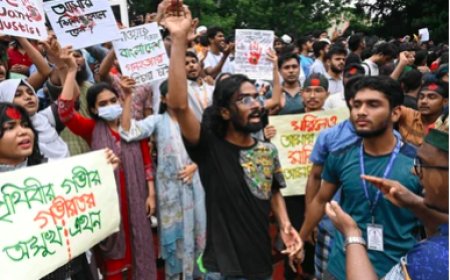
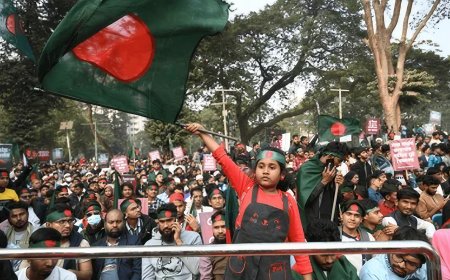
The CJP arrived downstream of a remarkable and still-unfolding global phenomenon. Bangladesh's 2024 July Revolution, where Gen Z students, communicating through WhatsApp chains and TikTok pages, overthrew a government, is now widely cited as the first successful Gen Z revolution of the modern era.
Nepal followed in September 2025, when young people took to the streets to protest government corruption and a social media ban, ultimately forcing Prime Minister KP Sharma Oli to resign within five days of sustained protests. Protests have since erupted in Indonesia, the Philippines, Madagascar, Morocco, Mexico, and elsewhere, each with its own local texture, but all sharing a recognizable architecture, with economic anxiety being the key factor, institutional betrayal, satirical communication, and a refusal to be condescended to.
What distinguishes this generation's political repertoire from earlier waves of youth activism is not intensity but medium. The CJP's rise is inseparable from the internet as infrastructure. Its membership form was a Google form. Its messaging was a meme. Its symbol, “a cockroach on a mobile phone,” brilliantly weaponized the insult aimed at it. The movement, as one observer put it, turned the label into a logo. And, this is a distinctly Gen Z political move. First, take the dehumanizing language of power, invert it, wear it as armor, and flood the digital commons with it until the original insult drowns.
But the CJP has also been careful to mark its limits. Its founder explicitly cautioned against comparison with Bangladesh and Nepal, declining to confirm whether the party would contest elections. And this caution is significant. India's institutional terrain is not Bangladesh's. The levers of state suppression are more sophisticated, the surveillance infrastructure more developed, and the BJP's capacity to co-opt or criminalize dissent, as the cancellation of Sonam Wangchuk's NGO's FCRA license in September 2025 demonstrated, is formidable.
Why Online? And Why Does It Last?
The CJP's essentially digital character is often treated as evidence of its shallowness. Critics ask: What does a fifteen-million-follower Instagram account actually do? It is a fair question, but it rests on a misunderstanding of what online mobilization accomplishes in the first instance.
Digital movements in authoritarian or semi-authoritarian contexts serve two functions that are frequently underappreciated. First, they construct a counter-public, a space where the official narrative of a thriving, developing, Hindu-majority India is contested, mocked, and held to account. When young Indians call themselves "the lazy and unemployed" with cheerful defiance, they are not conceding the point; they are deconstructing the ideological framework that made youth unemployment a moral failing rather than a policy failure.
Second, they produce solidarity across geography. The CJP has spread to Bihar, Madhya Pradesh, Uttar Pradesh, Jammu and Kashmir, and Himachal Pradesh. Young people in Patna and Lucknow and Srinagar are finding, through the algorithm, that their frustration is not private. That is, historically, how movements begin.
There is also something worth noting about who the CJP's founder is: A former AAP worker, trained in political communications, operating from the United States. This is a pattern familiar to observers of South Asian diaspora politics, the globally mobile young Indian who maintains a fierce attachment to the country's political life precisely because distance gives both clarity and immunity. The CJP is partly a product of what one might call India's transnational digital civil society, a constituency that Modi-era policies have not managed to fully intimidate.
The Future: Between Viral and Viable
What happens next? Three scenarios seem plausible.
In the most optimistic reading, the CJP's momentum translates into electoral experimentation, beginning, perhaps, with the Bankipur Assembly by-election in Bihar, where CJP supporters are reportedly considering fielding a candidate. This would test whether digital solidarity can survive the grind of door-to-door organizing, caste arithmetic, and the resource asymmetry of Indian electoral politics. The odds are long. But AAP was once called a joke, too.
In a more likely middle scenario, the movement consolidates as a pressure group, more as a persistent thorn in the side of a political class that has grown used to youth apathy. It doesn't win elections; it forces issues. Unemployment, exam fraud, institutional contempt for the young; these become harder to ignore when fifteen million people are signaling their presence online, and when volunteers are cleaning streets in cockroach costumes.
In the darker scenario, the state moves. An FCRA case here, a sedition angle there, and the founder finds himself too legally compromised to continue. India has a long history of institutionally neutralizing inconvenient voices, and the BJP's record on civil society is not ambiguous.
The likeliest outcome is, I suspect, a mixture of all three: Partial electoral experiments, sustained online pressure, selective state harassment, and eventually (if the economic conditions do not improve) a moment of convergence between the digital and the physical that neither the movement's founders nor the government fully anticipated.
A Final Remark on the Coexistence Paradox
The question I began with, how can a liberal, satirical, youth-led movement flourish in a country undergoing a decisive rightward shift, resolves itself when one stops treating India as a monolith. India is not moving uniformly right. It is fracturing along multiple axes simultaneously. The BJP is winning elections at the level of the state through sophisticated identity coalitions and institutional leverage. Gen Z is winning the internet through a combination of genuine grievance, cultural fluency, and the particular humor of people who have been told they are useless and decided to make art out of it.
These two things can coexist because they are playing on different fields, for now. The question of whether and when those fields collide, whether the cockroaches, as it were, eventually leave the phone and take to the streets, is the defining political question of the next five years in the world's largest democracy.
The Chief Justice called them parasites. They built a party. That, in itself, is an answer worth taking seriously.
Arifur Rahaman is a PhD Student of Political Science at the University of Alabama, USA.