



































































Ukraine's Masterstroke and Russia's Crumbling Air Defence
What Ukraine has executed is not merely a military operation. It is a masterclass in the psychological and strategic manipulation of an adversary whose leadership places symbolism above military reality.

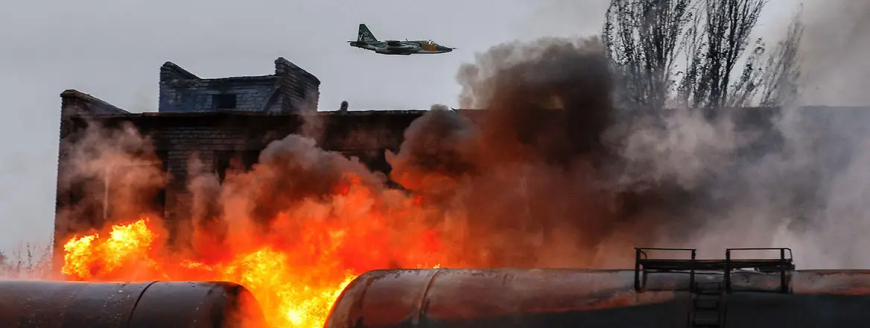
On June 18, thousands of Ukrainian drones pierced Moscow's supposedly impenetrable air defenses for the first time since the Nazi/Axis armies threatened the Soviet capital in World War II.
Russia's capital endured a devastating military strike on the Kapotnya oil refinery (which is the largest fuel supplier to the Moscow region).
Oil rain fell across Moscow while Russian state television looked the other way.
But more significantly, it is not what Ukraine destroyed, it is what Russia has been forced to do next, and what that reveals about the trajectory of a war that Vladimir Putin is progressively losing the ability to control.
A Thousand Drones
Ukraine's operation was not a stroke of luck. According to Russian authorities themselves, nearly a 1,000 drones and four cruise missiles were deployed, with parallel strikes designed to overwhelm air defenses across western Russia before the main swarm converged on Moscow.
Of those, nearly 200 reached the capital, far more than Russia's layered air defences could intercept within hours. The result was not just physical destruction in an irony almost too perfect for fiction, one Russian interceptor went off course and detonated a fuel storage tank, catapulting its lid hundreds of feet into the air: An own goal that circled the globe on social media before Russian censor web could stop it.
The Kremlin managed perceptions as it always does. No air raid sirens were sounded, to stop the population from panicking. When oil droplets began falling from the sky, authorities simultaneously warned children and the elderly to evacuate while denying that any oil rain was occurring at all.
State broadcasters ignored the story entirely. But the people of Moscow were not fooled. Fuel prices spiked within hours. Social media filled with tearful videos, and pro-war hardliners vented fury at the air defense apparatus they had been assured was "unrivalled anywhere in the world."
"It doesn't matter how many millions of targets your air defences have shot down if the facility they're protecting is hit … if they can reliably hit a target in Moscow, they can hit any other target in the country with much less effort."
— Russian military blogger 'Fighterbomber' June 2026
The Strategic Trap
What Ukraine has executed is not merely a military operation. It is a masterclass in the psychological and strategic manipulation of an adversary whose leadership places symbolism above military reality.
The formula, refined across four years of existential war, works as follows: Demonstrate the capacity to threaten Russia's supreme symbolic assets: The capital, the Kremlin, the strategic bridges, then wait for Moscow to reorient its finite military resources to protect those symbols, then strike at the logistical and military targets Russia has left exposed due to their reorientation.
Ukraine deployed this same logic against the Kerch Strait Bridge in Crimea. By credibly threatening the bridge, Kyiv compelled Russia into a defensive panic, then systematically dismantled every alternative supply route while Russian attention remained fixed on the crossing. Now, the same formula has been applied to the Russian capital itself, with consequences already plainly visible.
According to Ukrainian President Zelenskyy, Russia has repositioned hundreds of S-400, S-500, and Pantsir air defense systems to the Moscow region alone. Nearly 90 additional air defense launchers have been moved to Valdai, where Putin is reported to shelter. Meanwhile, across the rest of Russia, only a handful of air defense systems remain in place.
Crimea, described by defense analysts as now possessing "near to no air defenses beyond some ad hoc gun systems on trucks," has seen fuel terminals, radar stations, and power plants struck by Ukraine in the days immediately following the Moscow attack.
On successive days last week, Ukraine struck a semiconductor factory in Voronezh, a critical rail bridge in Crimea, and a power station supplying half the peninsula.
Semiconductors are the heart of modern weapons and with sanctions blocking exports to Russia, the Voronezh strike will hurt Russian strategic weapon capabilities for months to come.
The math is unforgiving. Russia has more territory to protect than ever before, fewer systems with which to protect it, and an adversary whose strike capabilities are expanding rapidly: Both technologically/quality wise and in terms of quantity. Ukraine's indigenously produced long-range cruise missiles such as the Flamingo are entering production.
Future strike campaigns will not only rely on drones that are comparatively easier to intercept. The window within which Russia's air defenses can hope to meaningfully contain Ukrainian long-range strikes is closing, and Moscow's own generals appear to know it.
Putin's Dilemma Has No Good Answer
Vladimir Putin now faces a dilemma that has no good answer. Repositioning air defenses to Moscow shields the capital and protects the political elite but strips the frontlines.
Leaving Moscow exposed is not politically survivable for a government that has built its entire legitimacy on projecting strength, control, and invulnerability. Every choice compounds the next failure.
At the frontlines, Russian military bloggers -- amongst the regime's most reliable internal barometers describe brigades inflated on paper but hollow in reality/quality, supply chains sustained by volunteer donations rather than the state, and an army described as "rotting from within" at the organizational level. Fuel shortages are spreading across Russian oblasts and Crimea faces simultaneous power outages and fuel rationing.
Ukraine has not won this war, far from it. But for the first time since the full-scale invasion began in February 2022, Russia has no credible path to winning it either. In choosing to invade, Putin wagered that Ukraine could be broken before the west rallied to its defense. That wager has failed.
Now, in choosing to shield Moscow at the expense of the front, he risks accelerating the very collapse he sought to prevent.
The sky over Moscow made the math plain enough. The question is no longer whether Russia can prevail. It is how long Putin is willing to pay in soldiers (Russian lives), in oil refineries (Russia’s top export), and in the quiet credibility of a state that can no longer keep oil from falling on its own capital for a war he has probably lost the capacity to win within the opening days of the war.
Shafqat Aziz is a barrister (Lincoln’s Inn) and an accredited Civil-Commercial Mediator (ADR-ODR International).