


































































Myanmar’s Civil War and the Expanding Shadow of Global Rivalry
Myanmar stands as a stark reminder that in today’s world, geography is destiny only until strategy intervenes


From Caracas to Tehran, the map of global tension seems to be acquiring new coordinates with unsettling regularity. Each flashpoint appears distant and self-contained until it suddenly reveals itself as part of a larger strategic pattern.
In that pattern, Myanmar is no longer a peripheral tragedy of civil war and humanitarian collapse. It is steadily emerging as a central theatre where competing visions of the Indo-Pacific order may collide.
At first glance, Myanmar’s crisis still appears domestic. A military junta struggling for legitimacy, an array of ethnic armed groups expanding territorial control, and a fragmented political landscape shaped by decades of mistrust.
This reading is increasingly inadequate. Beneath the surface, a deeper contest is unfolding, one that links pipelines to ports, minerals to maritime routes, and insurgencies to superpower rivalry.
Rakhine State, once primarily discussed in the context of ethnic conflict and humanitarian catastrophe, has been transformed into a geopolitical hinge. The Kyaukphyu deep-sea port, constructed with Chinese backing, has altered the strategic meaning of the region.
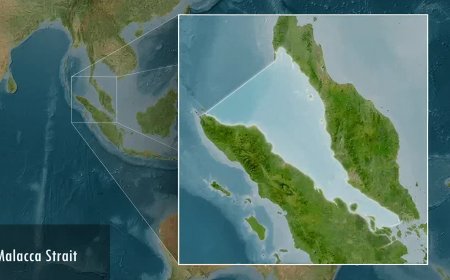
For Beijing, it is not simply an infrastructure project but an insurance policy against vulnerability. The long-standing anxiety over the Malacca Strait has driven China to seek alternative routes that bypass chokepoints dominated by rival naval powers.
Through Kyaukphyu, pipelines and transport corridors extend toward Yunnan, offering a shorter and potentially safer pathway for energy and trade.
This transformation is precisely what alarms Washington and its allies. Ports are never just ports in an age where logistics can be militarized and commerce can double as strategy.
A functioning Chinese corridor through Myanmar would not only reduce Beijing’s dependence on contested sea lanes but also deepen its presence in the Bay of Bengal and the wider Indian Ocean.
The implications stretch far beyond Myanmar’s borders, touching on the balance of naval power, the security of trade routes, and the architecture of regional alliances.
It is within this context that recent American policy moves must be understood. The legislative push often referred to as the Brave Burma Act is being interpreted as more than a human rights response or a sanctions framework.
It reflects a recalibration of strategy. By targeting the financial lifelines of Myanmar’s military government, particularly in energy and resource sectors, Washington appears to be attempting something more ambitious than punitive isolation. The objective seems to be structural disruption.
Sanctions aimed at state-owned enterprises and financial institutions are not merely symbolic. They strike at the capacity of the junta to sustain itself, to fund its operations, and to maintain patronage networks.
When combined with restrictions on aviation fuel and pressure on international financial access, the approach begins to resemble a slow tightening of economic space rather than a single decisive blow. It is a method designed to erode rather than to overthrow outright.
At the same time, the possibility of increased engagement with anti-junta forces introduces another layer of complexity. Support framed as strategic and non-lethal can gradually shift the balance on the ground, especially when insurgent groups already control significant territory.
In Rakhine, the rise of the Arakan Army has demonstrated how quickly local actors can evolve into quasi-state entities.
With administrative structures, territorial control, and public support, such groups blur the line between rebellion and governance.
This raises a fundamental question about the nature of external intervention in fragmented states. When outside powers engage with non-state actors, they do not merely influence outcomes.
They reshape the very definition of legitimacy. In Myanmar, where the junta’s authority is already contested, such dynamics could accelerate the emergence of parallel power structures.
Yet, the American approach is not unfolding in a vacuum. China and Russia remain deeply embedded in Myanmar’s strategic landscape. For the junta, their support is not optional but existential.
Military cooperation, arms supplies, and diplomatic backing provide the regime with a buffer against isolation. This has created a triangular dynamic in which pressure from one side is often counterbalanced by reinforcement from another.
The consequence is a form of geopolitical entrenchment. Instead of pushing the junta toward compromise, external pressure can harden its position. Sanctions may limit resources, but they can also deepen dependency on alternative patrons. In such a scenario, Myanmar risks becoming less autonomous, not more.
Its internal conflict becomes intertwined with external agendas, making resolution more elusive. The mineral dimension adds yet another layer to this already dense equation. Northern Myanmar is rich in rare earth elements, resources that have become critical in modern technological supply chains.
Control over these materials is no longer just an economic issue but a strategic imperative. Efforts by global powers to secure access to such resources inevitably intersect with local conflicts, turning resource-rich regions into contested zones of influence.
This convergence of interests explains why Myanmar’s civil war is increasingly viewed through a geopolitical lens. It is no longer only about governance or democracy. It is about corridors, commodities, and control.
The battlefield is not confined to jungles and towns but extends to financial systems, maritime routes, and diplomatic arenas.
However, the trajectory of this conflict does not suggest an imminent large-scale confrontation in the conventional sense. Unlike the dramatic escalations seen in other regions, Myanmar’s situation is more likely to evolve through incremental shifts.
Economic pressure, proxy engagement, and strategic positioning may gradually alter the balance without triggering a direct clash between major powers.
This slow-burn dynamic is, in some ways, more dangerous. It prolongs instability while avoiding the urgency that often compels resolution. It allows external actors to pursue long-term objectives without bearing the immediate costs of open conflict. And it leaves the local population trapped in a cycle where peace remains perpetually deferred.
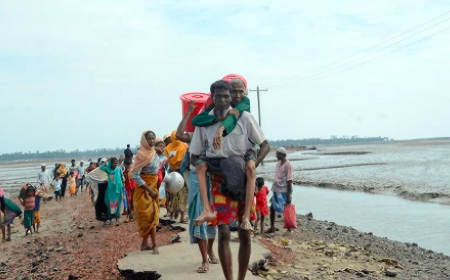
For neighbouring countries, the implications are significant. Instability in Myanmar is not contained within its borders. It spills over through refugee flows, economic disruption, and security concerns.
At the same time, the increasing involvement of global powers complicates regional responses. Any attempt to engage with Myanmar now carries the risk of entanglement in a broader strategic contest.
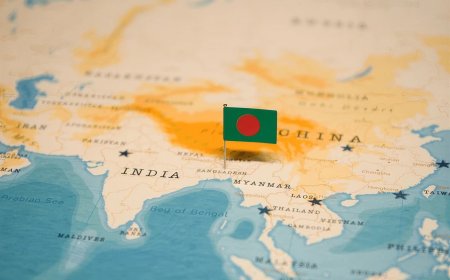
Bangladesh, in particular, cannot afford to view developments in Rakhine as distant. The region’s proximity, its connection to the Bay of Bengal, and its role in regional trade corridors make it directly relevant.
The evolution of power dynamics there will inevitably influence maritime security, economic opportunities, and humanitarian considerations.
The broader lesson is that contemporary conflicts rarely remain local. They are absorbed into larger frameworks of competition, where strategic calculations often overshadow humanitarian concerns.
Myanmar exemplifies this transformation. What began as a struggle for political control has become a node in a network of global rivalries.
Whether it becomes the next major flashpoint in global geopolitics depends less on any single event and more on the accumulation of pressures. If economic strangulation intensifies, if external support to armed groups expands, and if strategic assets like Kyaukphyu become contested, the risk of escalation will grow.
Not necessarily into a conventional war, but into a deeper and more entrenched confrontation that reshapes the region.
In the end, the question is not simply where Washington’s next target lies. It is how the logic of great power competition continues to redraw the map of conflict.
Myanmar stands as a stark reminder that in today’s world, geography is destiny only until strategy intervenes. And once it does, even the most localized crisis can become a global concern.
H. M. Nazmul Alam is an Academic, Journalist, and Political Analyst based in Dhaka, Bangladesh. Currently he teaches at IUBAT. He can be reached at [email protected].