




































































The Plantation That Outlived the Empire
Sylhet’s Tea Garden Adivasis and the Unbroken Architecture of Colonial Indenture

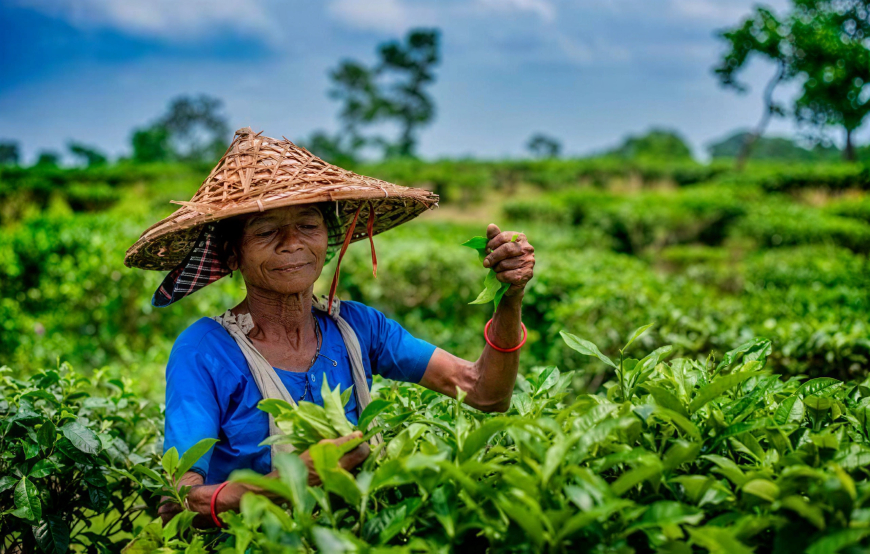
Thandharana Naidu, 81, has spent her entire life inside Longla Tea Garden in Kulaura, Moulvibazar -- and so did her mother. Her ancestors were brought from Jharkhand and Odisha by British plantation companies in the 1860s to harvest tea leaves for the empire. She still lives in the labour lines those first workers were assigned: Rows of narrow, tin-roofed rooms, a family to each, generation after generation.
“Many couldn’t even write their own names,” she recalls. “The order of things was to work.” Five generations of unbroken toil have produced no land deed, no title, no legal claim. The land belongs to the state, leased to the companies. The workers belong to neither.
The Inheritance Nobody Claimed
Between the 1850s and 1880s, the British Raj’s plantation companies deployed agents known as arkattis to recruit tribal labour from the Chotanagpur plateau: Oraon, Munda, and Santal communities from what is now Jharkhand, Odisha, and Chhattisgarh. They were not invited to Sylhet. They were transported to solve a labour problem the British had created -- local populations, having their own land, refused to work plantation wages.
This origin carries a permanent political cost. Because they were brought rather than native, their claim to the land they have worked for five generations is perpetually contestable. They arrived as instruments of empire and were left, after decolonization, without a legal status that matches their actual condition: Neither indigenous to Sylhet nor recognized as settlers with rights.
The second fact is starker. The Workman’s Breach of Contract Act -- Act XIII of 1859 -- made leaving the plantation a criminal offence. A worker who deserted faced imprisonment, fines, and flogging. This was not a labour regulation. It was a criminal statute. Desertion was not a dispute between employer and employee. It was a crime against the colonial state. These two structural facts -- juridical displacement and penal confinement -- are the foundation of everything that follows.
The Laws Changed; The Structure Did Not
Formal decolonization in 1947 and Bangladesh’s independence in 1971 repealed the indenture statutes. The Tea Plantations Labour Ordinance of 1962 -- the postcolonial state’s replacement instrument -- did not liberate the worker. It repackaged the same dependency. Employers are legally required to provide housing, subsidised rations, and medical facilities within the estate.
This sounds like welfare. It functions as a cage. A worker who leaves the garden does not merely lose a wage: Under Section 32 of the Bangladesh Labour Act 2006, she must vacate estate housing within sixty days of cessation of employment. She loses the school where her children are enrolled. She loses the only health clinic her family has ever used. She loses access to the subsidised ration that has kept the household above subsistence. Departure is not illegal. It is structurally unthinkable.
This must be named precisely: What persists in Sylhet’s tea economy is not poverty in the ordinary sense. It is the juridical skeleton of indenture, reassembled under the language of labour welfare and private contract. The British criminalised departure with a statute -- Act XIII of 1859 made desertion a criminal offence punishable by imprisonment and flogging.
The postcolonial state abolished the statute and rebuilt the constraint in brick and ration card and school enrolment record. The mechanism changed. The outcome is identical: A workforce that cannot leave, bound not by law but by the total enclosure of life within the estate boundary.
Postcolonial criminology has a term for this: The displacement of penal control from the statute book to the architecture of everyday life.
The colonial state said, "You cannot go." The postcolonial state says, "You can go, but you will lose everything." The first is coercion by prohibition. The second is coercion by dispossession. Bangladesh declared independence. The garden lines did not.
The Land That Was Never Theirs
Five generations of labour have produced no title. “They have no land rights. They never did,” says Philip Gain, founder and director of the Society for Environment and Human Development, who has documented tea worker conditions for over three decades. “The land they live on belongs to the government, leased to the companies -- 20 to 40 years depending on the garden category.
When leases are renewed, the government could grant rights to the workers. There has been no sign of that intention so far.” The workers are not tenants. They are not settlers. They hold no legal status on the land they were brought to clear, build, and cultivate. They are, in the law’s eyes, labourers -- and nothing more.
This legal invisibility has a documented absurdity at its centre: The ILO’s own study of Bangladesh’s tea plantation workers found that around 65 percent of workers believed they owned the land they farmed. The reality: Every square metre belongs to the state, sub-leased to private companies. The workers’ sense of ownership -- earned through generations of toil -- has no legal correlate whatsoever. They cultivate the land. They cannot inherit it. They cannot mortgage it. They cannot use it as collateral to borrow, to educate a child, or to exit the estate on any terms but destitution.
The consequences of this arrangement became acutely visible after August 2024. Following the political transition, owners of several tea estates reportedly abandoned their properties amid changed political circumstances, leaving workers without wages, without management, and without any legal pathway to claim the land they had occupied for generations.
By mid-2025, a government NSI report identified 31 tea gardens at high risk -- among them Lakkatura, Lovachhara, and Imam in Sylhet division. Workers in these gardens faced a condition with no legal name: Residents on land they could not claim, employed by companies that had disappeared, with no resettlement framework and no legal standing. The dispossession was not new. It had simply become impossible to ignore.
The Double Absence
Two absences define the tea garden Adivasi condition in 2026. The first is legal. Bangladesh’s political reforms have bypassed these communities entirely. In labour law, they appear as workers with wage rates and leave entitlements. In constitutional law, they appear in Article 23A -- if they appear at all -- as “tribes, minor races, ethnic sects and communities”, a formulation that confers cultural acknowledgement while granting no territorial rights and no mechanism of redress.
They do not appear as a community with cultural continuity, ancestral connection to land, or claims that predate the state. The law sees a worker. It does not see people. The second absence is political. The Constitutional Reform Commission, established in September 2024 and tasked with rebuilding Bangladesh’s legal architecture after the July uprising, submitted its report in January 2025.
The CHT Accord, Article 23A, the Adivasi recognition question -- these have at least generated organised demands to the reform commission from indigenous civil society. The Garo of Madhupur have a land movement. The Khasi of Sylhet have advocacy networks. The tea garden Adivasis have neither -- not because their condition is less severe, but because they were never legally constituted as a community capable of making claims.
Scattered across 166 estates, defined only as labourers, they have no institutional form through which to speak to a reform process that is, in any case, not listening.
What Justice Would Actually Require
Three things follow from the argument above -- not as demands, but as the minimum that a post-colonial democratic state owes to communities its predecessor state brought here under duress.
First, recognition of multi-generational labour as grounds for formal land tenure. The State Acquisition and Tenancy Act, 1950, already contains provisions for the rights of long-term cultivators on state land -- provisions that have never been extended to tea garden workers. Philip Gain has identified the precise legal moment when this could change: When government leases to plantation companies are renewed, the state could attach conditions granting residential and cultivable land rights to workers. It has chosen not to. That choice can be reversed.
Second, tea garden Adivasi representation in the constitutional reform process. The Labour Reform Commission is one of eleven bodies established under the interim government. Tea workers themselves have called for structural reform -- land rights, community recognition, resettlement frameworks. None of these demands have been formally received by any reform commission. Including elected tea garden community representatives in consultations on minority and indigenous rights is not a procedural concession. It is the condition for any reform that actually reaches them.
Third, a moratorium on garden closures pending a resettlement framework. Bangladesh currently has no policy framework for classifying or managing distressed tea gardens -- the Commerce Minister acknowledged this in June 2026, as 31 estates sat in legal limbo with workers unpaid and unhoused. A moratorium is not a subsidy to failing companies. It is a recognition that when a garden closes, five-generation communities cannot be made legally homeless by the same state that brought their great-great-grandparents here in the first place.
The tin roofs of the tea estates are still there. So are the labour lines her ancestors were assigned in the 1860s -- the same rows, the same dimensions, the same logic of enclosure. The reader who began this article seeing poverty now knows what they are actually looking at. It is architecture. It was designed by a colonial state to produce a permanent, captive labour force, and it has outlasted that state by over half a century. It survived Partition. It survived liberation. It has survived every reform commission, every wage movement, every political transition -- not because it is resilient, but because dismantling it requires first admitting that it was built.
The garden lines are still standing. The question is whether the new Bangladesh will finally have the honesty to call them what they are -- and the will to tear them down.
Kazi Ayman Awsaf is an Undergraduate Teaching Assistant, East West University, and an Indigenous Rights Activist and Writer.