





























































The Bangladesh We Aspire to Build
The Bangladesh we aspire to build will not emerge from slogans alone. It will emerge from the courage to reform, the discipline to implement, the wisdom to learn, and the integrity to put national interest above narrow interests.
There is perhaps no more important question for Bangladesh today than this: What kind of country do we aspire to become?
Not merely what kind of country we wish to imagine, but what kind of Bangladesh we are prepared to build; deliberately, patiently and courageously.
I firmly believe that no country, and indeed no individual, is ever 100% perfect. Such perfection is neither realistic nor attainable. Every successful nation has weaknesses, contradictions and difficult chapters in its history.
What distinguishes successful societies is not the absence of problems, but their ability to recognize shortcomings, learn from experience, correct their course, strengthen institutions and relentlessly pursue continuous improvement.
That is the real meaning of national progress.
Singapore, South Korea, Malaysia, and China offer important lessons in this regard. Their journeys have been very different, their political and economic systems are not identical, and none can be regarded as flawless.
Yet each demonstrated, at critical stages of its development, an extraordinary capacity to mobilise national resources, maintain strategic direction, invest in people and infrastructure, encourage enterprise, strengthen state capacity and sustain economic momentum over decades.
Their greatest achievement was not that they became perfect nations. It was that they became better versions of themselves, year after year and decade after decade.
That distinction matters enormously for Bangladesh.
A Nation of Extraordinary Potential
Bangladesh possesses many of the ingredients required for a remarkable national transformation.
We have a large and energetic population, an increasingly capable workforce, a resilient entrepreneurial spirit, a strategic geographical location, fertile agricultural land, a vibrant private sector, a strong export-oriented manufacturing base, a huge domestic market and a remarkable capacity of our people to survive and succeed under difficult circumstances.
Our people have repeatedly demonstrated that when given opportunity, they can compete with the best.
The success of our garments industry, remittance earners, entrepreneurs, professionals, technology workers and millions of Bangladeshis working around the world provides compelling evidence of this capacity.
The question, therefore, is not whether Bangladesh has potential. We unquestionably do.
The real question is why we have not yet been able to convert this enormous potential into sustained, broad-based and institutionally secure national performance.
In my view, one of our fundamental weaknesses has been the prolonged absence of sufficiently prudent, visionary, accountable and institution-building leadership at the highest level.
Leadership matters.
History repeatedly demonstrates that countries do not transform themselves through resources alone. They transform when leadership provides vision, direction, discipline, credibility and continuity, while institutions ensure that progress does not depend solely upon the personality of one individual.
We Do Not Need a Perfect Bangladesh
My aspiration is not to create an imaginary "perfect Bangladesh."
I dream of something both more realistic and more ambitious: an increasingly better Bangladesh; a country that continuously learns, reforms, innovates and advances, ultimately becoming the best possible version of itself.
This should become our national philosophy.
A better Bangladesh should not be measured merely by the size of its GDP or the number of kilometres of roads and bridges we construct. Economic growth is essential, but development is much larger than economic statistics.
The transformation must be visible, measurable, verifiable and sustainable.
We should see it in the quality of governance.
We should see it in the strength and independence of our institutions.
We should see it in the predictability of the business environment.
We should see it in the confidence of domestic and foreign investors.
We should see it in the quality of education and healthcare.
We should see it in the efficiency of public services.
We should see it in the dignity and security of ordinary citizens.
And, ultimately, we should see it in the everyday lives of our people.
If a citizen can obtain a public service without having to know someone influential, if an entrepreneur can start and operate a business without uncertainty or unnecessary interference, if an investor can trust that contracts will be honoured, if a young person can obtain quality education regardless of family background, and if a citizen can expect justice regardless of wealth or influence, then we will know that Bangladesh is genuinely progressing.
Rule of Law
At the very foundation of this transformation stands one indispensable principle: Rule of Law.
Without the Rule of Law, there can be no durable good governance, meaningful accountability, institutional integrity, genuine investor confidence or sustainable prosperity.
The Rule of Law is therefore not simply another item on a long reform agenda.
It is the foundation upon which the entire reform agenda must rest.
When laws are predictable and applied equally, citizens gain confidence. Businesses gain confidence. Investors gain confidence. Institutions become stronger. Corruption becomes harder to sustain. Arbitrary decision-making becomes more difficult. And the relationship between citizens and the state begins to change fundamentally.
No serious investor wants merely a large market. Investors want a predictable market.
They want to know that contracts will be respected, regulations will not change arbitrarily, disputes can be resolved fairly, property rights are protected and institutions will function independently and professionally.
This is why strengthening the Rule of Law is not merely a matter of justice. It is an economic imperative.
Bangladesh cannot aspire to become a major investment destination while leaving investors uncertain about the rules of the game.
From Government to Governance
We must also rethink what we mean by government.
A country can have ministries, departments, agencies, regulations and countless official procedures and still suffer from weak governance.
What Bangladesh needs is not simply more government, but better governance.
That means competent institutions, professional public administration, transparent decision-making, effective regulation, accountability and measurable performance.
The state should not unnecessarily obstruct enterprise. It should create the conditions in which enterprise can flourish.
The government should establish the rules, enforce them fairly and provide essential public goods. The private sector should be encouraged to invest, innovate, create employment and compete.
This partnership between a capable state and a dynamic private sector is essential for Bangladesh's next phase of development.
Institutions Must Outlive Individuals
One of the most important lessons we should draw from successful nations is that institutions matter more than individuals in the long run.
A visionary leader can initiate transformation. But only strong institutions can sustain it.
Our objective, therefore, should be to build institutions that are professional, independent, transparent and accountable; institutions capable of performing their responsibilities regardless of who occupies a particular office.
The judiciary must command public confidence.
Regulatory bodies must be credible.
Financial institutions must operate responsibly.
Public administration must reward competence and integrity.
Law-enforcement agencies must serve the law rather than individuals.
And political power must ultimately remain subject to constitutional and legal constraints.
This is how nations move from personalities to institutions, from discretion to predictability, and from uncertainty to confidence.
Business Environment Must Become Predictable
For Bangladesh's next economic leap, this is particularly important.
We need an environment where an entrepreneur can plan five, ten or twenty years ahead.
We need policies that do not change unpredictably.
We need faster approvals, efficient customs, reliable infrastructure, modern taxation, sound financial institutions and effective dispute resolution.
We need to make Bangladesh a country where an investor says: "I know the rules. I trust the institutions. I can plan for the future."
That single transformation in perception could unlock enormous domestic and foreign investment.
And investment means more than capital.
It means factories, technology, skills, employment, exports, innovation and opportunities for millions of young Bangladeshis.
Human Capital Must Become Our Greatest Asset
No national transformation can be sustained without investing in people.
Our young population is one of Bangladesh's greatest assets, but population alone does not create prosperity. Productive human capital does.
We must therefore transform our education system from one that often rewards memorisation into one that develops critical thinking, creativity, technical competence, problem-solving and innovation.
Vocational and technical education must receive far greater importance.
Healthcare must become more accessible, affordable and accountable.
A child born in a poor family should not be condemned to a poor future.
A talented young person should not have to leave Bangladesh simply because Bangladesh could not provide opportunity.
Our ultimate objective should be to create a society in which talent, hard work and integrity, not family connections or political influence, determine success.
The Bangladesh We Should Measure
Perhaps it is time to establish a new national conversation around measurable outcomes.
Instead of asking only how much money has been allocated, we should ask: What has actually improved?
Are citizens receiving better services?
Are businesses facing fewer obstacles?
Are courts delivering justice more efficiently?
Are schools producing better-equipped graduates?
Are hospitals providing better care?
Are public institutions becoming more transparent?
Are investors becoming more confident?
Are corruption and waste declining?
Are ordinary citizens experiencing greater dignity and security?
These are the questions that should define national performance.
Development must ultimately be experienced by people, not merely announced by governments.
Leadership: The Decisive Variable
At the heart of all this lies leadership.
Leadership does not mean merely occupying the highest office in the country.
True leadership means having the courage to make difficult decisions, the wisdom to listen, the humility to acknowledge mistakes, the discipline to maintain long-term direction and the integrity to place national interest above personal or partisan interest.
Great national transformations are rarely comfortable.
Reform creates resistance because every reform threatens an existing privilege somewhere.
That is why transformational leadership requires courage.
It requires leaders willing to say no to vested interests when the national interest demands it.
It requires leaders willing to strengthen institutions even when stronger institutions may eventually constrain their own power.
And it requires leaders who understand that the greatest legacy of political power is not how long one remains powerful, but what kind of country one leaves behind.
Who Will Bell the Cat?
Bangladesh does not lack ideas.
We have countless reports, commissions, strategies, development plans, policy recommendations and reform proposals.
We know many of the things that need to be done.
The difficult part is implementation.
And implementation requires political courage.
That brings us to an old but profoundly relevant question: Who will bell the cat?
Who will confront vested interests?
Who will challenge corruption?
Who will insist upon institutional accountability?
Who will reform systems that benefit the powerful but burden ordinary citizens?
Who will have the courage to establish rules that apply equally to everyone?
And, perhaps most importantly:
Who will have the wisdom, vision, integrity and courage to lead Bangladesh towards its best possible version?
This is not merely a question for politicians.
It is a question for business leaders, civil servants, judges, academics, professionals, entrepreneurs, civil society and, ultimately, every citizen.
National transformation cannot be outsourced to one person.
But it must begin with leadership at the top.
From Aspiration to Achievement
Bangladesh stands at an important crossroads.
We can continue to debate our failures, blame our predecessors, celebrate our partial achievements and move forward incrementally.
Or we can choose a more ambitious national project: to transform Bangladesh from a country of immense potential into a country of demonstrable performance.
The difference between the two is enormous.
Potential is what we possess. Performance is what we deliver.
Aspiration is what we dream. Achievement is what we build.
Vision is what we announce. Transformation is what people experience.
Bangladesh does not need to become Singapore, South Korea, Malaysia, China, or any other country. We should learn from the best in the world, but ultimately build a Bangladesh that reflects our own history, culture, aspirations and strengths.
We should seek the best possible version of Bangladesh.
A Bangladesh where the Rule of Law is respected. Where institutions are stronger than individuals. Where merit is valued over connections. Where enterprise is encouraged rather than obstructed. Where investment is welcomed because the rules are predictable. Where education creates capable citizens rather than merely certificate holders. Where healthcare protects dignity. Where public servants serve the public. Where young people see opportunity at home. Where citizens trust institutions. And where Bangladeshis, wherever they live in the world, can look at their country with confidence and pride.
That Bangladesh is not a fantasy.
It is an achievable national project.
But achievement will not come automatically.
Time is running out.
The world is changing rapidly. Artificial intelligence, automation, technological disruption, demographic shifts, climate change and geopolitical competition are reshaping economies and societies. Countries that reform, innovate and adapt will move ahead. Those that hesitate will fall behind.
The question, therefore, is no longer simply what Bangladesh needs to do.
We already know much of the answer.
The greater question is: Who will do it?
And who will have the courage to begin?
The Bangladesh we aspire to build will not emerge from slogans alone. It will emerge from the courage to reform, the discipline to implement, the wisdom to learn and the integrity to put national interest above narrow interests.
Our greatest challenge is also our greatest opportunity.
We have potential in abundance.
Now we must convert potential into performance, aspiration into achievement and vision into measurable national progress.
That is the Bangladesh we should aspire to build.
And that is the Bangladesh our next generation deserves.
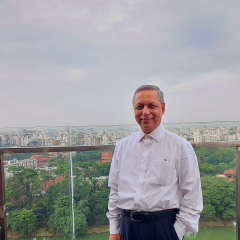
A Gafur is a Private Sector Professional and Writer, and Former Executive Director, The American Chamber of Commerce in Bangladesh (AmCham Bangladesh).