













































Did Bangladesh Export Its Gen-Z Revolution to India?
Political inspiration does not require identical conditions. What crossed the border was a template: Leaderless youth movement, social media satire as a weapon, a viral soundtrack, and a single figure to blame. Such templates do not need passports.
India's protest leaders say Dhaka showed them the way. The Indian government's reactions make a plausible connection impossible to ignore.
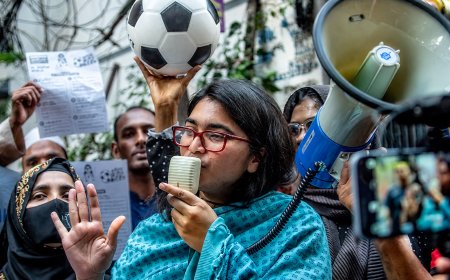
On October 15, a short video began circulating on Indian social media. In it, Neha Bora, the president of the All India Students' Association (AISA) and one of the most recognizable faces of the protests that have shaken New Delhi since the summer, spoke to the National Conference of Bangladesh's Socialist Students' Front.
Ms. Bora told the audience that the gen-z movement currently dominating Indian politics over recent months "first started in Bangladesh”. Before concluding her remarks with a “red salute”, the Indian student leader even went on to say, “Congratulations to you for showing us the way.”
The ruling Bharatiya Janata Party (BJP) started its media outburst within hours. Its national spokesperson, Pradeep Bhandari, reposted Ms. Bora’s clip with a one-line caption: "Open Admission of Regime Change!" He called Bora the "poster girl" of Indian opposition leader Rahul Gandhi and accused the Congress party of wanting to replicate in India what had happened in Bangladesh. Two days later, Bora was detained on her way to a rally.
It would be easy to dismiss the episode as one more round of India's polarized politics, with an activist overreaching and a government overreacting. That reading would, however, miss the fact that Bora was speaking with a clear purpose, as she was addressing a specific Bangladeshi audience while crediting a recent Bangladeshi event.
Therefore, the answer to the question of whether Bangladesh truly transshipped its gen-z protest to India would be lot closer to being affirmative than either India's government or its opposition wants to admit.
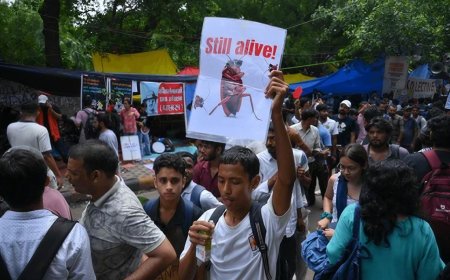
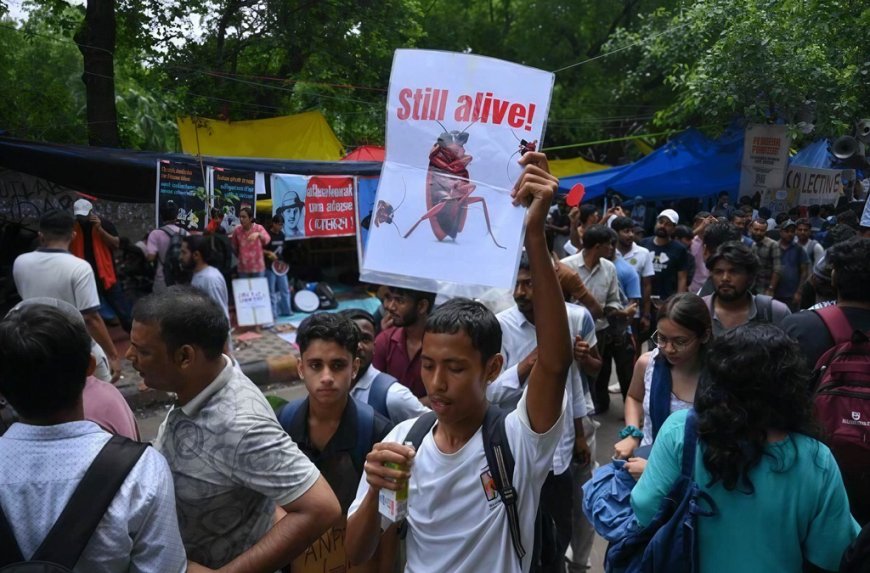
India's protest wave began as a satire. In May 2026, after a remark by the Indian Chief Justice was widely read as comparing unemployed young people to cockroaches, a political communications strategist named Abhijeet Dipke launched the "Cockroach Janta Party" online, a pun on the BJP's name.
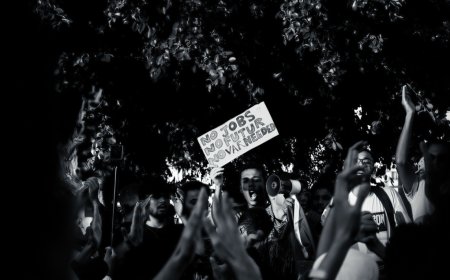
The joke soon turned into a popular political movement. Students started camping out protesting over paper leaks in the national medical entrance exam at Jantar Mantar, what used to be New Delhi's designated protest ground before the venue losing that designation on October 12.
Bora sat on a hunger strike there for more than three weeks alongside the climate activist Sonam Wangchuk. Education Minister Dharmendra Pradhan eventually resigned, a scalp that would have been unthinkable a year earlier.
Then the movement found a bigger target: The Election Commission's "special intensive revision" of voter rolls, which has removed more than 130 million names. Indian opposition says the purge favors Prime Minister Narendra Modi's party.
On October 10, the Cockroach Janata Party called a rally at Jantar Mantar once again. Delhi police refused permission.
Authorities cut mobile internet within a 4-kilometer radius, deployed tens of thousands of security personnel, shut dozens of metro stations, and detained protesters by the thousands.
One of the renowned protesters detained was Dhruv Rathee, one of India’s most recognizable YouTube commentators. About 50 police officers arrived at the YouTuber's home in Gurugram and detained him for about 18 hours preventing him from reaching the protest ground. A Delhi court a week later revived an eight-year-old defamation case against him and issued a bailable warrant.
Rathee's audience includes millions from Bangladesh as he introduced Bangladeshi gen-Z’s political struggles against the now-deposed Sheikh Hasina’s tyranny to his Indian audience. Some of Rathee’s widely distributed social media contents during the anti-Hasina uprising walked viewers through Bangladesh's jobs quota dispute, youth unemployment, the resulting student movement, police repression, and the overall authoritarianism of Sheikh Hasina's government.
Rathee also tried to explain the roots of anti-India sentiment in Bangladesh via his messaging, treating the phenomenon as more than a diplomatic spat. In effect, he gave Indian viewers a detailed account of how a Gen-Z movement brought down an entrenched South Asian dictator. Therefore, for Dhruv Rathee and his audience, the recent Indian protest movement is not too distant a leap from what happened in Bangladesh only two years ago.
Then there was the soundtrack.
At rallies and in reels across India in October, protesters have been singing and dancing to a Bangladeshi political song “Deshta Tomar Baaper Naki” -- which translates to "Is This Country Your Father's Property?"
The song’s target is not subtle, as it jabs at the inherited power of Sheikh Hasina, whose father was Bangladesh's founding president. Hasina was accused of running Bangladesh for 15 years without representative elections as a hybrid dictatorship -- something akin to a family estate.
The protest song was released by artists who regularly performed at rallies organized by the Bangladesh Nationalist Party (BNP), the leading opposition party that fought Sheikh Hasina’s dictatorship over a decade and a half, before she was eventually deposed by a student-led uprising.
During Bangladesh’s July 2024 uprising, that song became an anthem.
The song crossed the border almost immediately. Demonstrators in Kolkata, who are also native Bangla speakers, were singing that Bangla song at protests over the rape and murder of a doctor at R.G. Kar Medical College.
In Assam, a singer was detained in 2024 for posting a modified version, accused of stoking communal tension. On October 12 this year, the Congress party's Tripura unit posted a video on its verified Facebook page utilizing the song as its background music where Indian opposition lawmakers are seen marching towards the Supreme Court.
The irony of this song is hard to miss. The party of India’s Nehru-Gandhi dynasty is marching to a song that asks whose “father” owns the country. The song itself comes from the political stages of Bangladesh’s BNP, which now governs Bangladesh under the Prime Minister Tarique Rahman, whose father was a president of Bangladesh and whose mother was a prime minister at different eras.
The song transcended effortlessly among people with a shared language, a border, and common political realities.
India's political class noticed the unmistakable presence of Bangladeshi political props in Indian political theater.
Union Parliamentary Affairs Minister Kiren Rijiju alleged that a conspiracy like those in Bangladesh and France had been hatched in India, adding that its authors "forgot that India is neither Bangladesh nor France."
On October 19, Congress MP Shashi Tharoor responded with an echo: "India is not Bangladesh and India is not France." He insisted the Indian opposition wanted free and fair elections, not regime change, and supported only peaceful protests. His colleague Pawan Khera accused the BJP of recycling the "dangerous trope" of bringing up Bangladesh to discredit legitimate Indian grievances.
The same day, West Bengal Chief Minister Suvendu Adhikari accused communists and "cockroaches" of trying to create Bangladesh-style unrest in India. On October 21, Mr. Adhikari threatened those who share Bangladeshi social media narratives about Indian politics with arrests.
No one has yet produced any evidence that anyone in Dhaka organized India's protests. The movement's demands, including a credible voter roll and an accountable election commission, are the logical demands of people who still believe in elections.
For Ms. Bora, her “you [Bangladesh] showed us the way” remark became a political head-ache, and on October 23 she issued a clarification that she merely congratulated fellow socialists in Bangladesh and she does not endorse regime change operations in India.
India today is by no means like Bangladesh under Sheikh Hasina in the ways that count most. Governments in India still change at the ballot box, opposition parties run major states, and the country’s courts, however strained, remain a venue for redress.
But political inspiration does not require identical conditions. What crossed the border was a template: Leaderless youth movement, social media satire as a weapon, a viral soundtrack, and a single figure to blame. Such templates do not need passports.
Both the Indian government and the opposition seem to have accepted the comparison of Indian gen-z protests with that of Bangladesh’s as the frame of their arguments, even while denying it. The government invokes Bangladesh as a warning. The opposition invokes it as a strawman to knock down. The protest leaders, meanwhile, invoke it as a model.
Shafquat Rabbee is a Bangladeshi-American geopolitical columnist and social media commentator.