































![A Ledger of the Soul: Navigating the Allah-Bhagavant Nexus in a 19th-Century Puruṣākāra Jñāna Caupara [Gyan Chauper]](https://counterpointbd.com/uploads/images/202608/image_430x256_6a93baa3b09a7.jpg)


















The Bank Bailout Trap
According to the Finance Minister's statement in parliament, the government has already paid more than 80,000 crore taka and will have to pay another 100,000 crore taka in the future to maintain the Sammilito Islami Bank under the Bank Resolution Ordinance.
The public discourse around the newly legislated Bank Resolution Act, particularly the Section 18(a), appears to be a gross simplification of a highly complex issue.
According to public perception, the new act allows the return of the Sammilito Islami Bank -- formed by merging five weak banks through the Banking Resolution Ordinance of the interim administration -- to its old owners, especially to S Alam.
Sheikh Hasina's cashier S Alam has looted nearly Tk 100,000 crore from the banking sector. Returning the looted banks to S Alam would be as immoral and preposterous as marrying the rape victim to the rapist. This mechanism would be contrary to restoring discipline in the banking sector.
However, the idea that the amendment made to Section 18(a) of the Banking Resolution Bill 2026 was specifically brought to bring back S Alam is misinformed.
This is a highly nuanced and complex issue.
A contrarian perspective is that, ignoring the advice of the World Bank and many economists, the previous governor of the central bank effectively nationalized the bankrupt banks and shifted the burden of the bank looting that occurred during the Hasina regime onto the people of Bangladesh through the public finances.
To protect the public purse from this, some critical corrections were needed in this ordinance, because the Sammlito Islami Bank is creating a very big problem that no one is talking about.
The conventional wisdom is that the bravest step taken by the interim government to restore discipline in the banking sector was the Banking Resolution Ordinance 2025 -- merging five banks and removing ownership from the sponsor directors responsible for destroying them.
As a result, when converting this ordinance into a law, the provision that allows old shareholders to regain ownership by paying 7.5% of the state's invested money upfront and the remaining 92.5% within two years is being portrayed as something that S Alam will definitely use. The problem is that this narrative is only a fraction of the story.
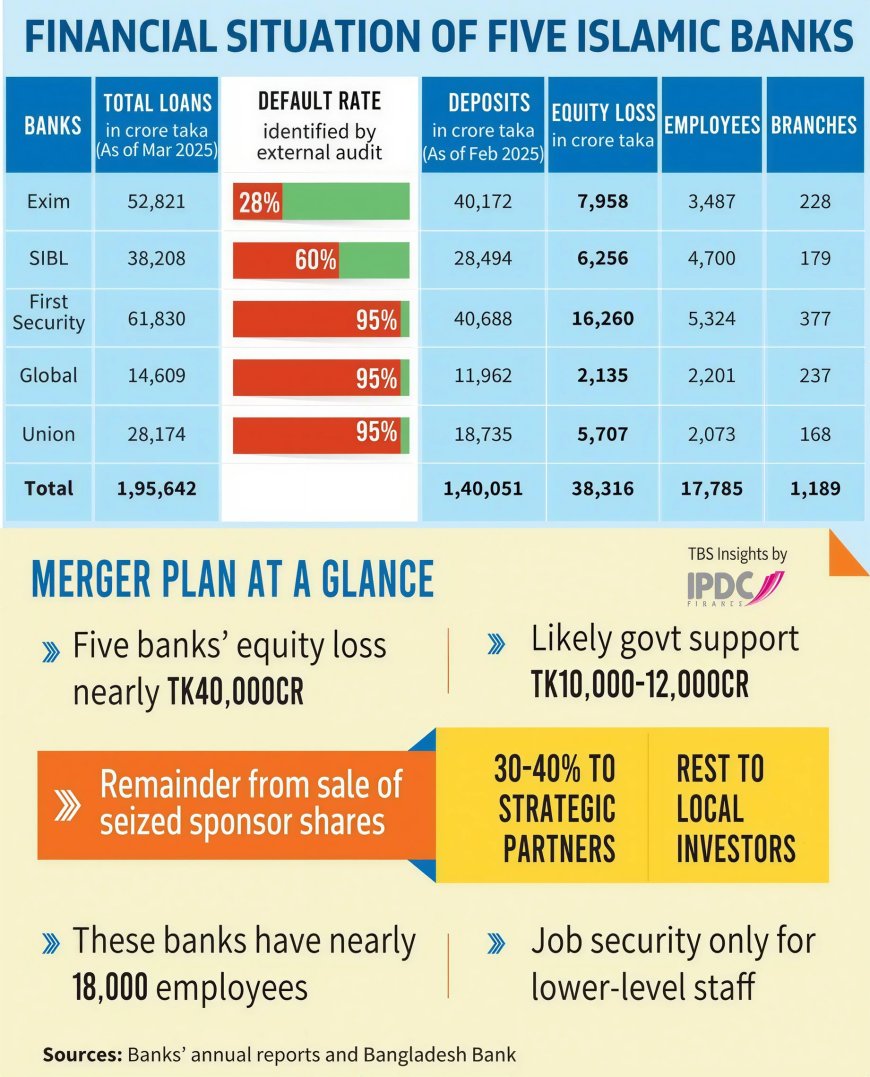
These five banks are all bankrupt. The net asset value of the banks is negative and the accounting equity is zero. That is, the liabilities of these banks exceed their assets. So when the previous governor merged these five banks and created Bangladesh's first state-owned Islamic bank, he essentially nationalized some bankrupt banks. Through this, he shifted the burden of repaying 142,000 crore taka in deposits belonging to 7.5 million depositors of these looted banks onto the state.
Against this 142,000 crore taka in deposits, there are 193,000 crore taka in loans outstanding, 90% of which are now non-performing. Without recovering these loans, 35,000 crore taka was required from the public coffers in the interim period alone to repay this 142,000 crore, and in the future, the people will have to pay more than 100,000 crore taka.
And my reading is that the government does not want that; the government wants to sell the banks and keep the door open for the old shareholders in that process. That is the essence of the amendment made to the Banking Resolution Bill 2026.
Yes, theoretically, this has paved the way for S Alam or Nazrul Islam to return. But that is only one part of the story, and arguably not even the main part.
In fact, the fiscal part is much scarier. Let me demonstrate.
According to the Finance Minister's statement in parliament, the government has already paid more than 80,000 crore taka and will have to pay another 100,000 crore taka in the future to maintain the Sammilito Islami Bank under the Bank Resolution Ordinance.
If the government had continued the interim policy, the amount that would have to be paid to recover these looted and destroyed banks could be upto a quarter of the government's revenue, or nearly 2% of GDP.
In the current situation, this government simply cannot afford it.
Clearly, the government does not want to pay this money, and given the state of revenue mobilization and expenditure needs, it is not possible to pay this money without either racking up debt or risking inflation.
Realistically then, the government has four options:
- Continue the Banking Resolution Order as per the interim plan and provide 100,000 crore taka in refinancing to the currently nationalized banks -- which is not possible given the current fiscal situation.
- Dissolve the banks and, according to Bangladesh Bank's regulations, first repay the depositors (insurance of 200,000 taka per depositor), then the creditors, and then the shareholders. As a result, depositors and capital market shareholders will lose almost everything, and the political cost of this is something the interim government did not have the courage to bear, and BNP also does not.
- Sell the banks anew. The question is, who will buy these banks if there is no government payment guarantee? Because the net asset value of all these banks is negative.
- None of these three options seemed acceptable or viable to the government. Because the government cannot afford to pay another 100,000 crore taka, nor does it want to face the anger of depositors by declaring the banks bankrupt, and no investor will be interested in buying these banks because their net asset value is negative. Therefore, the government has thought that the least bad option is to create a mechanism to return the banks to the old owners and impose some tough conditions on them.
These conditions are:
- All money provided by the government or Bangladesh Bank before or after the resolution must be repaid.
- New capital must be injected as determined by Bangladesh Bank and existing capital shortfalls must be filled.
- All loans, interest, equity, guarantees, and other assistance provided by the government, Bangladesh Bank, or other government and semi-government agencies must be fully repaid.
- Legitimate claims of depositors and domestic-foreign creditors existing before the merger must be settled.
- All tax and non-tax revenues must be paid.
Additional conditions will include:
- Compensation must be paid to those affected during the resolution period.
- Restrictions on share transfer or sale must be followed until the specified time.
- The bank's governance, risk management, and compliance structure must be restructured
If someone buys the banks by fulfilling these conditions, then according to sub-section (3) of the resolution, they must pay 7.5% of the money provided by the government or Bangladesh Bank upfront and repay the remaining 92.5% within two years along with 10% simple interest.
So what BNP is doing is creating a legal mechanism through this Banking Resolution Ordinance to free the state from the burden of payments to millions of people created by the state-owned bank formed through the ordinance, and to fully return the bank's shares, assets, and liabilities to the old owners and shareholders.
Zia Hassan is a member of the Citizens Coalition.