









































































Bangladesh at the Bottom
A lost generation is not necessarily one without ability. It can be a generation denied the opportunity to turn ability into ownership, influence and prosperity. We must not allow that to become our children's story.

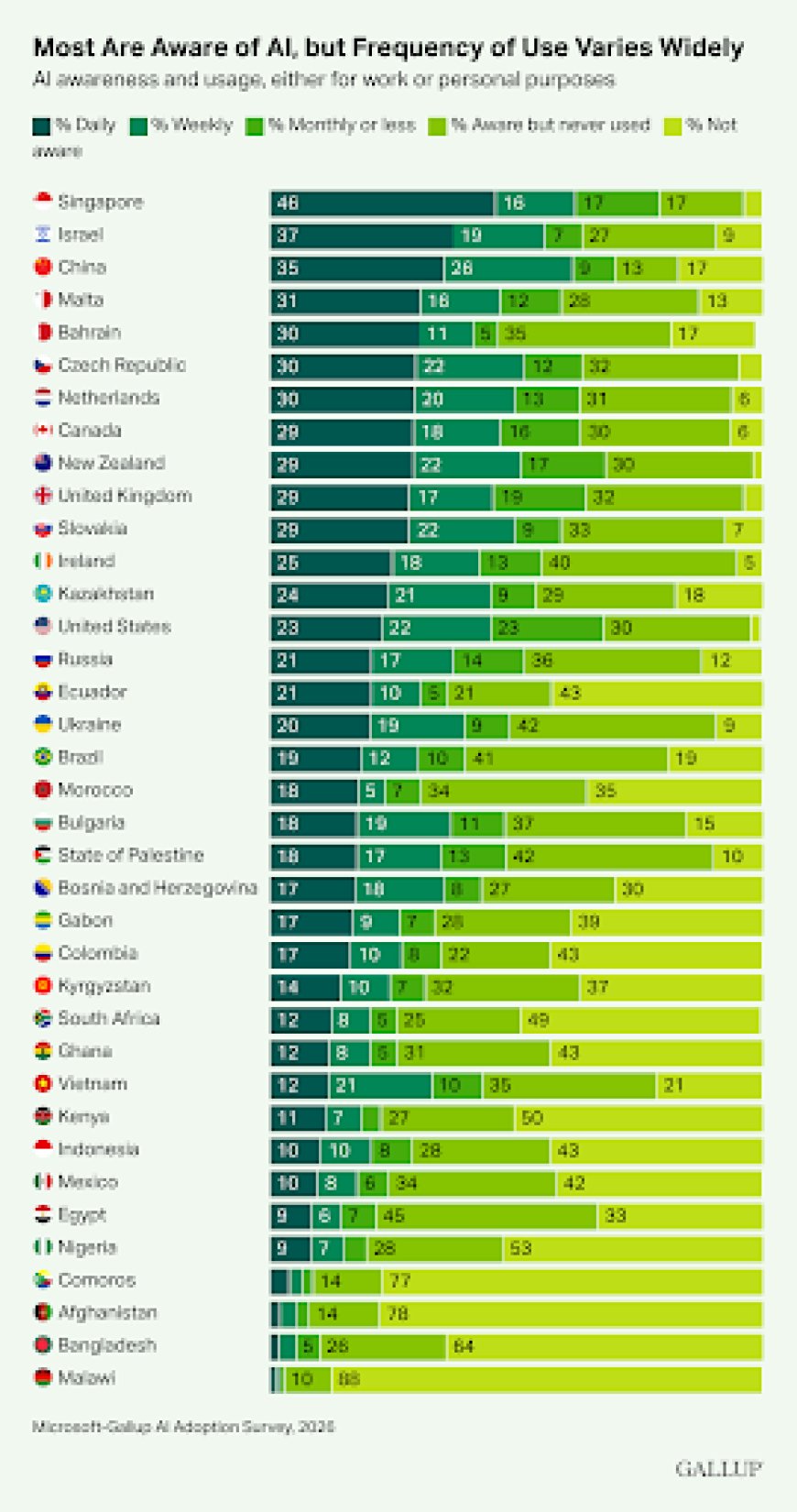
Look at the first accompanying chart. Start at the bottom.
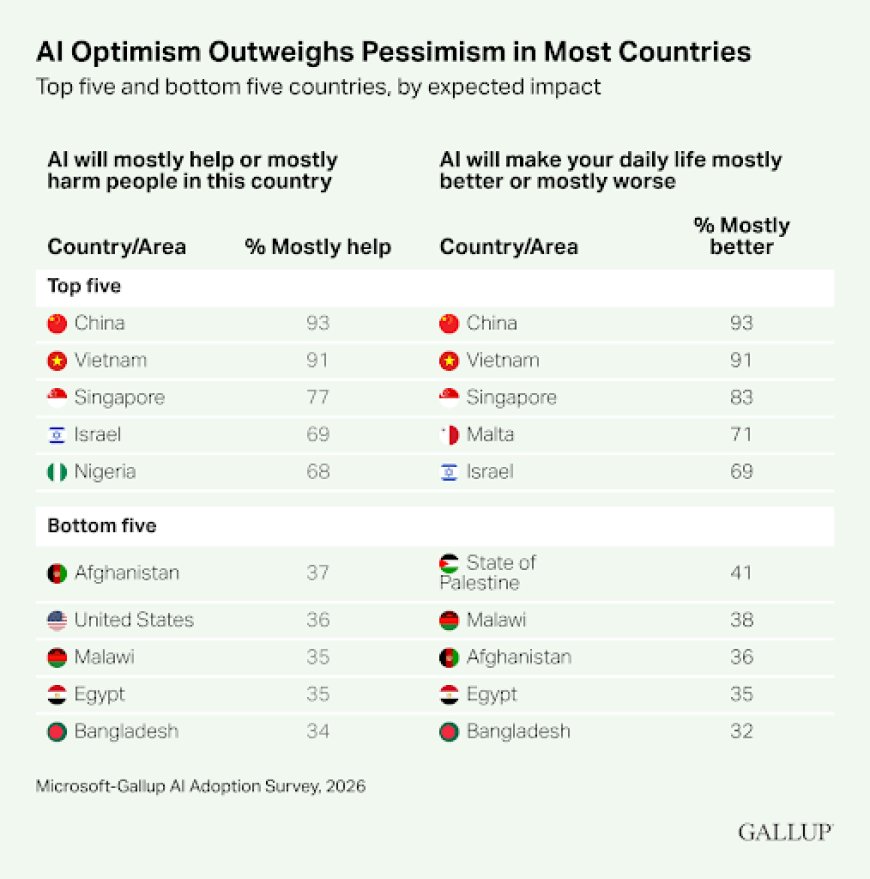
Bangladesh appears there twice.
In the Microsoft-Gallup survey published in September, just 34% of Bangladeshis who were aware of artificial intelligence expected it to mostly benefit their country. Only 32% expected it to improve their daily lives. These were the lowest figures among the 37 countries surveyed. In Vietnam, both figures were 91%.
This is not a ranking of intelligence or talent. It is a ranking of expectations. That makes our position particularly painful.
Now examine the second chart. 64% of Bangladeshi adults were unaware of AI. Another 26% knew about it but had never used it. Roughly nine in ten, then, had no reported experience of using this technology.
One chart reveals exclusion. The other reveals how little benefit those who know about AI expect from it.
Our technology leaders should study both before delivering another speech about the future.
When an entire sector inspires so little confidence, we should stop treating the result as a referendum on technology alone. It is also a referendum on the competence, priorities and character of its leadership.
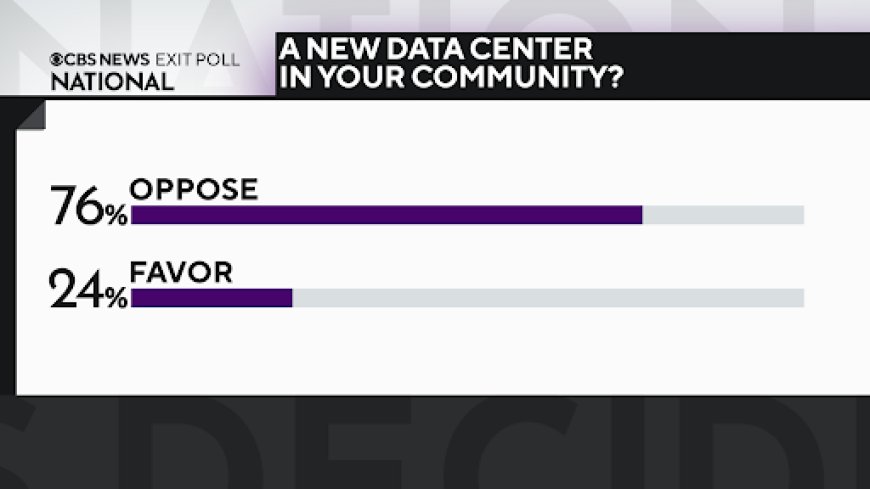
The recent American midterms offer a related warning. Opposition to AI data centers helped shape campaigns, and candidates promising restrictions won important races. That does not establish that voters rejected artificial intelligence itself.
A parent can appreciate a powerful tool while distrusting the people deciding how it will affect her children. A worker can use AI while questioning who will receive its rewards. Opposition need not mean hatred of innovation. It can mean refusing to entrust the future to leaders who have not earned that trust.
Bangladesh should recognize this distinction.
Our problem is not a shortage of patriotic slogans about technology. It is the gulf between the promises made in our name and the opportunities placed within our reach.
Consider the history. Academic accounts describe Bangladesh rejecting early submarine-cable connections amid fears about exposing state secrets. Technological ignorance was dressed in the language of national security.
Later governments learned to celebrate technology. Celebration, unfortunately, was not the same as competence.
The corruption allegations surrounding Aspire to Innovate, or a2i, are instructive.
In February 2025, the Anti-Corruption Commission reported preliminary evidence of irregularities involving contract awards, project approvals and invoices. These are allegations requiring due process, not permission to declare everyone guilty. They nevertheless demand something more substantial than another institutional rebranding.
Public money is supposed to purchase public capability. When procurement becomes the achievement, citizens have every reason to ask whose future is being financed.
One counterexample deserves particular attention: Enhancement of Bangla Language in ICT through Research and Development, or EBLICT (an initiative led by, among others, eminent technologist Muhammed Zafar Iqbal).
The project has developed Bangla language tools and resources, including speech technology and text recognition, while supporting research around problems rooted in our own language. For me, the most important legacy is the community of AI researchers and engineers such efforts help nurture.
Software matters. People who can build the next generation of software matter even more.
That should have been the organizing principle of our technology policy: Develop expertise, give talented people meaningful problems, and leave behind knowledge that outlasts a minister.
A laboratory that teaches students to solve difficult problems is worth more than a showroom that teaches visitors to admire equipment nobody has learned to use properly.
Instead, these charts confront us with the possibility of another generation watching a technological revolution from outside.
Consider what these expectations could mean for a young Bangladeshi deciding whether there is room for her in the emerging economy.
Does she see herself as a researcher, an entrepreneur, an owner? Or merely as someone whose work will be reorganized by technologies developed elsewhere?
A lost generation is not necessarily one without ability. It can be a generation denied the opportunity to turn ability into ownership, influence and prosperity.
We must not allow that to become our children's story.
Nor should we comfort ourselves that, being last, any change must improve matters. Bad leadership can always find new ways to waste an opportunity. This ranking gives us not a guarantee of improvement, but an urgent reason to demand it.
Begin with transparent research funding and independently audited procurement. Put computing resources within reach of universities and small businesses. Support Bangla tools that teachers, students, and workers can actually use. Judge training by demonstrated skills, not certificates distributed.
Give young researchers paid opportunities to build. Give entrepreneurs fair access without political sponsorship. Give citizens evidence that public investment serves them.
And choose technology leaders for what they understand and whom they serve, not whom they flatter.
Most importantly, buy from honest, serious Bangladeshi technology companies, even if that means bureaucrats will have to refrain from corruption. I know I am asking for a lot.
I urge our politicians, civil servants, academics, entrepreneurs and technology professionals to treat these charts as a summons. Our task is not to persuade Bangladeshis to give more optimistic answers next time. It is to build a country in which optimism has a rational foundation.
We cannot reclaim every squandered opportunity. We can still refuse to squander this one.
For the sake of our children.
Omar Shehab is a theoretical quantum computer scientist.