






































































The Cat Who Wasn't Impressed
The images of her with the cat and the milk aren't just pictures. They are a manifesto for a very specific kind of dignified living -- a life where glamour and domestic intimacy sit side-by-side, looking off into the middle distance, accepting the world exactly as it is.
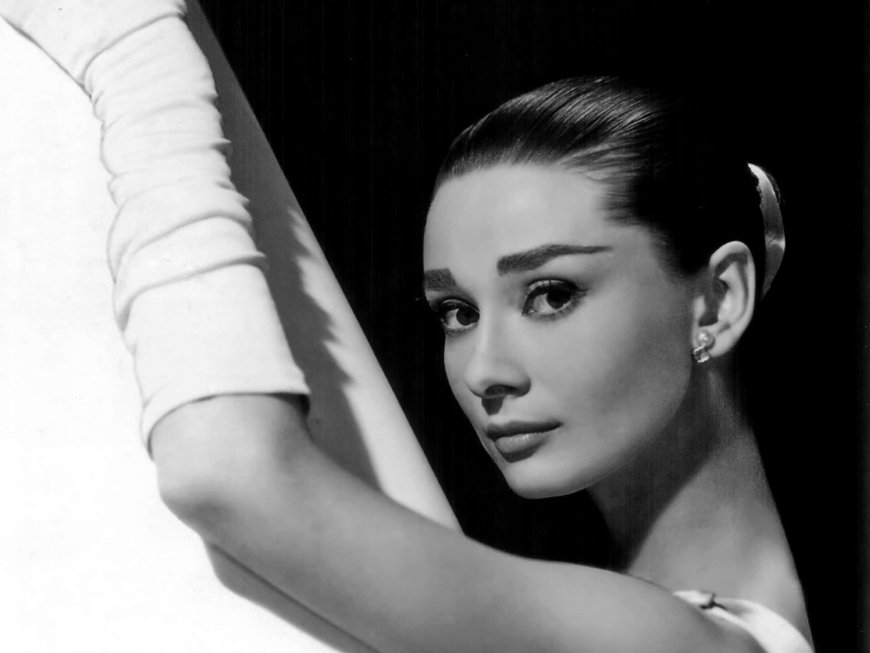
There is a quiet, vast blue behind her. In the first photograph, she is perched on a weathered crate of rough, splintered wood -- something about it looks like the end of a dock in a dream. Her hair is a pillar of teased, elegant honey. Her eyes are steady, dark, and impossibly calm. And there, resting beside a glass of chalk-white milk, is a ginger tabby cat with a perfectly unimpressed expression.
I have stared at this image for years.

In the second photo, just one frame later in the studio, the cat has shifted. Her hands are draped around its neck, intimate and easy. The facial expression is the same -- nonchalance incarnate. It is Audrey Hepburn at her most essential.
If I am honest, I have carried a quiet, unspoken crush on this image for as long as I remember discovering cinema. But over time, the feeling has transformed, deepened, and revealed itself as something far more fragile.
We say these names -- Hepburn, Garbo, Suchitra -- like deities. But what are we really saying? French philosopher Jean Baudrillard argued that in our hyperreal world, the image has consumed the original object entirely. The real Audrey Hepburn was a woman: She had arguments, she wore worn-out socks, she broke down in the middle of the night like the rest of us. But that messy, breathing creature has been erased. What remains is a pure sign -- a constellation of graceful gestures, a specific tilt of the jaw, the silhouette of a black dress against a blank slate.
In loving this image, am I loving a human? Or am I loving a beautifully rendered, impossible perfection -- a shimmering sign of grace?
When I try to explain this to myself, I have to shift registers. I have to put down the heavy philosophy for a moment and let the music begin in the space between my ears.
First, there is the cat. The ginger tabby, with his scruffy fur and his gaze fixed somewhere just left of the lens. He is not collaborating in the creation of a goddess. He is simply there, warm, indifferent, present. There is something softly hallucinogenic about this arrangement -- a chalice of milk on a splintered crate, a woman in a black dress, and a pet who looks as though he has signed no contract, agreed to no mythology.
It has the texture of a lullaby glimpsed through a half-closed eye. It is the sound of a world that refuses to take itself too seriously -- a honeyed, drifting, strangely intimate melody that invites you to lean your head against a stranger's shoulder and let the heavy minutes of the day dissolve.
If the cat carries the whimsical chord, the blue holds the deeper one. Behind her, the canvas is a perfect, studio-engineered shade -- a blue that seems to belong equally to dawn, dusk, and the lonely hour before a long goodbye. Her eyes have an unusual stillness. It is not static; it is a waiting. Not for anything in particular, but for a silver thread of memory to carry something lost down its gentle current. That look -- the one she held through the labyrinth of the lens -- has the quality of an old song you can't quite place. It doesn't demand tears. But it holds your hand while you shed them anyway.
And then, there is the gap. Between the first photograph and the second photograph, in the brief slice of seconds when the shutter lifted and fell again, something happened. The cat shifted. The arm relaxed. The world continued. But in that narrow, liminal space -- the cut between two frames -- a cool, turning chord hangs unresolved. It is a note that never quite lands. A drift. A suspended breath. It is the place where the mind stops admiring the surface and begins to ask the uncomfortable question.
French psychoanalyst Jacques Lacan spoke of the "Mirror Stage". As a baby, looking into a mirror, you see a whole, coherent image of yourself. But your internal feelings remain fragmented and messy. The "crush" on a screen goddess is a projection. I am not looking at Audrey Hepburn. I am looking at the version of myself that exists in this perfectly lit, perfectly composed mirror of her image.
And novelist Marcel Proust, in his labyrinthine exploration of love, said something I will never forget: We never fall in love with a person. We fall in love with an idea that the person triggers. They are just the accidental vessel for a constellation of virtues we already carry inside ourselves.
So, when I "love" her, here is the truth I have finally made peace with: I do not love the woman who grew old in Switzerland. I do not love the woman who suffered in war as a child. I do not love the woman who struggled with her own private demons and heartbreak.
I love the idea of a quiet, untouchable grace that her image allows me to temporarily borrow.
This is the "person you wish to become." Not her. The shimmering possibility of a life that contains that composure, that lightness, that kindness which shows up in her smile. The images of her with the cat and the milk aren't just pictures. They are a manifesto for a very specific kind of dignified living -- a life where glamour and domestic intimacy sit side-by-side, looking off into the middle distance, accepting the world exactly as it is.
So, is my crush a fantasy?
If fantasy means believing I could physically meet her? Yes. That is a fantasy, because she is no longer alive. Furthermore, as Baudrillard would dryly point out, the Sign of Hepburn has long since replaced the biological woman.
But if fantasy means inventing a part of myself that doesn't exist? Then no. The feeling is remarkably, grounding-ly real. It is a quiet, daily, stubborn compass that points toward the virtues I want to manifest in my own body, my own life, my own quiet mornings.
The cat still looks unimpressed. The milk is still milky. And she is looking right at the lens, right at me, with that perfect, symmetrical face.
She is not asking me to love her.
She is inviting me to recognize what she represents. And I am accepting the invitation.
Because that is the only kind of crush worth having -- one that never leaves the realm of the possible.
Zakir Kibria is a Bangladeshi writer, policy analyst and entrepreneur based in Kathmandu, Nepal. His email address is [email protected]