


















































Red Dust on a Clean Screen
To remain silent under the pretext of “not being close enough” is not humility. It is an abdication of awareness. The burden of witnessing belongs to anyone willing to look.

On August 9, when my article “Beautiful Lies” went live on this platform, it sparked a question about the diaspora writing about the raw realities of Bangladesh.
An acquaintance of mine read the article and questioned me: What can I really change by writing from the comfort of my home thousands of miles away?
My initial instinct was to ignore the comment altogether. Then, I decided to respond to the critique with a follow-up article. It might not be the perfect answer.
It is simply an explanation to those who, on occasion, write to me with questions about my authenticity. This is not the first time someone has questioned it. It goes back to 2009 when Counterpoint’s editor Zafar Sobhan was my editor in another newspaper.
I remember writing a Counterpoint essay where I addressed this exact issue. 17 years on, it was a déjà vu moment once again. The same question: Whether using descriptive images about the raw realities of the Bangladeshi poor brings me catharsis.
In other words, do I do it to ease my conscience, or are my essays supposed to act as a mirror to society? How genuine is my anguish about the poor from a temperature-controlled room?
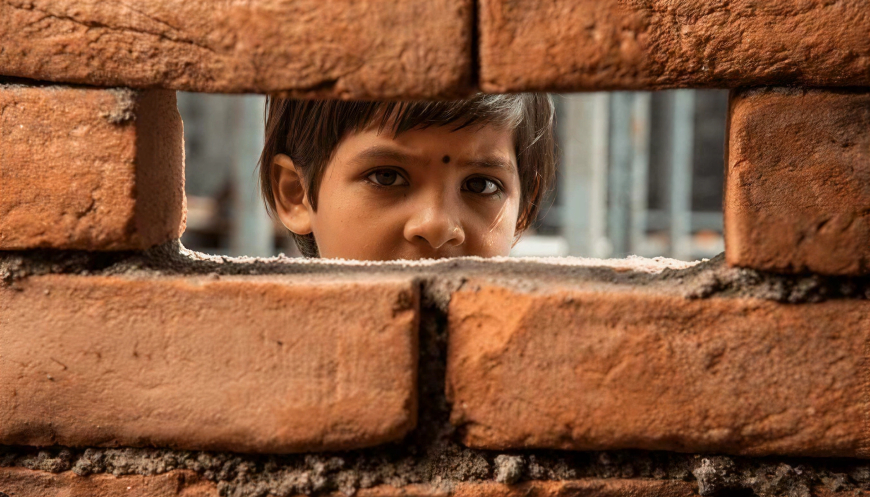
This article is also a refusal to let the debate about my identity turn into a distraction from a real human crisis of a brick kiln (that I touched on in my article of August 9)
As a diaspora contributor, I am not really obligated to defend my authenticity or litigate my distance from home. My geographic location is a fact, not a flaw. I am explaining because I do not want anyone writing to me demanding answers about identity and authenticity.
I have never identified myself as a hyphenated American for deeply philosophical reasons. I always introduce myself as a “Bangladeshi” living in America. I am tired of the “diaspora writer” badge because it is a restrictive label that forces me to defend my identity. Sometimes I feel I am treated as an “outsider” who must prove that I am “authentic” enough to speak about my own country.
The label not so subtly suggests that living outside of Bangladesh, my memory, empathy, and cultural understanding have somehow expired. Such critics assume that proximity equals purity.
They simply ignore the fact that distance can sometimes provide sharper and uncompromised perspectives on the nation’s failure in protecting the poor. These same groups expect that if one is writing from another part of the world, they should only focus on specific, predictable themes -- immigrant nostalgia, homesickness, assimilation, or identity crisis.
But when you choose to write about global capitalism, labor exploitation, and human dignity, you are laughed at behind your back with comments like, “What do they understand from afar?”
I reject the defense of these badges, but writing this essay because the discomfort of my safety demands an honest accounting. I am not part of social media platforms that turn human lives into frictionless scrolls.
I find modern technology flattens global inequality into a smooth experience for the observer. Yet images find me anyway. Last night, I saw an image and the location tag read Gazipur, Dhaka.
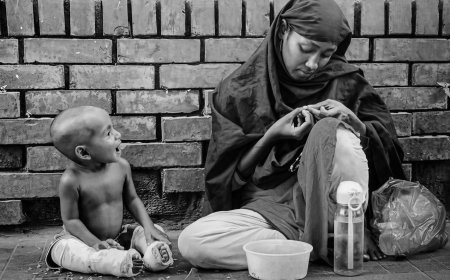
The image showed a brick crushing site where a young mother with a calloused hand was crushing bricks with a heavy iron hammer. Two feet away, her infant daughter lay curled inside a tokri (bamboo basket) wrapped in a hand-stitched, torn kantha.
In her makeshift cradle, she was swallowing the same smoky red air as her mother. Was I supposed to simply look away, saying: “There is nothing I can do to change the reality?"
Writing about this suffering child inhaling red silica dust is not to validate her existence through my privilege. I do it to dismantle the comfortable apathy of those who look away.
The alternative is the ultimate so-called “privileged” life abroad. I always have the choice to press the button, lock the screen, and make that scene at the brick crushing site vanish into the dark glass.
To do so is an act of silent complicity, agreeing that the life of the child and her mother are disposable data. By dismissing the critics, I push the conversation back to the reality of the crisis and shift the ethical burden where it belongs.
The question should be why the world permits a reality where a little child must inhale red dust? It should not be about whether I have the right to look so that others can debate the boundaries of who gets to speak.
When diaspora writers are criticized, the focus shifts away from the child whose lungs are getting destroyed. It gets into a debate about who holds what color passport.
As a result, some might get distracted from writing about the issues one deeply cares about. After many years of writing for Bangladeshi media, I know exactly what the real intent behind such comments is.
In my view, the tension stems from an underlying conflict over economic escape and narrative ownership. Critics in the homeland often point out that most diaspora writers were never poor enough to understand the suffering of the poor when they lived in their native country.
To some of the local readers, an expat perhaps only observed poverty from a car window. Criticizing someone who is writing from oceans away is a convenient shield to look away from the actual problem by focusing on the writer instead.
I have learned not to be distracted by these sweeping generalizations about geography. By stepping entirely outside this authenticity trap, I choose to place the conversation back to its rightful place: In the hearts and conscience of empathetic people who refuse to look away from human suffering.
I point out simply by asking a question: Why does a globalized economy permit a child to sleep surrounded by brick dust? That is the issue here. The geography of a person who points it out should not be ridiculed in any way.
No one should raise a question about who has the right to speak. This image I saw should be deeply alarming to anyone. Brick dust is incredibly dangerous for anyone, but it is catastrophic for the developing body of a child. It contains fine silica and toxic materials.
The blame is entirely on a system that builds skyscrapers on the broken health of the children in poor families. To blame an expat observer for the tragedy she saw on the screen is a grotesque misdirection of guilt.
From 1,000 of miles away, she did not hand a hammer to that young mother to choke her with terracotta dust. She is not responsible for such outcomes. The system is.
Research shows that when a baby breathes this in, the sharp dust cuts deep into their highly fragile lung tissue, causing severe respiratory distress, chronic wheezing, and a high risk of pneumonia.
While poverty forces a mother to work in risky conditions, unregulated business owners are directly to blame for the baby’s risk. Contractors profit from cheap labor while refusing to provide safe, shaded areas or basic child safety zones.
This exploitation of informal workers is enabled because of weak government enforcement, as national labor laws fail to monitor such work sites.
These mothers are left with impossible choices as there are no state-subsidized daycares for low-income laborers.
Such families usually live in the slum and therefore cannot leave their very young children or babies unattended. So mothers bring their babies to hazardous zones.
A day laborer starts her 9-hour day under the morning sun, and her baby sleeps a couple of feet away, inhaling the toxic dust. She works grueling hours to earn approximately $25 a month. And the child is still inhaling the rust-colored haze.
Without strict penalties, owners face no consequences for letting infants sleep in toxic dust. The image of shattered bricks represents human fragility, broken plans, or a life fractured by suffering and hardship.
The government should not look away from this image or use development narratives of a developing economy as a justification.
No human being should have to endure such a physical toll just to achieve basic survival.
I am not a policy analyst and therefore not debating macroeconomic statistics. I am just sounding the alarm. At some point, I will write an in-depth essay about this suffering child. Her presence on my screen has punctured the grand illusions of progress that Bangladesh boasts about.
To remain silent under the pretext of “not being close enough” is not humility. It is an abdication of awareness. The burden of witnessing belongs to anyone willing to look.
The red dust of that brick kiln has settled on the glass of my mobile screen. It will stay there for a long time.
Therefore, I refuse to let my own comfort make this image invisible. It is not to save the child; it is to force myself and others who read it to sit uncomfortably bearing the image of the mother and child in the dirt.
There will always be debates about whether a diaspora writer should write about their home country’s economic and social issues, and who has the right to look or speak.
To those who question the distance, I say -- After all, art knows no borders. A writer’s only true boundary is the depth of their empathy.
So, I will keep writing. Not because my words can cure poverty, but because the dust of manufactured poverty cuts right through the glass of the phone.
Looking away is a luxury I refuse to give in to. A writer’s artistic freedom means if the red dust lands on my phone screen, I have every right to pick up my pen.
Zeenat Khan is a regular contributor to South Asia based journals and literary magazines.