






































![A Ledger of the Soul: Navigating the Allah-Bhagavant Nexus in a 19th-Century Puruṣākāra Jñāna Caupara [Gyan Chauper]](https://counterpointbd.com/uploads/images/202608/image_430x256_6a93baa3b09a7.jpg)





















How Bangladesh Can Shield Itself from the Next LNG Shock
Energy security therefore needs to be considered not simply as an energy sector issue, but as an important component of Bangladesh's broader economic security.

For more than two decades, I have worked across the North American energy industry. My work has ranged from expanding energy markets and structuring complex transactions to commodity trading and managing a thermal power portfolio valued at more than $1 billion.
Today, I advise natural gas producers, power generators, pipelines, and large industrial energy users on fuel supply, transportation, transaction structuring, deal origination, and asset management.
That experience has reinforced a simple principle: Energy security is not just about securing the lowest price. It is about creating a portfolio that can withstand the unexpected.
For Bangladesh, the events of 2026 have made that lesson particularly relevant.
A Global Energy Crisis Has Become a Bangladesh Economic Issue
The latest conflict in the Middle East has again demonstrated how quickly geo-politics can become an energy-security and economic crisis.
The International Energy Agency estimates that disruptions following the effective closure of the Strait of Hormuz temporarily removed almost 20% of global LNG supply.
Asian LNG prices surged, and the IEA says second-quarter Asian spot LNG prices averaged approximately $17.50 per MMBtu -- 45% higher than a year earlier. For Asian economies dependent on imported energy, the consequences extend well beyond the gas market.
Higher LNG prices increase electricity-generation costs, industrial production costs, government subsidy requirements, and demand for foreign currency.
Energy shortages can constrain manufacturing precisely when economies need reliable and affordable power to grow.
Bangladesh is particularly exposed. The World Bank expects Bangladesh's economic growth to slow to 3.9% in FY2026 and has warned that a prolonged Middle East conflict could contribute to higher inflation, reduced fiscal space through higher energy subsidies, and pressure on the current account through higher import costs.
Energy security therefore needs to be considered not simply as an energy sector issue, but as an important component of Bangladesh's broader economic security.
Natural Gas Remains Critical to Bangladesh
Bangladesh has historically built a substantial part of its economy around natural gas.
According to Petrobangla documentation, natural gas -- including domestic production and imported LNG -- meets approximately 50-55% of the country's primary energy demand. Domestic reserves, however, have been declining as producing fields mature.
Bangladesh consequently began importing LNG in 2018 and entered the spot market in 2020. Imported LNG now accounts for more than one-quarter of Bangladesh's total gas consumption.
Approximately 42% of the country's gas consumption goes to the power sector. That means an LNG shortage can quickly become an electricity shortage, an industrial problem, and ultimately an economic problem.
The strategic question is therefore no longer whether Bangladesh needs LNG.
The more important question is: How should Bangladesh build an LNG portfolio that provides security, affordability, and flexibility over the next 15–20 years?
How Bangladesh Buys LNG Today
Bangladesh essentially obtains LNG through two channels. The first is long-term supply contracts.
These provide committed volumes over many years and typically use a pricing formula linked to an established commodity benchmark.
Bangladesh has long-term arrangements involving QatarEnergy and OQ Trading. More recent contracts include additional supply from QatarEnergy of up to 1.8 million tons per annum for 15 years, OQ Trading for up to 1.5M tons per annum for ten years, and Excelerate Energy for up to approximately 1M tons annually for 15 years.
The second channel is the spot market.
Spot LNG provides valuable flexibility. When demand unexpectedly increases or contracted supply is insufficient, Petrobangla can purchase individual cargoes through competitive procurement.
But flexibility comes with a risk: The buyer is exposed to whatever the international LNG market happens to be charging when the cargo is needed.
The current crisis demonstrates that risk dramatically.
The Cost of Being Forced Into the Spot Market
Qatar supplied approximately 4.15M tons -- around 60% -- of Bangladesh's nearly 7M tons of LNG import capacity in 2025.
Following the Middle East conflict and disruption of Qatari LNG exports, QatarEnergy reduced its scheduled 2026 deliveries to Bangladesh by approximately half. Bangladesh subsequently had to increase spot purchases substantially.
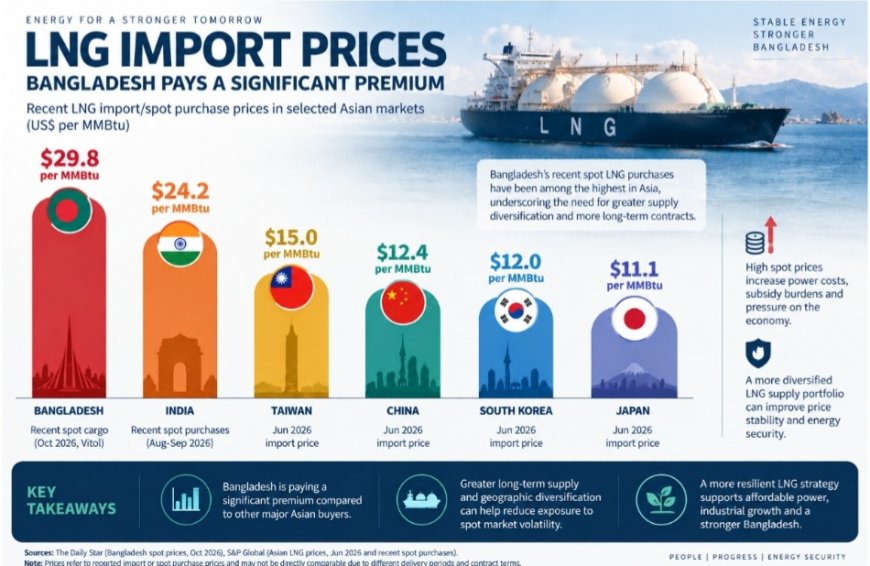
The financial consequences have been significant. Bangladesh recently approved October-delivery spot cargoes from Vitol at $29.795/MMBtu and TotalEnergies at $28.95/MMBtu. A standard cargo at those prices costs approximately Tk 1,200-1,230 crore.
By comparison, Indian buyers recently purchased prompt cargoes around the low-$20s/MMBtu. Japan's average LNG import price was $11.13/MMBtu in June, South Korea's $11.96, China's $12.44, and Taiwan's $15.00.
These numbers should not be interpreted as identical transactions -- some represent spot cargoes while others represent average landed prices, and the delivery periods differ.
But they illustrate an important point: Buyers with diversified portfolios and substantial long-term contracted supply are generally less dependent on purchasing marginal cargoes during periods of extreme market stress.
Geography Matters as Much as Price
Bangladesh's existing LNG portfolio has considerable Middle Eastern exposure.
That has historically been commercially logical. Qatar is one of the world's largest and most competitive LNG producers, is geographically well positioned for South Asia and has been a major reliable supplier to the global LNG market.
The objective should not be to replace Qatar. It should be to ensure that a disruption involving one producing region or transportation corridor cannot disproportionately affect Bangladesh's entire LNG portfolio.
Qatari LNG destined for Bangladesh leaves Ras Laffan, transits the Strait of Hormuz, crosses the Arabian Sea and Indian Ocean and enters the Bay of Bengal before reaching Bangladesh.
Approximately one-fifth of global LNG supply normally passes through Hormuz.
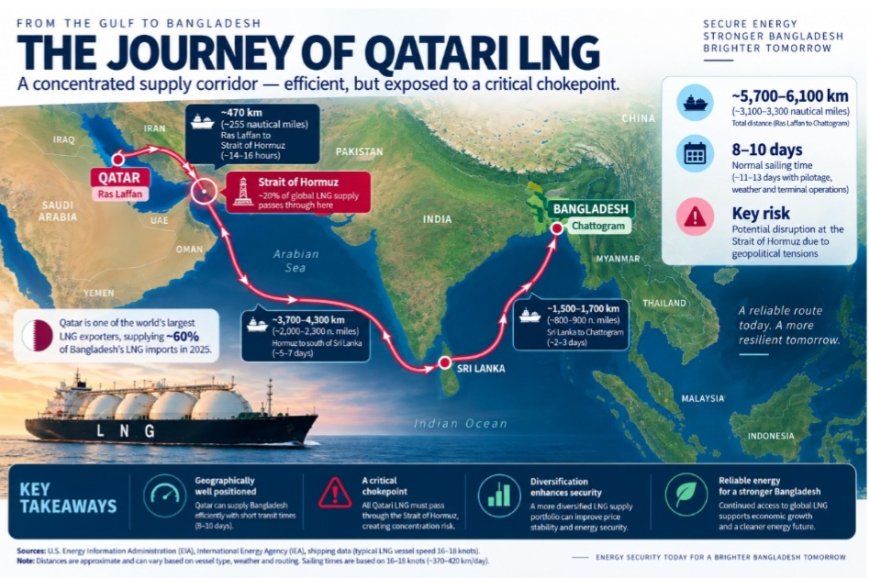
There is an important distinction: Omani LNG exported from Qalhat lies outside the Strait of Hormuz.
Therefore, not every Middle Eastern cargo carries identical chokepoint exposure. Nevertheless, Bangladesh's experience in 2026 demonstrates why geographic diversification has real economic value.
What Other LNG Buyers Are Doing
Bangladesh does not need to invent a new energy-security strategy. Large LNG-consuming economies are already demonstrating it.
China, for example, has developed supply relationships across Australia, Qatar, Russia, Malaysia, the United States and other producing regions.
In 2024, its largest suppliers included Australia at 34%, Qatar at 24%, Russia at 11%, Malaysia at 10%, and the United States at 5.5%. India's response to the current Middle East disruption provides an even more immediate example.
As Qatari and UAE supplies were disrupted, India significantly increased purchases from the United States, Nigeria, Oman and Angola. In May, the United States became India's largest LNG source.
The lesson is straightforward. A resilient LNG portfolio should diversify three things: Supplier. Geography. Pricing index. Bangladesh has already recognized part of this need.
It recently explored a 13-year US LNG arrangement with Gunvor that contemplated eventually shifting pricing from an Asian LNG benchmark to the U.S. Henry Hub gas benchmark.
While negotiations stalled briefly in late July 2026, Bangladesh's Cabinet Committee on Government Purchase (CCGP) advanced and approved the 13-year supply agreement with Gunvor USA LLC for 117 cargoes in August 2026 at revised pricing terms.
That concept -- diversifying both the physical source of LNG and the underlying pricing mechanism -- deserves further consideration.
Canada is Emerging as a Major New LNG Supply Source
This is where Canada deserves Bangladesh's attention.
Western Canada contains one of the world's largest natural gas resource bases. For decades, Canadian producers primarily served Canadian and US markets because the country lacked large-scale LNG export capability.
That is changing rapidly. LNG Canada began exporting LNG from British Columbia in 2025, establishing Canada's first major LNG export corridor to global markets. More importantly, Canada's federal and British Columbia governments are now explicitly supporting accelerated LNG infrastructure development.
The private sector is moving as well. LNG Canada's participants have committed additional funding toward work required for a potential Phase 2 final investment decision.
These developments are important signals. Government policy, infrastructure investment, producer participation and international buyers are beginning to converge. That combination could substantially accelerate Canada's LNG development over the coming decade.
Why Canadian LNG Is Particularly Interesting for Bangladesh
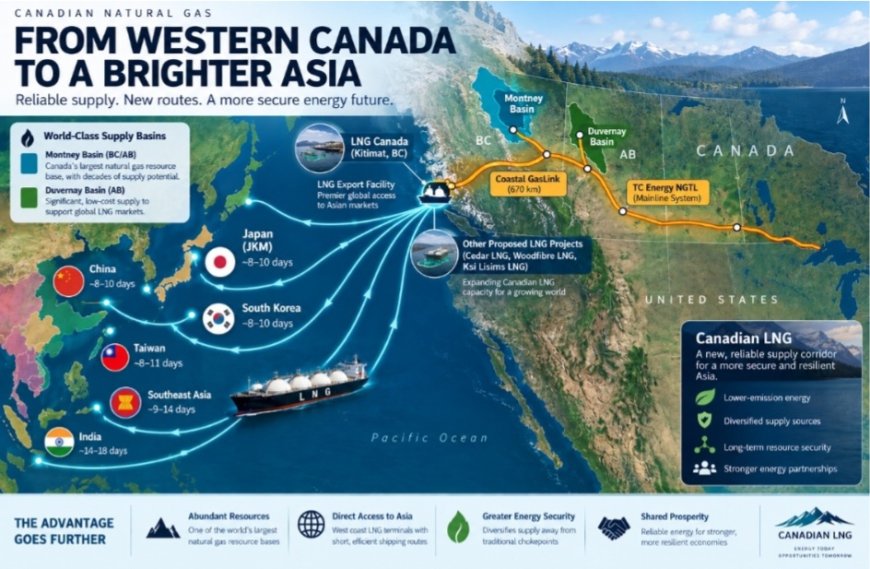
Canada offers Bangladesh several attributes that are difficult to obtain simultaneously from its existing portfolio.
First is geographic diversification. LNG exported from Canada's Pacific coast reaches Asia without passing through the Strait of Hormuz. Canadian LNG therefore provides a genuinely independent supply corridor from Bangladesh's principal Qatari supply.
Second is resource security. Western Canada's enormous natural gas resource base supports the possibility of supply arrangements extending 15 or 20 years and potentially longer.
Third is pricing diversification. Rather than having virtually the entire portfolio exposed to LNG or oil-linked pricing, Bangladesh could explore Canadian structures linked to North American natural gas prices -- potentially including AECO, Western Canada's principal gas benchmark, cheapest gas in North America.
Fourth is direct producer participation. Canadian LNG creates the potential to consider structures extending beyond a conventional LNG purchase from a commodity trader.
Bangladesh could explore relationships connecting long-term demand with Canadian natural gas producers, transportation infrastructure and LNG liquefaction capacity.
Properly structured, that could provide greater transparency around the components of the delivered LNG price and potentially create long-term alignment between producer and consumer.
And finally, there is timing. Canada's next generation of LNG projects is being commercialized today for deliveries beginning around the early 2030s.
20 year agreements are already being signed. Bangladesh therefore has an opportunity to participate while developers and suppliers are assembling their long-term customer portfolios rather than waiting until capacity has already been committed.
What Bangladesh Should Do Next
Bangladesh should not respond to today's crisis simply by replacing one supplier with another. Nor should it abandon spot LNG.
The spot market remains an important source of flexibility. Instead, Bangladesh should develop a deliberate long-term portfolio strategy.
The objective should be to establish a diversified base of long-term LNG supply across multiple producing regions and pricing mechanisms, supported by sufficient spot-market flexibility to manage variations in demand.
Canada should be evaluated alongside the United States and other emerging supply alternatives as part of that strategy. The first step does not need to be a multi-billion-dollar LNG commitment.
Bangladesh could begin by engaging Canadian governments, LNG developers and natural gas producers to evaluate potential supply beginning around 2030–2032.
Commercial discussions could examine different volumes, contract durations, FOB versus delivered LNG, AECO or other North American gas-linked pricing, destination flexibility and security-of-supply provisions.
The World Bank is already helping strengthen Petrobangla's ability to enter longer-term LNG arrangements through payment guarantees and financing support- precisely because reducing dependence on expensive spot purchases can improve energy security and economic resilience.
That creates an opportunity to think beyond the next cargo. Bangladesh's LNG strategy for the coming decade should not be built around predicting where the next geopolitical crisis will occur.
No government can reliably do that. It should instead be built so that when the next disruption occurs, Bangladesh has multiple ways to respond. Canada cannot provide the entire answer.
But with its enormous natural gas resources, emerging Pacific LNG infrastructure, growing government support, access to North American gas pricing and a supply route independent of the Middle East, Canadian LNG could become an important part of a more diversified and resilient Bangladesh energy portfolio. And the time to explore that opportunity is before the next energy crisis- not during it.
Nayem Baig is President, 3nergy Solutions.