

























































A Ledger of the Soul: Navigating the Allah-Bhagavant Nexus in a 19th-Century Puruṣākāra Jñāna Caupara [Gyan Chauper]
Taken together, the visual, linguistic, and material evidence suggests that this folio preserves a rare intellectual milieu in which Persianate and Indic traditions were not experienced as competing systems, but as complementary vocabularies for describing the soul’s ethical journey.

![A Ledger of the Soul: Navigating the Allah-Bhagavant Nexus in a 19th-Century Puruṣākāra Jñāna Caupara [Gyan Chauper]](https://counterpointbd.com/uploads/images/202608/image_870x_6a93baa35af3e.jpg)
The Jñāna Caupara (Gyan Chauper or Game of Knowledge) represents a singular genre of South Asian cartography wherein moral topographies are mapped onto ludic grids. While the 72-square Vaiṣṇava board is the standard archetype, the Puruṣākāra (anthropomorphic) variant represents a high-esoteric development, primarily associated with meditative practices that internalize cosmic geography.
This article examines a rare 19th-century folio whose iconographic and epigraphic program suggests a deliberate reconfiguration of conventional sectarian categories by integrating a Persianate Nasta’līq epigraphic programme into the anatomical structure of the Cosmic Man (Puruṣa). Through a comparative study with institutional benchmarks -- notably British Library Or. 13957 and MFA Boston 2000.975 -- this study proposes that such objects served as vital tools for a shared moral accounting (hisāb) that bridged the Sufi ṭarīqa and Indic karmic traditions.
Fig. 1. A Puruṣākāra Jñāna Caupara (Gyan Chauper or Game of Knowledge in Human Form), North India (Delhi-Awadh or Marwar-Nagaur), c. 1780–1830. Opaque watercolor, carbon ink, and gold on waṣlī. 10 x 6 inches (25.4 x 15.2 cm). Private Collection. (Photo: Author).
I. The Topography of the Soul: Anatomical Cartography
In the intellectual landscape of eighteenth- and nineteenth-century North India, the Jñāna Caupara functioned as a sophisticated mnemotechnic tool for the moral accounting of the soul. Players moved their pieces across a grid where ladders represented virtues (Sudarśana, Dayā) and sinuous snakes represented vices (Lobha, Krodha).
The most profound evolution of this tradition is the Puruṣākāra board. Here, the grid is no longer a detached cosmic map; it is an internalized physiology. The 72 squares are superimposed upon the figure of the Puruṣa, the Cosmic Man, aligning the moral path with the body's internal energy centers (cakras) and channels (nāḍīs).
Macro-analysis of the present folio reveals a high degree of anatomical specificity; the sensory organs and facial features are individually labeled in Nasta’līq script (e.g. Nayan for eyes), indicating that every physical faculty was mapped onto a corresponding spiritual state.
As established by Andrew Topsfield (2006), this format facilitated a visualization of spiritual progress as an organic ascent through the Suṣumṇā nāḍī toward the Sahasrāra (crown chakra), represented here by a four-headed Brahma figure seated upon the crown.
II. Architects of Pluralism: The Munshī and the Shared Moral Vernacular
The folio represents a particularly sophisticated instance of linguistic and conceptual synthesis. While institutional examples of Puruṣākāra boards typically utilize Devanāgarī script (e.g. MFA Boston 2000.975), this folio utilizes the Persian Nasta’līq script to articulate Indic metaphysical concepts.
The top row of the grid, for instance, labels the four states of liberation (Sālokya, Sāmīpya, Sārūpya, Sāyujya) alongside the ages of time (Satya Yuga, Kali Yuga), all rendered in a fluid, administrative hand.
This synthesis is deeply rooted in the socio-intellectual world of the Munshī -- drawn largely from educated Kayastha, Khatri, and other Persian-literate administrative families. This class served as the cultural "hinge" of North Indian statecraft. As Muzaffar Alam (2004) observes, the Munshī was not merely a clerk but a "cultural broker" who mediated between local traditions and the broader Indo-Persian world.
Educated in a curriculum that synthesized Persian adab (ethics) with a deep engagement with Indic philosophy, these elites maintained an intellectual network defined by administrative multilingualism across the Delhi-Awadh-Marwar axis.
The central didactic block situated between the figure’s legs may be understood as a theological proposition of the Gaṅgā-Jamunī Tehzeeb:
“Udhārī lekh bhagwant allāh barmāl maule darmān ...”
(“The account of debt [Karma] is written by the Lord [Bhagavant] and Allah ...”)
In this context, the Persianate concept of hisāb appears to have been interpreted in a manner broadly analogous to the Indic concept of karma.
Such environments may have fostered forms of Indo-Persian religious synthesis in which esoteric Hindu cartography could be interpreted through a Sufi ethical vocabulary.
This finds a formal parallel in British Library Or. 13957, where the mystical path (ṭarīqa) is mapped onto the grid, though the BL example lacks the anthropomorphic complexity seen here.
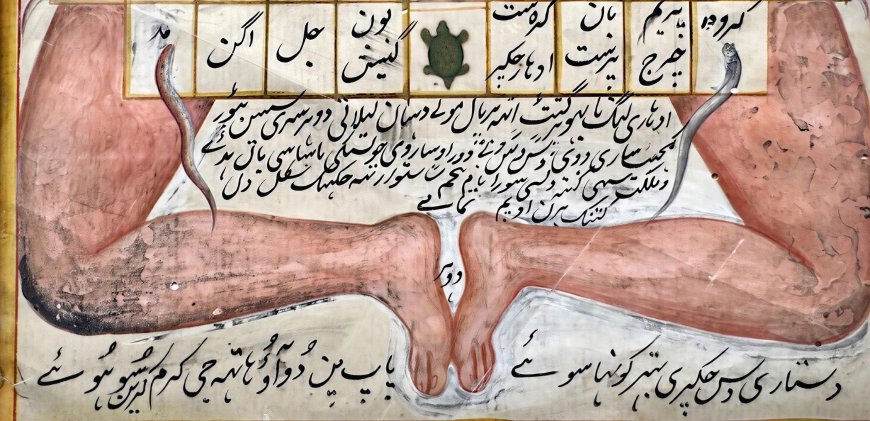
Fig. 2. Detail of Fig. 1 showing the Nasta’līq anatomical labeling and the central didactic block.
III. Materiality and Codicological Vetting
The material evidence supports a production date between 1780 and 1830. A diagnostic marker of this period is a pigment alteration consistent with the well-documented long-term oxidation expected in traditional lead-white pigments (safedā), visible as a brownish-grey mottling on the Puruṣa’s flesh (Fig. 3).
Material analysis of the verso (back) of the folio provides critical data regarding its historical usage. A prominent horizontal fold line bisecting the paper confirms its function as a portable board intended for private study or travel, a common feature in manuscripts used by wandering ascetics or traveling administrators.
The substrate, a traditional waṣlī (layered paper), shows authentic wear and localized pigment flaking consistent with the mechanical stress of folding over two centuries.
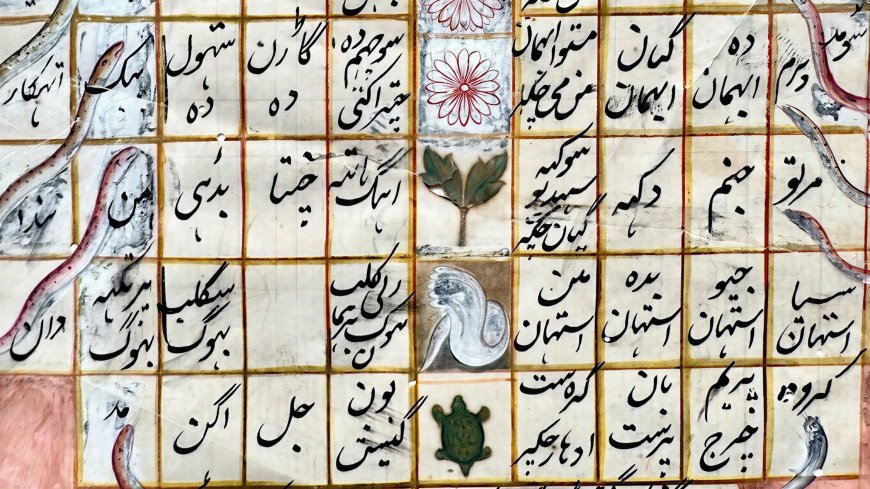
Fig. 3. Technical Detail of Fig. 1 illustrating lead-white oxidation and the foundational avatars (Matsya and Kurma).
Although based upon a single surviving folio, the present study is intended as a contribution to the broader discussion of Persianate-Indic intellectual exchange rather than as a comprehensive account of the Puruṣākāra Jñāna Caupara tradition.
Rather than demonstrating rigid sectarian identities, the present folio illustrates how moral, linguistic, and metaphysical traditions could be expressed through a shared visual language. It preserves rare material evidence of a pluralistic intellectual culture in which Persianate and Indic concepts were consciously brought into dialogue within a singular devotional object.
Taken together, the visual, linguistic, and material evidence suggests that this folio preserves a rare intellectual milieu in which Persianate and Indic traditions were not experienced as competing systems, but as complementary vocabularies for describing the soul’s ethical journey.
Acknowledgements
The author gratefully acknowledges the pioneering scholarship of Andrew Topsfield, whose work on the Jñāna Caupara tradition provided the essential framework for the present study. Any new interpretations or errors remain the responsibility of the author.
Selected Bibliography
Alam, Muzaffar. The Languages of Political Islam in India: c. 1200–1800. Chicago: University of Chicago Press, 2004.
British Library, London. Shatranj-i 'Urafa (Chess of the Gnostics), Or. 13957.
Coomaraswamy, A.K. The Transformation of Nature in Art. Cambridge: Harvard University Press, 1934.
Digby, Simon. "The Sufi Shaykh as a Source of Authority in Medieval India." Purusartha, 1986.
Eaton, Richard M. The Rise of Islam and the Bengal Frontier, 1204–1760. Berkeley: University of California Press, 1993.
Ernst, Carl W. Refractions of Islam in India: Situating Sufism and Yoga. Delhi: Yoda Press, 2016.
Flood, Finbarr Barry. Objects of Translation: Medieval Intercultural Identity and the Mongol Conquest. Princeton University Press, 2009.
Green, Nile. Making Space: Sufis and Settlers in Early Modern India. Oxford University Press, 2012.
Husain, S. Abid. The Destiny of Indian Muslims. Bombay: Asia Publishing House, 1965.
Kramrisch, Stella. The Hindu Temple. Calcutta: University of Calcutta, 1946.
Museum of Fine Arts, Boston. Puruṣākāra Jñāna Caupara Board, Accession No. 2000.975.
Sharma, Sunil. Persian Poetry at the Indian Frontier. Delhi: Oxford University Press, 2000.
Topsfield, Andrew. The Art of Play: Board and Card Games of India. Chicago: Art Media Resources, 2006.
Shahab Sattar is a connoisseur and independent scholar of Islamic and South Asian art, with a special interest in Indian miniature painting, Qur’anic manuscripts, and the Bengal School.