








































![A Ledger of the Soul: Navigating the Allah-Bhagavant Nexus in a 19th-Century Puruṣākāra Jñāna Caupara [Gyan Chauper]](https://counterpointbd.com/uploads/images/202608/image_430x256_6a93baa3b09a7.jpg)




















How We Talk About the Rohingya Matters
There will be speeches insisting that promises and pledges translate this time to “real action,” and by this these parties will gesture to policy change. Inaction stems, though, not only from empty words. The old lexicon, an entire philosophy of rhetoric, must be retired.

Language is slippery, often subversive. When Burma became Myanmar in 1989, this was the ruling junta’s most obvert disavowal of the colonial past. In striking out Britain’s name for the nation, the military attempted to put forth a new image.
The old name, derived from the dominant Bamar ethnic group, was replaced in a sort of semantic trick. It suggested the nation, this new Myanmar, welcomed all ethnic groups composing the vast country.
Junta control would go on to ebb and surge amid the stuttering thrust of “true democracy” -- as it does, as it will -- but that new name, the national veneer, the nom de plume to dissemble the nom de guerre, was largely accepted.
Most of the world today indeed recognizes the name “Myanmar.” Manipulations of language have proven effective tools for the authority of Myanmar.
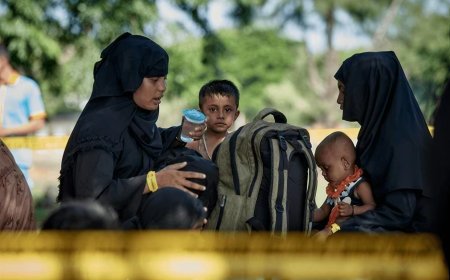
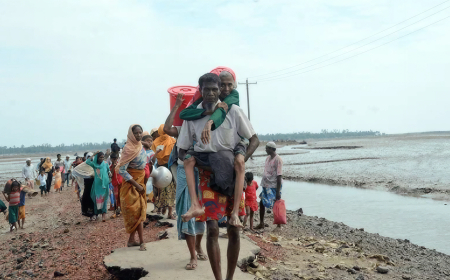
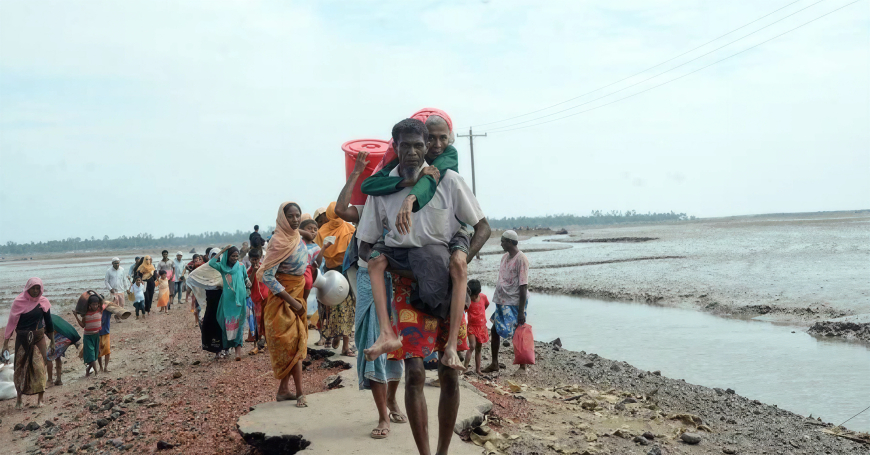
The explosive consequences of these actions are laid bare in decades of ethnic cleansing of the ethno-religious minority Rohingya, over a million of whom now seek refuge in neighboring Bangladesh.
While linguistic exploitations by Myanmar state perpetrators have been scrutinized, a parallel adaptation of language concerning the refugees by humanitarian systems and host nations has been largely overlooked, despite this language increasingly compromising the welfare of the Rohingya.
A Refugee Host Nation’s Unprecedented Stage
Re-evaluating the standard lexicon of the aid system now is critical. Bangladesh, primary host nation of Rohingya refugees, is poised for the first time to preside over the upcoming 81st session of the UN General Assembly opening in September.
At the helm is Foreign Minister Khalilur Rahman, selected by the UN in a historic election this past June, who was previously the High Representative on Rohingya Issues during the interim government of Bangladesh.
This is an unprecedented position for the refugee host nation with high potentiality given Rahman’s expertise, but will the old rhetoric staging the refugees’ condition -- ineffective, often counterproductive -- be finally retired?
Sweeping language abounded in the listed objectives for the United Nations’ first high-level conference on the Rohingya and other minorities of Myanmar which took place in September 2025.
The UN organ published aims of the conference ahead of last year’s meeting, including to “review the overall [Rohingya] crisis and address its root causes,” the aspirational denouement of which being “a comprehensive, innovative and concrete plan for a sustainable resolution of the crisis.”
This conference was a result of Bangladesh’s campaign to garner greater international commitments and fast-track a repatriation solution for the refugees.
Head of Bangladesh’s interim government at that time, Muhammad Yunus, put forth an address at that meeting which included a seven point plan concerning the Rohingya in Bangladesh.
The entirety of this address, however, did not include the word “refugee” to describe those displaced under conditions of war and genocide. And though this was yet another appeal by the Bangladesh administration to the global community for aid concerning the Rohingya, the displaced population in Cox’s Bazar in Bangladesh (composing the largest camp system in the world) are still not recognized de jure by the Bangladesh government via the term “refugees.”
Instead, they are designated “Forcibly Displaced Myanmar Nationals” (FDMN). Bangladesh also continues to abstain from ratifying the 1951 Refugee Convention and its 1967 Protocol, which upholds refugee rights through the universal mechanisms of international protection law.
The Words Bangladesh Uses
Yunus also stated during that September 2025 UN meeting: “Bangladesh is a victim of the crisis. We are forced to bear huge financial, social and environmental costs. Criminal activities ... threaten our social fabric.”
The portrayal of Bangladesh as a victim of a crisis, closely juxtaposed with the formulaic generalization of the Rohingya as criminal, is also a calculated linguistic -- ideological -- construction.
Notably, the Rohingya are largely financially supported by international donor groups and other foreign governments (covering 99.6% of the Rohingya Joint Response Plan launched by Bangladesh in 2025), with Bangladesh experiencing local economic development in Cox’s Bazar from the influx of foreign aid and personnel.
Moreover, Bangladesh bars the Rohingya from legal higher education or employment opportunities, so the refugees are often forced into markets which exploit Rohingya workers for further economic gain.
The language of criminality as it pertains to the Rohingya, then, presents a sustained and systemic manufacture as an intrinsic attribute.
Through the underhanded economic leverage and use of the refugees as negotiating asset in greater geopolitical dialogue, Bangladesh has in fact extracted a certain legitimacy and foothold through perpetuated Rohingya containment.
International Aid Community Language
The characterization of the refugees in the greater international aid community must also be assessed. The words “burden” and “burden-sharing” (a term which has its genesis at the inception of the UNHCR) are near-universal phraseology for deliverables related to refugee solutions development.
Though this language has been modified at times through the expanded term “burden and responsibility sharing” (this term appearing in documents concerning the high-level UN conference on the Rohingya), the diction invariably confounds sustainable solutions development.
Expediency, asymmetrical compromise, and generalization become the dominant undercurrents of conversation, often influencing safety and longevity considerations.
The refugee community of Cox’s Bazar thus become the load to cast off, an onus of little apparent value (humanistic, capitalistic, all that lies between).
Host nations certainly require assistance of international bodies to manage massive refugee populations. These bodies must be cognizant of the unintended effects of modern aid solicitation language.
A major component of this aid solicitation language is made manifest by the international community’s description of the Rohingya refugees’ condition as a “crisis.”
In our modern landscape, the hackneyed term is somewhat a misnomer when describing the state of refugees.
The connotations of “crisis” elicit ideas of acute, natural phenomena: Successions of events by which victims and witnesses alike are vulnerable, with this state of “crisis” materializing no obvious perpetrators.
Indeed, in recent headlines relating to the Rohingya, ample mention is made of a humanitarian disaster, a population that is aid-dependent.
Less emphasis and fewer details concerning the Myanmar authority are expounded upon, leaving the refugees an abstraction isolated from the political and historical events which made them refugees.
In that sense, the term “genocide” is important to revisit. The single largest episode of extermination of the Rohingya resulted in a mass exodus of the refugees to Bangladesh in 2017.
A statement by then UN High Commissioner for Human Rights Zeid Ra’ad Al Hussein in December 2017 introduced the term “genocide” as an inquiry -- “can anyone rule out that elements of genocide may be present?” -- before qualifying that it was a legal determination better suited for “competent courts.”
International consensus is nearly universal now in defining the events as genocide, though equivocation in language (over reliance on the word “crisis,” for instance), endures in discourse.
Retiring a Philosophy of Rhetoric
Since the first high-level conference at the UN last year, the issues facing Rohingya in Bangladesh persist. Notably, however, there is fertile ground for reform at the moment. Bangladesh has transitioned from its interim government to a new administration.
When Khalilur Rahman takes the helm in New York this September, he will oversee numerous agendas, including the old call for a “sustainable resolution” for the ongoing displacement and genocide of the Rohingya.
There will be speeches insisting that promises and pledges translate this time to “real action,” and by this these parties will gesture to policy change.
Inaction stems, though, not only from empty words. The old lexicon, an entire philosophy of rhetoric, must be retired.
Farihah Ahmed is a writer, healthcare professional, and the founder of RoVena, a global civil society organization which advocates for refugee rights.