
































![A Ledger of the Soul: Navigating the Allah-Bhagavant Nexus in a 19th-Century Puruṣākāra Jñāna Caupara [Gyan Chauper]](https://counterpointbd.com/uploads/images/202608/image_430x256_6a93baa3b09a7.jpg)

















The Enchantress of Fatehpur Sikri: A Film We Haven't Made Yet
What if Salman Rushdie's Mughal-Florentine fever dream was the film South Asia desperately needs right now?
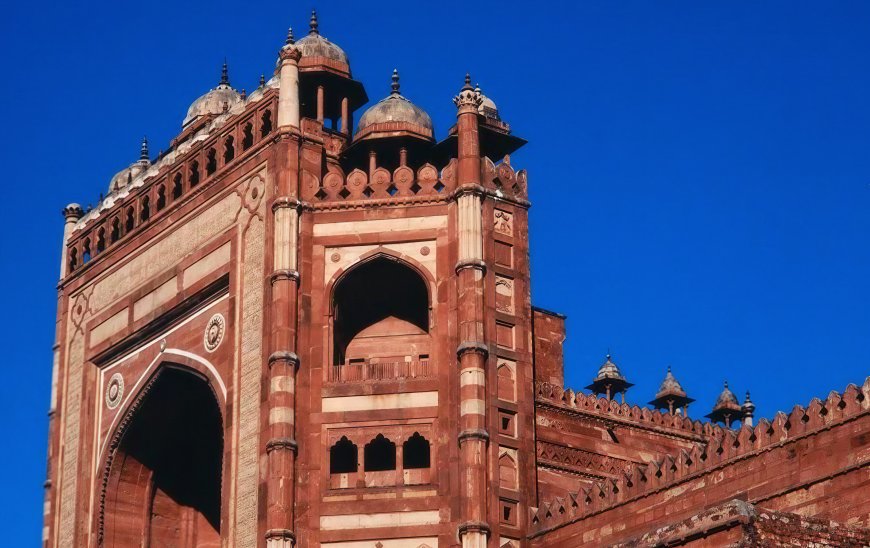
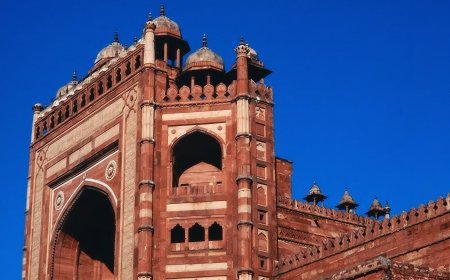
Imagine a film that opens not with a title card but with light -- the syrupy, golden light of a Fatehpur Sikri evening, sandstone breathing amber, shadows stretching like calligraphy across marble courtyards.
The camera swoops low and finds him: Niccolò Vespucci, a Florentine adventurer with dust-caked feet and a story coiled in his mouth like a serpent. He has walked across half the world to stand before Akbar, the Shadow of God on Earth, and claim kinship.
The air is thick with rosewater and something sour beneath -- betrayal, perhaps, or just the smell of an empire too vast to hold. This film does not exist. And yet, in the cacophony of our present moment -- scroll, rage, scroll, forget -- it feels like the film we desperately need.
Not a costume drama with lacquered beards and palace intrigues, but a hallucinatory splice of two continents, two eras, and one impossibly seductive word: Secular. Rushdie's The Enchantress of Florence gives us the blueprint.
The novel arrives like Vespucci himself, bearing the question no one quite knows how to answer: What happens when one civilisation's dream about itself meets another's?
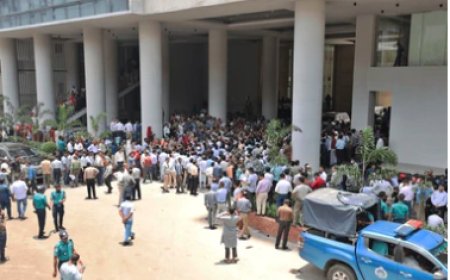
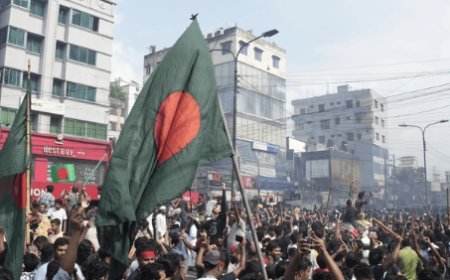
The book has sat on shelves since 2008, shortlisted, celebrated, half-forgotten -- but scroll past any South Asian newsfeed today and you will feel its pulse. In Dhaka, where students topple governments and the ghosts of 1971 stir restlessly.
In Delhi, where history has become a lit match. In Kolkata, where self-appointed guardians of tradition police the Durga Puja platter, turning a fish fry into a confessional test of belonging. In Nepal's Madhesh, where Hindu-Muslim riots test the secular promise of a young republic.
Everywhere the old grammar of "secular versus religious" fails to parse what is actually unfolding. We are all, now, characters in a Rushdie novel we didn't realise we were living inside.
First Reel: The Stranger's Gaze
Vespucci enters the Mughal court and sees what any Renaissance European would see: a tyrant, a philosopher-king, a mystic. He has no language for what Akbar actually is -- a sacred absolutist who elevated tolerance to an instrument of imperial power.
Sulh-i-kul, universal peace, is not the separation of religion from politics. It is the emperor's own body claiming to transcend every creed, to contain them all within his divinely illumined person. This is not secularism.
This is something older, stranger, and less reassuring. Rushdie's Akbar quarrels with an imaginary Jodha. He dreams. He aches. He is already being mythologised by everyone who gazes upon him -- including us.
The film's dramatic engine is not "what was Akbar really like?" but what does everyone need him to be? The Jesuit priest needs a soul to harvest. The orthodox mullah needs a heretic to condemn.
The Florentine needs a mirror of Renaissance glory. And we, sitting in the dark, need a secular icon -- the forefather of our fragile, besieged pluralism. This is the trap the film must spring.
Second Reel: The Word That Distorts
A whispered voiceover in Rushdie's own cadence: The secular is a complex formation. Talal Asad's great insight is a kind of detective story about a category that disguised its own origins.
The "secular," he showed, is not neutral. It invents "religion" as a private, interior thing -- belief, essentially -- and then announces it has heroically separated this thing from "politics."
But this separation would have been unintelligible in Akbar's court, where the sacred was the very medium of sovereignty.
To call Akbar secular is to translate him into a grammar that misreads what power and faith meant in his universe. And yet we cannot think without categories.
The question is not whether we use terms born in the modern West -- it is whether we do so reflexively, aware that every term is a translation, and every translation is a betrayal.
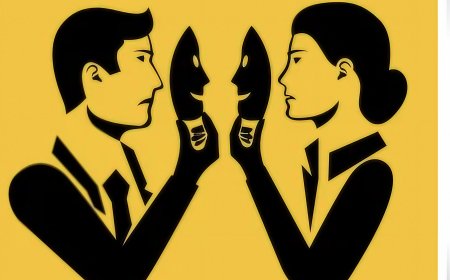
The film we need would show the word "secular" as a character itself: A shapeshifter, arriving from post-Reformation Europe, wearing a mask of universality, quietly reshaping everything it touches.
Third Reel: The Splice
Now the editing grows feverish. Cut from the Ibadat Khana -- where Jesuits and Jains and mullahs argued while the emperor watched -- to a Dhaka university plaza seething with slogans, mobile-phone torches blazing.
Cut from a Mughal miniature to a Delhi mob tearing down a shrine, stone dust hanging like incense. Cut from a Sufi qawwali at Sikri to a Buddhist nationalist rally in Myanmar, faces contorted with a rage that is also grief.
The soundtrack turns dissonant. A shehnai becomes a siren. The argument about Akbar's secularism has never really been about the sixteenth century. It is a coded argument about now.
In South Asia today, labelling Akbar a secular icon is either an act of ancestral defence -- see, we have always been plural -- or ancestral prosecution -- see, he was always a heretic. There is no neutral ground.
The past is not a country; it is a battlefield, and the dead are conscripted into the armies of the living. Bangladesh becomes the emotional core.
Born of a language movement, baptised in a liberation war, constitutionally secular until military decree rewrote its preamble, now wrestling with a nationalism oscillating between the Bengali and the Islamic, the plural and the pure. Shahbag 2013.
The rupture of 2024. Each generation re-litigates the same questions: Who are we? Is the word "secular" a shield or a wound?
The camera does not answer. It only pans over faces caught between hope and exhaustion.
Final Reel: The Enchantress
And now, at last, she is felt. Qara Köz, the enchantress of the title, the hidden princess whose beauty unspools empires. Rushdie never pins her down. She is reported, sung, conjured, desired, but never fully present.
In our film, we would never show her face. She would be a trail of jasmine scent, a fabric's rustle just out of frame, a colour -- indigo, perhaps, or the particular gold of a Dhaka sunset -- that saturates the screen and vanishes.
She is South Asia herself. Irreducibly plural, impossible to govern, constantly seducing every empire that tries to name her.
The Mughals tried.
The British tried. The postcolonial nation-states are trying still.
And now the purveyors of "secularism" as a diagnostic label -- well-intentioned, often necessary, but sometimes as enchanted as any courtier -- try too, calling her by a name she does not entirely recognise.
The film refuses to resolve her mystery. That is its gift: The recognition that our categories, too, are forms of enchantment. Spells we cast to make the unmanageable manageable.
The word "secular" is not a scalpel that cleanly dissects the past. It is a story we tell ourselves -- a net, as Vespucci might say, that catches the wind.
Fade Out
The camera returns to Fatehpur Sikri, now empty. The real city, abandoned centuries ago for lack of water, stands silent under a moon that does not care about our arguments.
Corridors where no one lives.
The ghost of Vespucci -- or perhaps Rushdie himself, in cameo -- murmurs: A story is a net that catches the wind.
Cut to black.
A title card: The Enchantress of Fatehpur Sikri: A Film Waiting to Be Made.
And beneath it, the real question, released into the silence: What will we create when we finally learn to film the wind?
Somewhere, a director reads this and reaches for a notebook. Somewhere else, a student in Dhaka or Delhi or Lahore, tired of the old binaries, begins to imagine a third language.
The enchantress smiles, unseen.
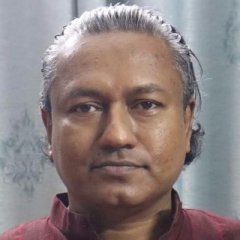
Zakir Kibria is a Bangladeshi writer, policy analyst and entrepreneur based in Kathmandu, Nepal. His email address is [email protected]