











































![A Ledger of the Soul: Navigating the Allah-Bhagavant Nexus in a 19th-Century Puruṣākāra Jñāna Caupara [Gyan Chauper]](https://counterpointbd.com/uploads/images/202608/image_430x256_6a93baa3b09a7.jpg)




















From Economic Giant to Global Leader
The defining question is no longer whether China has become a global power, but whether its model of development and statecraft will shape the rules of the international order in the decades ahead.
The 19th century is often described as Britain's imperial century, while the twentieth century unquestionably belonged to the United States.
Whether the 21st century will ultimately be remembered as China's century remains uncertain.
What is no longer in doubt, however, is that China has emerged as the foremost challenger to American primacy and a central architect of an increasingly multi-polar international order.
Unlike previous great powers whose rise was often fueled by territorial conquest and military expansion, China's ascent has largely been driven by economic transformation, technological innovation and strategic patience.
While the United States has spent much of the past three decades engaged in costly military interventions, Beijing has focused on strengthening its industrial base, investing in infrastructure, expanding global trade and nurturing technological self-reliance.
This long-term strategy has enabled China to project influence worldwide without becoming directly involved in major interstate wars. China's economic transformation has been unprecedented in modern history.
Since initiating market-oriented reforms in 1978, it has become the world's largest manufacturing nation and the leading trading partner for over 120 countries.
On a purchasing power parity (PPP) basis, China already possesses the world's largest economy. Although economists remain divided on whether it will surpass the United States in nominal GDP during the next decade, China today occupies the centre of global manufacturing and supply chains, giving it immense geoeconomic influence.
That economic strength has translated into geopolitical leverage. The Belt and Road Initiative (BRI), launched in 2013, has financed ports, railways, highways and energy projects across Asia, Africa, Europe and Latin America.
While critics view the initiative as an instrument of strategic influence, supporters see it as a catalyst for infrastructure development and regional connectivity.
Regardless of the debate, the BRI has significantly expanded China's global footprint and strengthened its political influence across the developing world. Beijing is also seeking to reshape elements of global financial architecture.
Institutions such as the Asian Infrastructure Investment Bank and the New Development Bank provide alternatives to traditional Western-led financial institutions.
Simultaneously, China has promoted greater international use of the renminbi in trade settlements and expanded cross-border payment systems that reduce dependence on the US dollar and the SWIFT network. Although the dollar remains the world's dominant reserve currency, these initiatives reflect China's long-term ambition to build a more diversified and multipolar financial order.
Technology has become the defining battleground of the 21st century, and here too China has made remarkable progress. The "Made in China 2025" strategy transformed the country from a low-cost manufacturing hub into a global leader in advanced industries.
China now dominates electric vehicle production, lithium battery manufacturing, solar panels, drones and high-speed rail technology. Chinese firms such as BYD have overtaken established competitors in global electric vehicle sales, illustrating how rapidly the country's industrial capabilities have evolved.
Artificial intelligence has further intensified strategic competition. Massive investment in research, vast datasets and strong state support have enabled Chinese companies to become major players in generative AI, intelligent manufacturing, healthcare, robotics and autonomous systems.
While the United States continues to lead in frontier semiconductor design and several cutting-edge AI technologies, China's advances have narrowed the technological gap considerably.
Semiconductors have become the focal point of this rivalry. Recognizing that advanced chips underpin everything from artificial intelligence to defence systems, Washington has imposed export controls on high-end semiconductor technology and advanced chipmaking equipment.
In response, Beijing has accelerated efforts to develop indigenous semiconductor capabilities, committing hundreds of billions of dollars to reduce dependence on foreign technology.
The competition over chips has evolved into one of the most consequential strategic contests of our time, with implications extending far beyond economics.
China's growing influence is also reflected in expanding multilateral institutions. The enlargement of BRICS has strengthened Beijing's efforts to amplify the voice of emerging economies and promote reforms in global governance.
Although BRICS is far from becoming a unified geopolitical bloc, its expansion underscores the growing demand among many developing countries for a more representative international order that is less dominated by Western institutions.
China's military modernisation has advanced alongside its economic rise. The People's Liberation Army has transformed into a technologically sophisticated force equipped with advanced naval platforms, fifth-generation fighter aircraft, hypersonic weapons, cyber capabilities and expanding space assets.
China's navy is now the world's largest by number of battle-force ships, reflecting Beijing's determination to safeguard its maritime interests and protect expanding overseas economic investments. Yet China's rise differs from previous great powers in one important respect.
Despite increasing tensions in the South China Sea and across the Taiwan Strait, Beijing has generally avoided direct involvement in major interstate wars. Instead, it has relied primarily on economic partnerships, diplomacy and strategic competition to expand its influence.
This approach has allowed China to devote national resources to economic and technological development while avoiding the enormous financial and political costs associated with prolonged military conflicts.
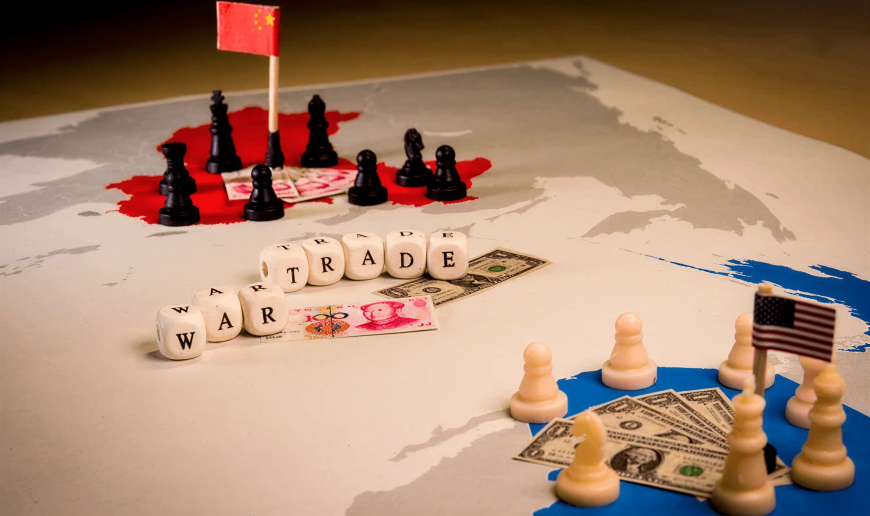
Today's US-China contention extends far beyond military competition. It encompasses trade, technology, finance, supply chains, critical minerals, cyber security and competing visions of global governance.
Tariffs, export controls, investment restrictions and industrial policies have replaced conventional military confrontation as the principal instruments of strategic competition.
Yet unlike the Cold War between the United States and the Soviet Union, the world's two largest economies remain deeply interconnected through trade, investment and global supply chains.
China dominates the processing of rare earth minerals essential for advanced electronics, renewable energy and defence industries, while American companies continue to maintain significant commercial interests in the Chinese market.
Former Singaporean Prime Minister Lee Kuan Yew once observed that China initially sought to share global leadership with the United States, but ultimately aspired to become the world's pre-eminent power.
Whether that ambition is realised will depend not only on China's continued economic and technological progress but also on how effectively it addresses domestic challenges, including demographic decline, slowing growth and external strategic pressure.
Equally important will be the ability of the United States and its allies to preserve their technological edge, alliance networks and institutional influence. China’s rise has already transformed global trade, technology, finance, and geo-politics.
The defining question is no longer whether China has become a global power, but whether its model of development and statecraft will shape the rules of the international order in the decades ahead.
Brigadier General (Retd) Mustafa Kamal Rusho is a Research Director at the Osmani Centre for Peace and Security Studies.