

























































When a Distant War Reaches the French Street
When a generation experiences the future as a list of diminishing possibilities, discontent in the classroom can become distrust of the republic itself.

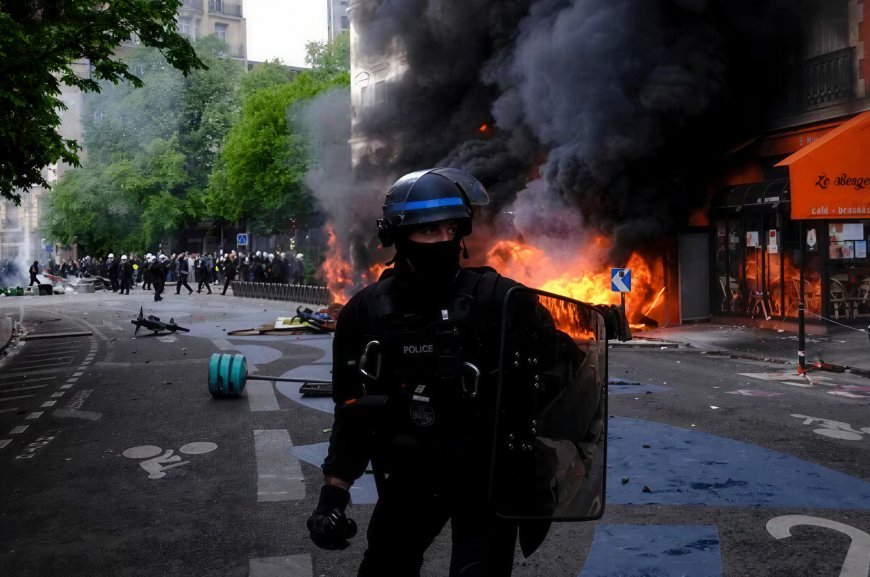
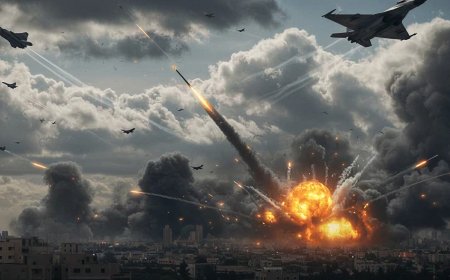
Modern war has developed a strange geography. Missiles land in one country, tankers stall in another country’s strait, fuel prices rise across a third continent, household budgets collapse elsewhere, and eventually fires appear on the streets of Paris, Marseille, Lyon, and Limoges.
France’s unrest is therefore more than a story about rioting. It shows how international conflict, domestic austerity, failing public services, and political distrust can converge until a local grievance becomes a national rupture.
Yet it would be analytically careless to describe the violence as the direct product of war in the Middle East. That war did not create France’s discontent.
It intensified pressures that were already embedded in French society. The spark may travel through global energy markets, but the combustible material was accumulated at home.
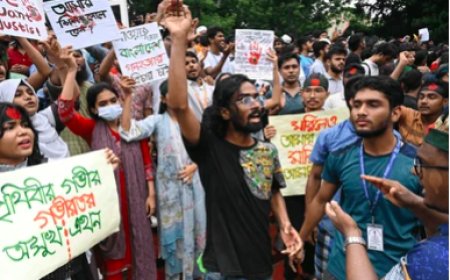
The movement did not begin as an anti immigration revolt or as an organized attempt to overthrow the state. It began in September at a school in Créteil, outside Paris, where pupils protested against teacher shortages and deteriorating educational conditions.
Within days, the movement spread across the country. By early October, more than 1,000 schools, close to one in four nationally, had been affected by protests or blockades.
The pupils’ demands were strikingly ordinary. They wanted teachers in classrooms, repairs to neglected buildings, relief from overcrowding, a more intelligible university admissions process, and an education system that did not leave some children missing months of teaching because staff absences remained unfilled.
In one of the world’s wealthiest states, access to a functioning classroom had become a political demand.
That changes the meaning of the unrest. When young people must leave school in order to demand that school works, the failure no longer belongs only to an education ministry. It becomes an indictment of the state’s moral priorities.
Parents, teachers, workers, trade unions, farmers, left wing activists, and veterans of the Yellow Vest movement subsequently joined the demonstrations.
A protest about schools became a wider mobilization over fuel prices, stagnant wages, declining purchasing power and the fraying of public services.
On October 17, the authorities estimated that around 550,000 people marched nationwide. Organizers put the number closer to 800,000. About 110,000 demonstrated in Paris alone. Most of them were peaceful.
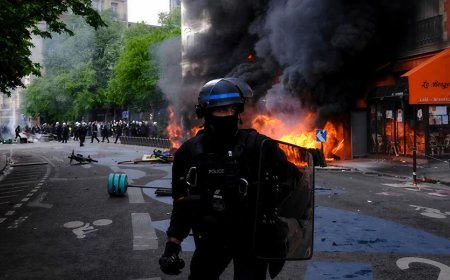
Television, however, has its own political economy. Hundreds of thousands of peaceful citizens carrying placards received less attention than burning cars, broken shopfronts, and the collapsing clock tower of Limoges City Hall. A grievance is politically important, but a burning building is visually profitable.
Alongside the authorized marches, masked and highly mobile groups attacked public buildings, police facilities, vehicles, and businesses. Looters exploited the disorder.
The distinction is essential. It is dishonest to define a mass movement by the conduct of a violent minority. It is equally dishonest to romanticise arson and looting as authentic expressions of social pain.
Burning a town hall cannot repair a school. Looting a supermarket cannot reduce inflation. Fire may communicate rage, but it cannot write a workable public policy.
The state’s security failure was nevertheless substantial. Around 60,000 police and security personnel were deployed, yet Interior Minister Laurent Nuñez acknowledged that officers lost control in several major cities.
He offered his resignation after admitting failures of anticipation and intelligence. President Emmanuel Macron refused it, instructing him instead to disclose what had gone wrong and develop new methods for dealing with mobile groups of rioters and looters.
By October 19, more than 2,300 people had been taken into custody. The authorities reported that close to 1,000 police officers and gendarmes had been injured.
There were also serious allegations concerning police tactics, including an incident in which a protester reportedly lost a hand after being struck by a crowd control grenade.
The problem was not simply that police were absent where they were needed. In other places, the manner of their presence intensified questions about proportionality and accountability.
Two official responses capture the contradiction in French state capacity. The government promised 3,000 additional substitute teachers to address staff shortages. It deployed around 60,000 security personnel to manage a single day of demonstrations.
The figures describe different tasks and should not be mechanically compared, but their political symbolism is difficult to ignore. The state that struggles to appear promptly in the classroom can arrive on the street with shields, water cannon, and tear gas.
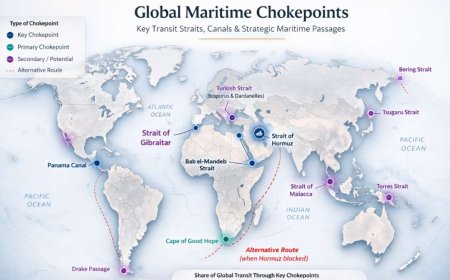
This is where the global war enters the French crisis. Disruption to energy flows through the Strait of Hormuz and the wider conflict in the Middle East have driven up the cost of oil and refined fuels.
The French government has itself acknowledged that the international crisis is hurting households through historically high energy prices. The Group of Seven has coordinated releases from strategic reserves, confirming that the supply shock is not imaginary.
But an international conflict can explain why prices rise without deciding who must absorb the increase. That distribution is political. A wealthy citizen and a low paid worker may buy fuel at the same pump, but they do not experience the same price.
For one, the increase may alter a holiday plan. For the other, it may force a choice between travelling to work, heating the home and feeding a child.
War creates pressure. Domestic policy distributes the pain. A government may not be able to prevent the geopolitical storm, but it remains responsible for the condition of the roof under which its citizens are expected to survive it.
The defining political feature of contemporary war is that decisions and costs no longer occupy the same territory. A small number of leaders and military planners make strategic choices.
Bus drivers, teachers, students, pensioners and small business owners across distant societies pay for them. They do not hear the explosions. They encounter the war on supermarket receipts, energy bills and transport costs.
France also faces a fiscal trap. Public debt is rising, economic growth is weak and the government is under pressure to reduce its deficit.
Following the unrest, French shares fell and government borrowing costs increased, demonstrating how quickly political disorder can become financial risk. Improving schools and public services requires money. Reducing debt requires restraint. Cutting expenditure intensifies public anger, while increasing it alarms markets and creditors.
Paris is trying to calm citizens and bond markets at the same time. Unfortunately for citizens, bond markets do not vote, yet governments often hear them more clearly than voters.
During the Yellow Vest crisis of 2018 and 2019, the government had greater room to purchase social calm through concessions. That fiscal space is now considerably narrower. Temporary subsidies may soften the immediate pain, but they cannot resolve the underlying choice confronting France.
Will the social state’s promise of education, welfare and economic security be renewed, or will the security state gradually become the institution citizens encounter most reliably?
The timing makes the crisis still more dangerous. France will elect a new president in 2027, and Macron cannot seek another term. Any appearance of state weakness during his final months will benefit the political extremes.
Marine Le Pen’s nationalist right can present disorder as evidence of national decline and failed authority. Jean Luc Mélenchon’s radical left can present it as the inevitable revolt against the inequalities of the Macron era.
The centre possesses spreadsheets, fiscal projections and policy committees, but it is losing the language with which political anger is recognized.
The right says the state is not hard enough. The radical left says it is hard but unjust. The centre promises to convene stakeholders and formulate concrete proposals. When the street is burning, the vocabulary of the committee room rarely generates much political warmth.
Youth protest carries a particular historical charge in France. The memory of May 1968 remains embedded in the country’s political imagination.
Youth movements are difficult for governments because they are often decentralised, unpredictable and without a single leadership that can negotiate on behalf of everyone. They also retain public sympathy. A serious injury caused by police can transform the political mood faster than any opposition speech.
The government’s earlier response had already helped deepen mistrust. Thousands of arrests during the first weeks of school protests and images of aggressive police intervention allowed an argument about education to expand into an argument about state power.
When the authorities begin to treat every school gate as a security threat, students learn to see the state less as the provider of teachers than as the provider of control.
This is therefore a generational revolt as well as a social one. The young are not angry only about damaged classrooms. They are confronting a future in which education deteriorates, housing becomes less affordable, secure employment recedes and the state repeatedly demands patience without offering a credible social settlement in return.
When a generation experiences the future as a list of diminishing possibilities, discontent in the classroom can become distrust of the republic itself.
France’s turmoil is fundamentally a crisis of the social contract. The French Republic historically asked citizens to accept relatively high taxation in exchange for education, healthcare, social protection and a dignified form of citizenship.
Many citizens now feel they are still paying their part while the state’s side of the agreement is being gradually revised.
When social provision contracts while the security presence expands, the state changes character in the public imagination. It ceases to appear primarily as a provider and increasingly appears as a regulator of discontent.
Macron was right to distinguish legitimate peaceful protest from organised violence and opportunistic looting. That distinction must now appear in policy, not merely in presidential language.
Looters should face justice. Peaceful demonstrators should be protected. Teacher shortages, the cost of living and the degradation of public services require credible answers. Arrests can empty a street. They cannot fill a political vacuum.
If the government responds only through bans, surveillance and more aggressive policing, it may restore temporary order while further weakening democratic legitimacy.
If the left minimises arson and looting in the name of social solidarity, it destroys the moral basis of protest. A democratic state must contain violence while addressing the grievances that violent actors exploit.
Performing only the first task produces authoritarianism. Discussing only the second while neglecting public safety produces paralysis. France is currently caught between those two failures.
The geopolitical implications reach beyond France. Europe is confronting war in Ukraine, instability in the Middle East, energy insecurity and pressure to increase military expenditure.
At the same time, social cohesion within European states is weakening. A government may project strategic power abroad, but if teachers, workers and students experience increasing insecurity at home, the foundation of that power becomes brittle.
Military capability and social stability are not substitutes. A state cannot indefinitely finance geopolitical ambition by drawing down the trust of its citizens.
Europe’s influence in the world depends not only on weapons, alliances and diplomatic declarations, but also on whether its political systems can distribute the costs of those commitments without hollowing out the societies in whose name they act.
The streets of France therefore reveal a wider European contradiction. Europe wants to operate as a geopolitical power, yet it struggles to explain and distribute the domestic costs of that role fairly.
The war may be geographically distant, but its political explosion can occur at home when international decisions generate private gain and socialized loss.
France must do more than stop the riots. It must demonstrate that the republic can hear citizens before fire becomes their loudest political intermediary. State strength cannot be measured by the number of people arrested.
It is better measured by the number of people who still believe they can obtain teachers, security and political dignity without setting their city alight.
A government that hears tear gas before it hears its citizens may recover control of the street. In the process, it risks losing the moral authority to govern it.
Dr Lubna Ferdowsi is an academic, researcher and geopolitical analyst based in the United Kingdom. Her work draws on sociology, anthropology and critical approaches to migration, identity, power, gender and contemporary politics.