


































































When a Slap Matters More Than a Child
A parent's anger does not authorize violence; neither does a crowd's religious fervour. If the public argument remains fixated on the slap while a child and her family face fear, we will have learned something unsettling about our hierarchy of concern.


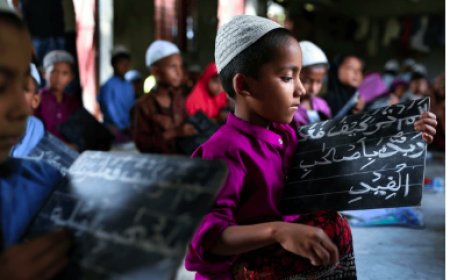
A seven-year-old girl reportedly told her family that she had been sexually abused by a senior teacher at her madrasa in Tongi. The accused vice-principal was arrested and sent to jail pending proceedings.
Yet the public controversy appears to have shifted with remarkable speed from the child's allegation to an altogether different injury: A slap allegedly delivered to the teacher by the child's father.
Social-media posts circulating around the case allege that a group identifying itself as “Tawhidi Janata” demanded the father's arrest within 24 hours and threatened mob action against the family. Those particular threats require independent verification. If authentic, however, they reveal a disturbing inversion of moral priorities.
A child reports abuse. A parent responds angrily. A religious figure is struck. Suddenly, the loudest argument is about the religious figure's dignity. The child, whose safety should be the organizing principle of every response, risks becoming an inconvenient detail.
There is no need to excuse the slap to recognize this distortion. Physical assault is not an acceptable substitute for investigation, prosecution, or trial. An accused teacher retains legal rights, including the presumption of innocence.
If the parent committed an offence, the allegation should be assessed through due process. The same principle applies to allegations of violence, intimidation or damage directed at the institution. But the law cannot be invoked selectively, as though it awakens only when a socially powerful person is struck.
The relevant questions begin elsewhere.
Was the child's account received promptly and sensitively? Was she protected from further contact with the accused? Was there any attempt to discourage disclosure? Did the institution have an effective safeguarding procedure independent of its senior staff? What psychological support is available to the child? And, given the reports of threatened retaliation, is her family safe?
These are not secondary questions. They are the questions by which a society's professed commitment to children's rights should be judged.
The politics of this case lies in the struggle to decide what counts as the central wrong. Institutions do not exercise power only by concealing information. They also exercise it by redirecting attention.
An allegation of sexual abuse can be reframed as an attack on a respected teacher, an affront to religious sentiment or a threat to an institution's reputation. The complainant is then required to defend the act of complaining, while the substance of the allegation recedes from public view.
This is a familiar mechanism of secondary victimization. The initial allegation is followed by social pressure, reputational attacks, disbelief or intimidation. For a child, such reactions can be particularly damaging. The prospect of being blamed, disbelieved or exposed to retaliation may silence not only the child concerned but others who are considering whether it is safe to speak.
Safeguarding therefore extends beyond investigating one incident: It requires creating conditions in which disclosure does not become a second ordeal.
Religious authority makes this problem especially sensitive, not because religious education is inherently abusive, but because authority can become difficult to question when criticism of an individual is represented as hostility to a faith.
A teacher's religious title does not alter the evidentiary standard for a criminal allegation. Nor does it make the teacher guilty. It should simply make no difference to the procedures used to establish the facts. Accountability becomes impossible when an individual's institutional or religious status is treated as a defence in itself.
Bangladesh has painful reasons to understand the risks of institutional retaliation. Nusrat Jahan Rafi, a madrasa student in Feni, reported sexual harassment by her principal and was subsequently murdered by being set on fire in 2019.
The circumstances of the Tongi case are not equivalent, and no such outcome should be presumed. Yet Nusrat's case remains an unmistakable warning about what can happen when allegations against authority figures trigger efforts to silence the complainant rather than protect her. The lesson is not to prejudge every accused teacher; it is to take threats against complainants seriously before violence occurs.
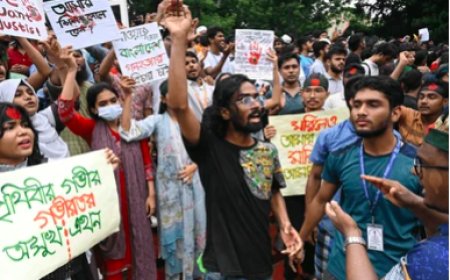
The language of the “mob” deserves equally careful scrutiny. A crowd is not a court, and a deadline issued by a self-appointed group has no legal authority. If people publicly threaten to attack a family unless police arrest a particular person, they are not defending the rule of law.
They are attempting to dictate law enforcement through coercion. The irony is acute: Those demanding punishment for an alleged assault may themselves be threatening an assault on people whose principal act was to report abuse.
Max Weber's account of the modern state is useful here. The state claims a monopoly over the legitimate use of physical force within its territory. That does not mean state violence is automatically justified. It means private groups cannot lawfully appoint themselves investigators, judges and executioners.
When officials appear unable or unwilling to protect citizens from organized threats, the practical meaning of citizenship changes. Security begins to depend less on equal rights than on which group can assemble the larger crowd.
The constitutional stakes are direct. Article 27 of Bangladesh's Constitution promises equality before the law. Article 31 concerns the protection of law, and Article 32 protects life and personal liberty. These guarantees cannot be conditional on whether a citizen belongs to a popular religious constituency, has political patrons or commands public sympathy.
They protect the accused teacher, the parent and, above all, the child and her family. Applying one legal standard to all of them is not moral relativism. It is the minimum requirement of justice.
The case also exposes a wider inconsistency in public morality. Sections of society can become intensely agitated by consensual intimacy between adults while showing less urgency when children report sexual harm.
The contrast is revealing. Moral outrage is not always distributed according to vulnerability or severity of injury. Often it follows power: Whose conduct can be policed, whose reputation must be defended, and whose testimony can be treated as expendable.
The issue is not whether people may defend religious institutions against unfair accusation. They may, and they should insist on fair investigation. The issue is whether such defence can coexist with an equally vigorous defence of children. A community that mobilizes immediately for a teacher's dignity but hesitates over a child's safety should ask what, precisely, its moral commitments protect.
There is also a political test here. Parties that routinely speak about Islamic values, public morality, minority rights or justice should be asked to state plainly whether they condemn intimidation of a family reporting alleged child sexual abuse.
This includes Jamaat-e-Islami, the National Citizen Party and other parties seeking public trust. Their responsibility is not to pronounce on an accused person's guilt. It is to defend an independent investigation, reject vigilantism and demand protection for the child. Solidarity with Muslims facing persecution abroad is important; it loses credibility if concern for vulnerable Muslim families at home is selective.
A serious response would be practical rather than theatrical. Police should assess any credible threats and provide appropriate protection. Investigators should preserve evidence and conduct child-sensitive interviews, avoiding repeated questioning that can compound distress. Relevant authorities should examine the madrasa's safeguarding arrangements, reporting channels and supervisory accountability.
The child should have access to medical and psychological support, with her privacy respected. Any allegations of assault or property damage against the institution should be investigated separately and fairly, without allowing them to eclipse the child's case.
More broadly, this incident should renew scrutiny of safeguarding across residential educational institutions, religious and secular alike.
Children who live where they study are especially dependent on adults for food, shelter, supervision and access to their families. That dependence increases the need for independent complaints mechanisms, staff vetting, training, inspection and credible routes to report abuse without retaliation. Institutional reputation should be earned through demonstrable protection of children, not preserved through enforced silence.
At the heart of the controversy is a simple distinction. An accused person's rights must be protected; their social standing must not be allowed to overwhelm a child's rights.
A parent's anger does not authorize violence; neither does a crowd's religious fervour. If the public argument remains fixated on the slap while a child and her family face fear, we will have learned something unsettling about our hierarchy of concern.
The question is not whether the teacher's dignity matters. It is why a child's safety should have to compete with it.
Dr Lubna Ferdowsi is an academic researcher, geopolitical analyst and social commentator based in the UK.