

















































![A Ledger of the Soul: Navigating the Allah-Bhagavant Nexus in a 19th-Century Puruṣākāra Jñāna Caupara [Gyan Chauper]](https://counterpointbd.com/uploads/images/202608/image_430x256_6a93baa3b09a7.jpg)




















Designing Recruitment Around Trust, Not Discretion
In public recruitment, discretion is not automatically a sign of sophistication, and subjectivity is not automatically a measure of quality. Sometimes the most modern recruitment system is simply the one that leaves the least room for anyone to ask who was favoured and why.

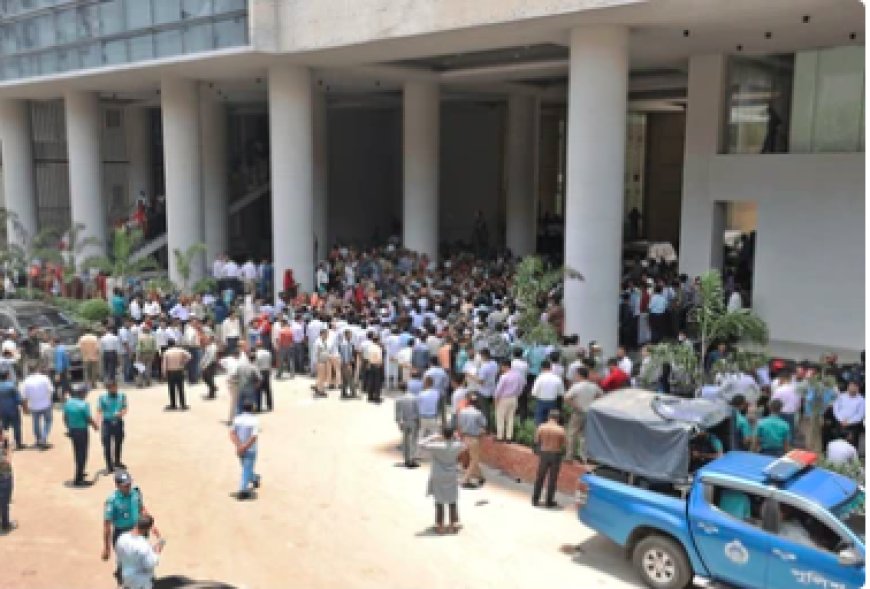
There is something deeply unsettling about the idea of making the viva voce more important in the recruitment of government employees. The government may argue that a stronger oral examination will help identify skilled, confident and suitable candidates.
On paper, that sounds reasonable. After all, written examinations cannot measure everything. But in a country where public recruitment has long been shadowed by allegations of political influence, nepotism, corruption and favouritism, the real question is not whether a viva can assess qualities that a written test cannot.
The real question is this: Should we give greater power to the least transparent part of the recruitment process?
The proposed changes to the recruitment examination structure for grades 11 to 20 therefore deserve much more scrutiny than a technical discussion about examination marks.
Under the draft rules, oral examinations would carry 50 out of 150 marks for grades 11 and 12, 40 out of 100 for grades 13 to 16, and 25 out of 100 for grades 17 to 20.
The written component would consequently become less decisive. The government says the objective is to recruit skilled and competent manpower.
Yet competence cannot be strengthened simply by transferring marks from a relatively standardised examination to an assessment that is inherently more subjective.
A written examination has its limitations, but it possesses one quality that a viva often lacks: comparability. Thousands of candidates can answer the same questions under broadly identical conditions.
Their scripts can be preserved, reviewed and, at least theoretically, challenged. A candidate who receives 70 marks has a record explaining how those marks were earned. In a viva, however, the assessment depends substantially on the judgement of the panel.
A candidate’s communication skills, confidence, personality, accent, appearance, composure and even the chemistry between the candidate and the interview board can influence the outcome. These may sometimes be relevant to a job, but they are difficult to measure consistently.
That becomes particularly problematic when the viva carries a large proportion of the total marks. Imagine two candidates who perform almost equally in the written examination. A difference of 10 or 15 marks in the viva can completely reverse their positions.
The written examination may identify the candidates as broadly equal in merit, while the oral examination becomes the decisive mechanism for selecting one over the other.
At that point, the question of who performs better may quietly become secondary to the question of who is perceived as more suitable by a handful of people sitting across the table.
There is another problem that is rarely discussed: The viva rewards confidence, but confidence is not synonymous with competence. A polished speaker may perform exceptionally well in an interview without necessarily being the better employee.
Conversely, a nervous, introverted or socially disadvantaged candidate may know considerably more but struggle to demonstrate it within a few minutes of questioning.
This matters particularly for lower and middle grades of government employment, where the recruitment system should primarily identify people who can perform the duties of the position rather than people who can impress an interview board.
In Bangladesh, this distinction is even more important because access to confidence-building opportunities is not equally distributed. Candidates from affluent families may have better educational backgrounds, stronger English proficiency, greater exposure to interviews and more opportunities to develop presentation skills.
Candidates from rural or economically disadvantaged backgrounds may have comparable academic ability but less experience navigating formal interviews. If the viva becomes more heavily weighted, socioeconomic differences can quietly enter the recruitment process under the respectable label of “personality assessment.”
The argument that a viva is necessary to ensure “quality” also needs to be examined carefully. If the government believes that written examinations are failing to identify competent candidates, the answer should be to improve the written examination, not simply make the viva more powerful.
Questions can be redesigned to test reasoning, problem-solving, practical knowledge, ethics and situational judgement. Examination systems can incorporate practical tests where appropriate. Computer-based examinations can reduce opportunities for manipulation.
Standardised marking schemes can improve consistency. There are many ways to measure competence without creating a recruitment mechanism in which subjective judgement carries disproportionate weight.
Most importantly, transparency should determine the architecture of public recruitment. The more powerful an assessment becomes, the more transparent it should be. Yet the very nature of a viva makes transparency difficult. A written answer remains a tangible record.
An interview is largely an event that happens and disappears. Even if marks are recorded, the reasoning behind those marks may remain difficult for an unsuccessful candidate to understand or challenge. Why did one candidate receive 18 out of 25 while another received 10?
Was it knowledge, communication, confidence, personality or something else? Without detailed and verifiable criteria, such distinctions can become impossible to establish.
This is where the proposal risks creating an institutional contradiction. The state wants citizens to trust public recruitment, but it is considering giving greater weight to a stage of recruitment that citizens may find harder to scrutinise.
Public confidence is not built merely by declaring that a system is merit-based. It is built by designing a system in which merit can be demonstrated, measured and independently verified.
There is also a broader historical lesson here. Whenever institutions have weak safeguards, their integrity eventually depends on the personal integrity of the people operating them.
That is not a sustainable model of governance. A recruitment system should not require every member of an interview board to be exceptionally honest, impartial and resistant to pressure. Good institutions assume that human beings can be biased and therefore build procedures to minimise the consequences of that bias.
This is particularly important for government jobs because they are not ordinary employment opportunities. For millions of Bangladeshis, a government job represents economic security, social mobility and, in many cases, an escape from generations of financial uncertainty.
The competition is therefore intense. When candidates believe that a written examination can be objectively prepared for but a viva can be influenced by subjective discretion, distrust can spread even before the results are announced. Once that happens, rumours of connections, lobbying and influence can become almost as damaging as actual irregularities.
The irony is that the proposed change may ultimately weaken the government’s own stated objective. If the purpose is to recruit the best people, the recruitment system must convince unsuccessful candidates that they lost because another candidate performed better, not because somebody preferred another candidate.
Meritocracy is not simply about selecting competent people. It is also about making the process of selection credible.
That does not mean the viva should be abolished. There are qualities that an oral examination can legitimately assess. Communication, situational judgement, professional attitude and the ability to respond to unfamiliar questions can matter in public service.
The viva should complement merit assessment, not dominate it. Its weight should be limited, its criteria should be clearly defined, panels should be appropriately trained, and wherever possible, assessments should be structured and documented.
There is an even simpler principle the government could follow: The less objective an assessment is, the less power it should have over the final outcome.
This principle would lead naturally towards a recruitment system in which written and practical examinations carry the greater weight, while the viva plays a supplementary role.
Bangladesh does not merely need faster recruitment or more confident recruits. It needs a recruitment system that citizens believe is fair even when they do not get the job.
That distinction is fundamental. A candidate who fails a difficult written examination may be disappointed, but can understand that another candidate answered more questions correctly.
A candidate who loses because an interview board gave someone else a substantially higher subjective score may leave with a very different feeling.
The government should therefore pause before increasing the power of the viva. In public recruitment, discretion is not automatically a sign of sophistication, and subjectivity is not automatically a measure of quality. Sometimes the most modern recruitment system is simply the one that leaves the least room for anyone to ask who was favoured and why.
If merit is the destination, transparency must be the road. We should not make the road narrower while claiming to improve the journey.
H. M. Nazmul Alam is an Academic, Journalist, and Political Analyst based in Dhaka, Bangladesh. Currently he teaches at IUBAT. He can be reached at [email protected].