



































































The Strait That Can Choke Dhaka
For Bangladesh, the closure of the Strait of Hormuz would not represent a diplomatic crisis with Tehran. It would represent a market crisis. The country’s exposure lies in its increasing dependence on globally traded LNG without deep diversification, strategic reserves, or substantial domestic alternatives.
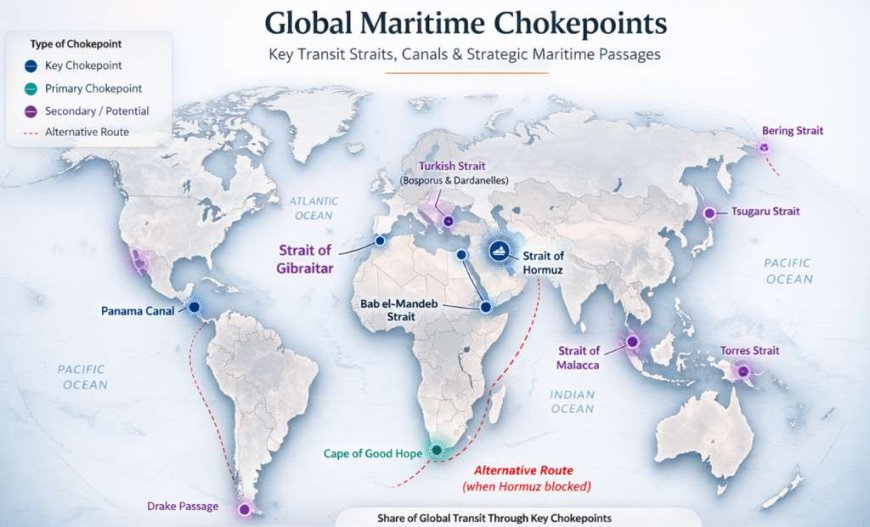

Figure 1: World’s maritime transit chokepoints for oil and gas
If the Strait of Hormuz stays closed, as the Iranians have just announced -- even for few weeks -- the shockwaves would travel far beyond the Persian Gulf. For Bangladesh, a country increasingly dependent on imported liquefied natural gas (LNG), such a disruption would not merely be a geo-political headline. It would be an economic emergency.
Bangladesh already has a shaky economy, which just recently stopped bleeding from its wounds sustained during the 17 years of autocracy and plunder. With a new government in town, already with some initial missteps regarding key personnel appointments like the central bank governor, the country lacks strategic or economic headroom to sustain a prolonged energy shock.
The World’s Most Dangerous Chokepoints
The Strait of Hormuz is the narrow maritime passage connecting the Persian Gulf to the Arabian Sea. Roughly 21 million barrels of oil per day -- about one-third of global maritime petroleum liquids transport total, according to the US Energy Information Administration (EIA). In addition, about 20% of globally traded LNG transits the strait, primarily from Qatar and the United Arab Emirates.

Figure 2: Percentage of Maritime Oil Transport via major chokepoints as of 2023. Source: U.S. Energy Information Administration (EIA), “World Oil Transit Chokepoints”
This makes Hormuz the single most critical energy chokepoint in the global system. Even the threat of mere disruption of energy carrying tanker passage through the Hormuz has historically triggered oil price spikes due to supply fears, insurance surcharges, and speculative activity.
Iran’s Oil and Gas Exports
In 2023, Iran ranked as OPEC’s fourth-largest crude oil producer and was the world’s third-largest producer of dry natural gas in 2022. The country possesses some of the largest proven oil and natural gas reserves globally, placing third in oil reserves and second in natural gas reserves worldwide in 2023.
By the end of 2023, Iran held approximately 24% of the Middle East’s oil reserves and about 12% of total global oil reserves. However, despite this substantial resource base, Iran’s overall liquids production remains constrained due to years of underinvestment and the impact of ongoing international sanctions on its energy sector. Sanctions and infrastructure constraints have limited its ability to liquefy and ship gas globally. Instead, Iran exports natural gas primarily via pipeline to neighboring countries such as Turkey, Armenia, and Azerbaijan.
Turkey remains the most significant customer for Iranian pipeline gas under long-term agreements. However, Iran’s smaller stake in the global LNG markets does not diminish the systemic risk tied to Hormuz. The real vulnerability lies in Gulf LNG exporters -- most notably Qatar -- whose cargoes must pass through the strait.
Removing Gulf Supply From the Global Markets
While a prolonged war in Iran or removing Iranian pipeline gas alone would not cripple global LNG markets, a closure of Hormuz would halt exports from Qatar -- the world’s leading LNG exporter.
In 2024, an estimated 83% of LNG transiting the Strait of Hormuz was shipped from Persian Gulf exporters to buyers in Asia. The largest recipients were China, India, and South Korea, which together accounted for 52% of all LNG volumes passing through the strait that year.
Qatar accounts for roughly 19% of global LNG trade. Unlike some oil exporters, it has no alternative maritime route to bypass Hormuz. If LNG shipments from Qatar were suspended, Asian and European buyers would be forced into a scramble for alternative supplies.
The consequences would be immediate:
- Spot LNG prices would surge
- Europe and Asia would compete for limited cargoes
- Energy-importing developing economies, like Bangladesh, would face severe balance-of-payments stress
During past supply disruptions -- such as Russia’s invasion of Ukraine -- global LNG spot prices reached historic highs. A Hormuz shutdown could produce similar volatility, particularly if combined with elevated oil prices.
If Hormuz stays blocked for sustained periods of time, Brent crude could spike well above $100 per barrel from its current level of $72, depending on duration and severity. Oil price surges matter for gas markets in two ways:
- Many LNG contracts in Asia are indexed to oil prices, meaning higher oil translates directly into higher LNG costs.
- Shipping, insurance, and energy substitution effects increase overall energy system stress.
Energy markets are deeply interconnected. A chokepoint crisis does not isolate commodities; it amplifies systemic price pressures.
Bangladesh’s LNG Exposure
Bangladesh does not import Iranian gas directly. Yet it is structurally exposed to Gulf LNG flows that must pass through Hormuz. In other words, the vulnerability is systemic, not bilateral.
Bangladesh’s growing dependence on LNG imports stems from several structural pressures: A heavy reliance on gas-fired power generation, declining domestic gas reserves, limited expansion of renewable energy capacity, and the diminishing feasibility of new coal projects. According to data from the government’s Energy and Mineral Resources Division, LNG imports accounted for 22% of total gas demand by FY2022.
Bangladesh began importing LNG in 2018. By 2023, its purchases had reached 5.2 million metric tons -- an increase of 19% from the previous year. The country is likely to continue to heavily rely on LNG as its population expands and domestic gas production continues to decline.
Bangladesh spent roughly 60 billion taka (about $504 million) in 2023 on LNG imports, primarily to fuel power generation. More than half of these volumes are secured through long-term government contracts with Qatar and Oman, while the remainder is sourced from the spot market. Although around 50 percent of Bangladesh’s installed power-generation capacity relies on gas, many plants are operating below capacity due to supply constraints.
A Hormuz disruption would affect Bangladesh through multiple channels:
- Contracted Qatari LNG deliveries could be delayed or suspended
- Spot LNG prices would spike, making replacement cargoes prohibitively expensive
- The country’s import bill will rise resulting in foreign exchange pressures
- Power shortages could intensify if LNG procurement becomes constrained
Early estimates from experts put an immediate term price increase of 5-10 BDT per liter if turbulence prolongs in Iran. The price increase could be higher, obviously, if the Hormuz blockade sustains for weeks.
The Strategic Lesson
For Bangladesh, the closure of the Strait of Hormuz would not represent a diplomatic crisis with Tehran. It would represent a market crisis. The country’s exposure lies in its increasing dependence on globally traded LNG without deep diversification, strategic reserves, or substantial domestic alternatives.
The episode would reinforce three strategic imperatives:
- Diversification of LNG suppliers beyond the Gulf.. North American LNG could be an alternative in this regard, particularly in light of the recent trade deal between US and Bangladesh
- Expansion of storage capacity and long-term hedging mechanisms
- Accelerated investment in renewables and domestic energy resilience, including taking a second look at coal
Energy chokepoints are no longer regional flashpoints. They are global economic fault lines -- and Bangladesh sits squarely within their tremors.
Shafquat Rabbee is a Bangladeshi-American geopolitical columnist and founder of the news platform Centrist Nation.