


























































The Global South Watches America's Dystopian Test Run
We have a choice: To be passive consumers of the spectacle, or active collaborators in writing a different ending -- one based not on fear and division, but on the unbreakable, transnational solidarity of those who believe, against all odds.
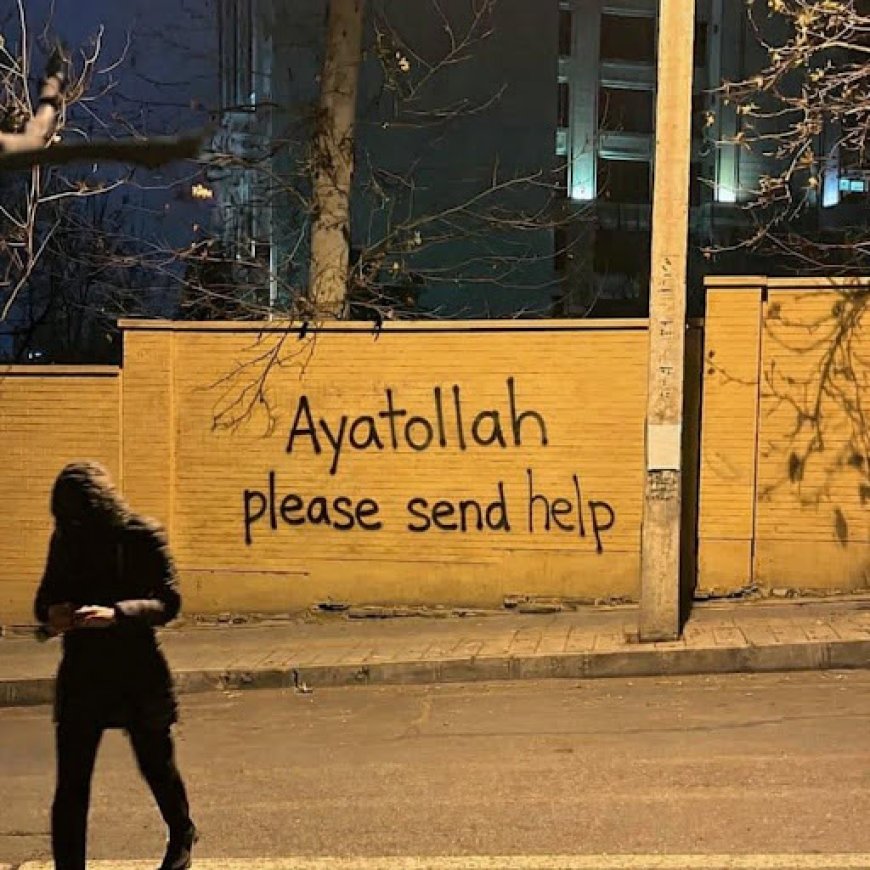
A photograph slices through the digital noise of our feeds. Under the sickly orange glow of sodium streetlights, on a cold Minneapolis wall, a plea is painted in hurried strokes: “Ayatollah please send help.” For a moment, the world seems to tilt.
This viral image -- a piece of raw, ironic protest art from the heart of the American Midwest -- is not a literal cry to Tehran.
It is a desperate metaphor, a satirical flare shot into the sky by citizens who feel so besieged by their own government that they ironically appeal to a historic adversary. It is a signal that the dystopian anxieties of Hollywood have found their real-world stage.
This symbolic cry did not emerge from a vacuum. It was ignited by the piercing sound of gunfire on January 7, 2026, when an Immigration and Customs Enforcement (ICE) officer shot and killed 37-year-old U.S. citizen Renee Good in her car.
Her killing, part of the federal “Operation Metro Surge” that deployed thousands of agents to Minnesota, became a watershed moment. It transformed local tension into a national confrontation, witnessed by the world through the same lens of cellphone video that once broadcast the murder of George Floyd on these very streets.
The response from the state’s highest office was one of unprecedented condemnation. Minnesota Governor Tim Walz reached for a historical analogy of profound gravity, stating that children in his state were hiding in fear, causing many to recall the story of Anne Frank. “Somebody is going to write that children’s story about Minnesota,” Walz warned, directly addressing the President.
While the comparison sparked controversy and was criticized by institutions like the U.S. Holocaust Museum, its utterance by a sitting governor reveals the depth of the crisis.
It frames the federal crackdown not as simple policy, but as a form of political persecution terrifying enough to evoke the darkest chapters of modern history.
From our vantage point in the Global South, these layers -- the viral graffiti, the state-sanctioned violence, the invocation of historical trauma -- form a coherent and alarming narrative. What we are witnessing is a live-fire exercise in a new American playbook.
It is a test case written in the ink of dystopian fiction, funded by a massive border security budget, and tested on a population whose spirit of resistance was, perhaps, prophesied by its own purple poet.
A Nation’s Anxiety Projected
Before the armoured vehicles rolled into Minneapolis neighbourhoods, American cinema had already staged the collapse. Recent years have seen a glut of Hollywood films depicting a United States torn by civil war, authoritarian rule, and societal fracture. The most piercing of these, Alex Garland’s Civil War, presented a vision so visceral it sparked uneasy debate: Was this entertainment, a warning, or something more unsettling?
Critics and filmmakers dismiss the idea of literal “predictive programming,” and they are likely correct. These films are not blueprints but symptoms.
They are the fever dream of a collective psyche grappling with deep-seated anxieties about polarization, institutional failure, and the fragility of the project of union.

Now, watch the news from Minnesota. The fictional “three-term president” of Garland’s film finds his echo in the real-world rhetoric of a campaign pledging to be a “dictator on day one.”
The film’s desolate battlegrounds are replaced by the tense streets of a major American city, where thousands of federal agents from Immigration and Customs Enforcement (ICE) and Customs and Border Protection (CBP) have launched “Operation Metro Surge.”
The dystopian fiction has shed its celluloid skin. The anxiety has been weaponized, transformed from a narrative on a screen into a tool of political spectacle.
The deployment is a show of force, a theatre of intimidation designed to project dominance and create a simple, televisable narrative: The strong state versus the chaotic mob.
The Purple Prophet
But a spectacle requires a stage, and this stage -- Minneapolis -- was not a passive blank slate. It is soil steeped in a legacy of pain and artistic resistance.
To understand the ferocity of the community’s response, one must listen to the ghost in the machine: The spirit of Prince Rogers Nelson.
The global icon was not born in a vacuum. He was forged in the North Minneapolis of the 1960s and 70s, a community whose very infrastructure, like the nurturing community centre The Way, was a direct response to the racial uprisings of 1967. Prince’s genius was a product of a community that metabolized trauma into transcendent art.
He was also, quietly but firmly, an activist. He penned “Baltimore” after the police killing of Freddie Gray, singing, “If you ain’t got no money, you ain’t got no say.”
In 2020, his estate released a handwritten note from his archive: “Nothing more ugly in the whole wide world than INTOLERANCE.” His famous phrase, “Love 4 One Another,” was a gentle command for community.
When residents now invoke Prince, they are not claiming he predicted 2026. They are tapping into the deep cultural memory he represents: A city that has always answered brutality with creativity, and isolation with soulful, defiant solidarity.
The federal playbook anticipated compliance; it did not account for a citizenry trained, in a way, by a prince to believe in their own sovereign community.
A Global Script for Repression
Where did this playbook originate? Its authors looked far beyond America’s borders. The tactics on display in Minneapolis -- the mass deployments, the surveillance, the dehumanizing rhetoric -- are not homemade.
They are imports, refined in the laboratories of endless occupation and global militarism.
For years, a dangerous exchange has been underway. High-ranking U.S. law enforcement officials, including those from ICE and the Department of Homeland Security, have travelled to Israel for training sessions with military and police forces.
These “counter-terrorism” seminars explicitly teach the management of civilian populations under perpetual threat.
The exchange is not merely theoretical. It is technological. The very surveillance towers installed on the U.S.-Mexico border are built by Elbit Systems, an Israeli defence contractor whose technology was first field-tested around Palestinian territories.
This is the grim fusion: Tactics born from controlling an occupied population, merged with frontier technology, and brought home to police American cities and borders. The “Ayatollah, please send help” graffiti ceases to be mere satire when you follow this chain. It becomes a stark, logical question: If your own government adopts the tools of distant authoritarian regimes, to whom else are you supposed to appeal?
Minneapolis as the First Domino
This brings us to the chilling, central question for the Global South: Is Minneapolis a one-off, or is it a dress rehearsal? The evidence points squarely to the latter. “Operation Metro Surge” is consistently described by its architects and critics alike as a “test case.”
The logic is mechanical: If a massive, militarized federal intrusion can be normalized in a progressive stronghold like Minnesota -- if the legal challenges fail, if the media narrative can be controlled, if the public can be numbed -- then the blueprint is scalable. Chicago, New York, Los Angeles, any city labelled a “sanctuary” could be next.
This is the essence of the spectacle engine. It creates a scalable production. The immediate victim-blaming after federal shootings, the labelling of protesters as “terrorists,” the threat of invoking the Insurrection Act to use the military domestically -- all are scenes in a drama designed to shock, divide, and ultimately paralyze opposition.
It is reality television meets state repression, where the chaos is the point, and the resulting fear is the product sold to the public.
For the communities in Minneapolis, from the long-standing Somali residents to the mutual aid volunteers, this is not an abstract political theory.
It is the nightly reality of unmarked vehicles, patrols, and the stomach-churning fear that a loved one will not come home.
Our Shared Battlefield
From afar, it would be easy to view this as a singular American tragedy. But we in the Global South are not just an audience; we are characters already written into this script. The connections are not metaphorical; they are direct lines of cause and effect.
First, consider the boomerang of repression. The militarized policing model, the surveillance architecture, the legal justifications for indefinite detention -- all are lucrative exports.
What is tested in Minneapolis today can be sold to a regime in Asia, Africa, or Latin America tomorrow as “best practice” in population control. Our struggles for democracy are undermined by tools perfected in the West’s own internal conflicts.
Second, witness the cycle of displacement and violence. Who are the people being targeted by ICE in Minneapolis? A great many are refugees from Somalia, from Venezuela, from nations shattered by war, poverty, and climate disaster catastrophes often fuelled by Western imperial policy, economic exploitation, and arms sales.
The United States helps create the conditions for flight, then militarizes its response to the refugees, criminalizing the very survival it forced. This hypocrisy is a global constant.
Finally, look at the cruel machinery of deportation. ICE has been caught in grotesque schemes, flying detained individuals under false pretences not to Louisiana, but to Djibouti, for expulsion into a collapsing South Sudan.
This is not immigration policy; it is the externalization of brutality.
The Global South becomes the dumping ground for human beings discarded by the American system, a practice that destabilizes our regions and treats our sovereignty with contempt.
Writing a Different Script
Yet, within this stark analysis lies our power and our path. The true story of Minneapolis is not just one of top-down repression. It is, more importantly, the story of the organic, formidable resistance that rose to meet it. This is the second, more hopeful blueprint emerging from the test case: The blueprint of people-powered solidarity.
When the federal surge began, Minneapolis did not fold. It organized. Teachers, nurses, and neighbours formed “ICE-watch” networks, using encrypted apps to track agent movements.
They conducted legal observer training and created rapid-response systems. Tens of thousands marched in sub-zero cold.
Faith communities opened sanctuaries, framing their work around Dr. King’s “beloved community” -- the very ideal Prince echoed. This is not a chaos to be feared, but a model to be studied. It is a masterclass in how a multiracial, working-class coalition can build a firewall against state terror through coordination, courage, and care.
Our solidarity, therefore, is not a sentimental gesture. It is a strategic necessity. When we raise our voices for Minneapolis, we are fighting the same systems that threaten us: the export of authoritarian tools, the disregard for our sovereignty, the violent disruption of our communities.
We stand with them because their fight is, inescapably, our fight. The graffiti on the wall is a message in a bottle for the world. It tells us that the dystopian film is rolling, and the script is still being written.
We have a choice: To be passive consumers of the spectacle, or active collaborators in writing a different ending -- one based not on fear and division, but on the unbreakable, transnational solidarity of those who believe, against all odds, in love for one another.
Zakir Kibria is a Bangladeshi writer, policy analyst and entrepreneur based in Kathmandu, Nepal. His email address is [email protected].