





































































Is South Asia Entering a New Cold War Without Realizing It?
In this low-grade, slow-burning rivalry, silence does not equal absence. It usually means that the game has already started.


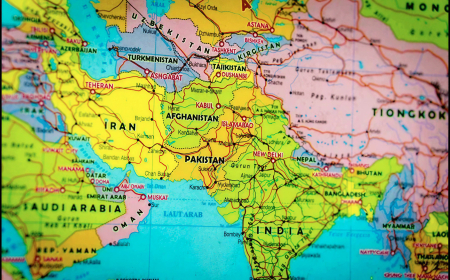
There is a seismic shift happening in South Asia quietly, the kind that rarely lands on the front-page news screaming positive or negative, but one that is gradually determining what will happen here.
In contrast to the definitive ideological battle of the 20th-century Cold War, today’s geopolitical struggle between the United States and China is subtle, layered and often cloaked in development, trade or security cooperation. But for nations such as Bangladesh and Pakistan, the results could be no less defining.
What this actually means is relatively straightforward: South Asia might already be entering a new Cold War and this time, hasn’t necessarily written it out as such.
The escalating competition between Washington and Beijing is no longer limited to the Pacific or global trade routes. It has also arrived at the ports, infrastructure projects and diplomatic corridors of South Asia.
As the United States fortifies its Indo-Pacific strategy, China persistently broadens its economic and strategic footprint as part of plans such as the Belt and Road Initiative. This region, between these two behemoths, is increasingly a site of quiet competition.
Take Pakistan, for example. And while its economic and infrastructural links with China were deepening well before China’s Belt and Road, they have been accentuated by the CPEC, positioning it squarely within Beijing’s strategic ambit. At the same time, Islamabad is still trying to manage a complicated relationship with Washington especially in terms of security and financial aid. This balancing act is not new, but the stakes have never been higher.
Bangladesh offers a different but no less telling example. Dhaka has welcomed Chinese infrastructure investments even as it fosters trade and derivatives ties with the U.S. and its allies.
Instead of siding with one or the other, Bangladesh seems to be following a playbook of strategic neutrality by engaging with both powers without being overtly aligned with either. But the space for neutrality is shrinking in a world increasingly defined by binary competition.
India, the region’s largest power, provides another layer of complication. Its strengthening partnership with the United States, particularly in defense and technology, has an unmistakable tilt toward Washington.
Where at the same time its longstanding tensions with China continue to shape regional dynamics. This creates a strategic environment that these smaller South Asian states must continuously maneuver, in relation to this triangular relationship China, the United States and India.
Here’s where things get interesting. Rather than ideology, today’s competition is bereft of Cold War-style drivers. There is no Cold War-style capitalism versus communism narrative dominating global discourse.
Instead, the competition is about influence in markets, infrastructure, technology and strategic geography. Ports, highways, digital networks and energy projects have become the new battlegrounds.
That complicates the current state of affairs, not simplifies it. Because alignment is not declared anymore; it is embedded. A country might sign a trade deal with one power, accept infrastructure financing from another and hold military exercises with a third. In theory, this is diversification. In reality, it can create entangled dependencies that restrict strategic autonomy.
For South Asia, this raises an important question: Is it possible for the region to stay out of a great power competition or is that already a lost cause?
The pressure appears to be mounting. The United States has been more outspoken about “trusted partnerships,” supply chain security, and democratic alignment. In contrast, China stresses non-interference and development cooperation, providing financing with fewer political strings attached. Where urgent development needs exist, these offers are hard to refuse.
But every partnership has its trade-offs. Debt vulnerabilities can arise from infrastructure loans. Security collaboration can influence foreign policy choices.
Even relationships with technology companies can shape data governance and digital sovereignty. The decisions taken now are likely to determine the strategic space of these nations for decades.
Analysis: There is another dimension which is normally underplayed, that dimension is public perception. In much of South Asia, China is viewed as a dependable development partner that provides tangible infra projects.
The United States, by contrast, is frequently considered a land of education, technology and world opportunity. Such perceptions affect domestic debates and, consequently, help determine the directions of foreign policy.
So is a new Cold War upon South Asia?
Not in the traditional sense. There are no avowed blocs, no iron curtains, no formal declarations. But those patterns do exist, increasing competition for influence, with whom to align strategically, and broader polarization across global politics. The difference now: The lines are blurred.
What makes this moment especially important is that South Asian countries are not just passive players. They have agency. Bangladesh’s canny balancing act, Pakistan’s strategic recalibrations and even the smaller states’ attempts to diversify partnerships all reflect an awareness of the shifting sands. The challenge is to transform this awareness into a coherent strategy.
In the end, the more important question is not whether a new Cold War exists but how it feels. For the great powers, it is a struggle for supremacy. It is a navigation test for South Asia. The region is at a crossroads.
It could emerge as a theater of rivalry, or field of tactical bargain. The difference will hinge on how its countries handle their relationships not just with Beijing and Washington, but with one another. Because in this low-grade, slow-burning rivalry, silence does not equal absence. It usually means that the game has already started.
Md Shihab Uddin is an independent researcher and a student of Folklore and Social Development Studies at the University of Rajshahi.He may be contacted at [email protected].