











































































Thank You, Mr Miles Davis
A birthday tribute to Mr. Miles, the one who could translate the entire humanscape into music, the chaotic cacophony of noisy human affairs could be syncopated into high art

Dear Mr. Miles Davis,
Happy 100th birthday!
I want to pen something for you out of sheer gratitude from Bangladesh, so far away from the world you lived in. It's a rainy monsoon morning in Dhaka, and as the downpour hits, I wonder if you have ever experienced such an elemental natural force in your life.
Having lived in St. Louis, where you were born, for about four years, I frequently found myself missing my favourite drama queen: The monsoon.
Mr. Miles, for me, you are the one who could translate the entire humanscape into music. But your gift went even further: You translated all the vibrations, pulses, and movements of the cosmos itself into sound.
Yet, despite the universal scale of your music, my journey with you was, and still is, by and large a solitary one. I was never formally trained in music, nor have I ever picked up an instrument. I know, however, that you would be kind enough to forgive my inadequacies.
After all, we were just a bunch of kids growing up in Dhaka in the eighties, far removed from the geography of your birth. Music from your world travelled across the oceans to us through records, cassettes, independent recording shops, the radio, and the occasional concert by visiting musicians. There were local bands of course -- extremely talented musicians playing tributes and making amazing rock music -- but their sound was quite far from the slightly more exquisite, elusive world of jazz.
Life was simpler back then, defined by physical places rather than digital streams. There was a tiny shop called Rainbow, awkwardly tucked under the staircase of a small shopping mall at Elephant Road. You could buy blank audio cassettes, choose albums from the hundreds of LPs on display, and order them to be recorded onto the tapes.
This shop was our sanctuary, the place to go with almost all genres of music available at one's fingertips. The shopkeeper, our resident DJ if you might say, was Kabir Bhai -- bearded, sort of cool, and a tad moody at times. In those days, trying and tasting new bands was nothing short of a grand adventure. On a 90-minute blank TDK cassette tape, you could record two full albums for about 100 taka!
Looking back, I cannot fully explain how you really hit me, Mr. Miles, nor do I even attempt to know why. My friends, my elder brother, and his peers all listened to the Beatles, Pink Floyd, Bob Dylan, and a predictable rotation of rock bands. Then there was Beethoven, Mozart, and the Indian masterworks. Would you believe that we were first introduced to Beethoven's Ninth through Kubrick's A Clockwork Orange! This serendipitous encounter opened the wide door to Western classical music.
I guess I was a geek with nothing much to do; I would play those recorded tapes over and over again, until the sounds became familiar and the music started playing randomly in my head. It was into this mix, without any lived experience, guidance, or formal introduction to your world, that I got The Man with the Horn taped, solely on a recommendation from Kabir Bhai!
Looking back, that encounter seems absolutely miraculous. There were many legendary LPs by Miles in the shop, but somehow, Kabir Bhai guessed that I might like that particular contemporary album, intuitively knowing my evolving preferences.
I think I have a kind of spatial appreciation of music -- it often triggers vivid visual images in my mind. Later, I realized that had he suggested any album from your funk period current at that time, my journey with you would not be the same. Instead, the opening heavy bass notes of Fat Time -- the first track -- pushed me through a thick membrane into a topsy-turvy world of dark, heavy colors, where sharp horns and guitar chords struggled to keep the listener from sinking into an attenuated gravity.
A strange, intense, drowsy feeling thickens, expands, contracts, intensifies, becomes a labyrinth of haze, and finally dissipates. You certainly hooked me, Mr. Miles, with that single groovy track! I guess my sort of prodigal indulgence with Pink Floyd, courtesy of my elder brother, had prepared my ears for such sonic experimentation. Nonetheless, rest assured, nothing can really prepare a listener for the sheer scale of your oeuvre, Mr. Miles, for you constructed, deconstructed, and reconstructed entire genres of music in a single lifetime.
This fluidity convinces me that music is deeply rooted in the landscape it evolves from. One may even go as far as to say that music is the interpretation of the human spirit reacting to the energies of a specific landscape. No wonder Ravi Shankar and Ali Akbar Khan's Bangla dhun transports one instantly to the moist monsoon-scapes of Bangladesh, where they both trained under Alauddin Khan -- a synergy that naturally birthed the iconic soundtrack of Pather Panchali. Legend goes that Shankar captured that entire emotional score overnight whilst viewing the rush prints.
Intriguingly, this miraculous event of 1955 closely coincides with your own cinematic milestone: the creation of the score for Ascenseur Pour L'échafaud in 1957. One wonders whether these two young, exceptional figures simultaneously emancipated themselves from the traditional boundaries of auditory art.
You both arrived at a new form of thinking about music -- a more open-ended, intuitive response to feelings generated spontaneously from life itself, like an author writing a score that syncs directly to the energies flowing on a screen.
Yet, while Ravi chose to essentially pursue the historical lineage of the Maihar Gharana, alongside his incomparable East meets West series, you embarked on radical adventures probably only you could undertake, moving with a mystique and elemental force unseen elsewhere in the century.
Because they rely on air, wind instruments carry a special connection with breath -- the essence of our very existence -- and hold an incomparable connection with ether itself, shaping it directly. And your chosen instrument, Mr. Miles -- the horn -- has a pitch and timbre difficult to tame.
It behaves more like a flute which refuses to fly, choosing instead to compress sound and make tones flow like the thickest coat of paint. But that challenge was one you clearly loved. Among the many things which make you special was your innate sense of hearing the latent musical possibilities in your fellow musicians; you heard what they could do before they even played a note. Your intuitions acted like invisible tentacles, reading music from anything and anyone.
For me, Kind of Blue (1959) stands as the definitive map of the entire emotional terrain of humanity and nature. Love, hate, apathy, drudgery, melancholy, solitude, tenderness, and vulnerability are all mapped into forty-five minutes of energy so crisp, so sharp, so pure, and so triumphantly human that it feels totally Mozart-esque.
Listening to it, one can almost hear the lyrical ballads and serenades becoming the vital joie de vivre flowing through the heartbeats of clubs, bars, restaurants, ballrooms, concert halls, and homes across the planet.
Flamenco Sketches captures the definitive portrait of modern man: alone, wandering aimlessly in the early hours through emptied city streets, or sitting in a room overlooking a landscape awash with moonlight -- presumably full, yet in dire need of company. When you made me feel that you were reaching out through that silence, Mr. Miles, you hit me with your tenderness like a gunshot!
Just as we thought we understood your trajectory, who could have guessed your next move? You sauntered off to Spain and boldly reworked the string-based Concierto de Aranjuez using wind instruments! How could you, Mr. Miles? Aranjuez is the child of lives spent in grand palaces like the Alhambra, neatly perched on the drier landscapes of Córdoba -- worlds apart from the colder urban environments of the United States.Yet, in a couple of seconds, you transport the listener into the slow dusks of blue skies, yellow-reddish palaces, cypress and olive trees, and empty courtyards.
You fill these spaces with an untold story and a yearning to listen -- allowing the interplay of light and shadow to become breath before becoming notes, chords, harmonies, and then silences again. The smells and softness of daybreak in the gardens, the scenes of grandeur, intrigue, passion, and flair all combine to frame an essentially Spanish spirit. Mr. Miles, you were a true chameleon, capable of becoming all ears to anyone or anything!
I am not really a romantic, Mr. Miles, but I guess your rendition of Someday My Prince Will Come shows all that love is capable of doing -- which is, probably, to release us from the pull of gravity and lift us into a realm of open light, the light of pure lightness!
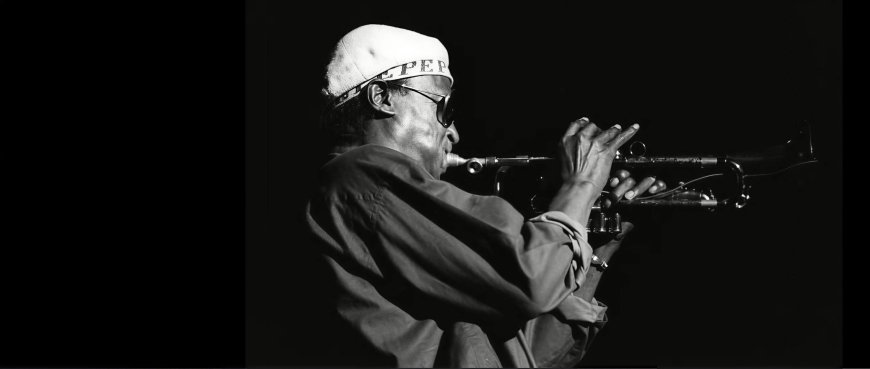
Years later, when YouTube brought a vintage performance of 'So What' to my screen, I was stunned not only by the music, but by your physical presence. You looked regal, totally statesmanly, as if Mozart himself was on stage, impeccably dressed and defining the very apex of class. But as your career progressed, it became obvious that you had to break free from anything that defined institutional boundaries.
You probably knew you possessed the genius of Mozart, but you refused to be confined by his ghost. So the thick sunglasses came in, the tailored suits were thrown out, and you became the only thing that you could be: your own man!
As I have mentioned, Mr. Miles, I was never formally trained in music. Nonetheless, In a Silent Way (1969) has swept me off my feet for decades. It operates less like music as we traditionally know it, and more like a portal into a cosmos where everything is vibrating and pulsating, with matter constantly transforming into light and colour.
By building that portal of sound, you initiated a new space odyssey, freeing us from the gravity of human emotions and familiar landscapes, and launching us into the infinite beyond in search of the Unknown Unknown, where all vibrations become one. In doing so, you became Wassily Kandinsky in reverse; where he sought to paint music, you sought to score the canvas.
You animated the visual worlds of Picasso, Miró, and Rothko into pure sound. It is no wonder that you eventually picked up brushes and colours and began to paint yourself, recognizing that colours and sounds were just two different manifestations of the light and vibrations of pure energy!
Of course, many musicians were also trying to push frontiers at the dawn of the space age. But for me, no one possessed your rare, intuitive grasp of listenability, remaining a master of the human soundscape even at its most avant-garde.
Mr. Miles, you became a guru. The souls you liberated -- ranging from direct studio cohorts like John McLaughlin to distant musical disciples like Brian Eno and Pink Floyd -- each pushed further into the freedoms you had opened, acting the way the best minds always do when they learn how to make walls come down.Then came Bitches Brew, telling your story through a magical theatre of almost post-human soundscapes like no other. Once again, you effectively surpassed all the comfortable expectations of your listeners.
The album earns a powerful, almost frightening position in the pantheon of art -- operating like a mirror that draws energy in like a black hole, rather than a conventional piece of music. Inspired by how people love to call you the Prince of Darkness, I even tried to pen a few lines for you -- a small tribute to the perfect stranger whom I feel I really know:
Mirrored
Darkness at the end of the tunnel shines
like a perfect stranger staring at the mirror
only to see the abyss.
-- Sujaul Islam Khan
I often wonder, Mr. Miles: Was the highly charged, hostile atmosphere of racist America pushing you to break through all these walls? The stigma, the endless daily humiliations, that infamous punch by the watchman outside the jazz bar -- did that cumulative anger keep you moving all through your life? Were you constantly masking the inner world of a tender soul permanently in exile? Did Europe, by contrast, feel more like a refuge? Was your artistic life simply a lifelong journey to break free from all those debilitating societal boundaries?
I think I found the definitive answer in the closing voice-over of your 1971 album, A Tribute to Jack Johnson: "I'm Jack Johnson, heavyweight champion of the world! I'm black! They never let me forget it. I'm black alright! I'll never let them forget it!" This brings me back to the idea that music belongs to a particular landscape.
As I grow older, I come to think of the blues as the ultimate precursor to this defiance. The blues, along with soul, jazz, and the entirety of Black music, served as vital vehicles through which African Americans could vent their anguish and stubbornly preserve their humanity.
It was a profound resilience built against structural racism, one of the most demonic regimes humans ever unleashed on fellow humans, set across a vast, unforgiving American terrain. Mr. Miles, you told the world through your horn that the wounds never stop bleeding, but you fiercely refused to let them define you.
You proved that even the chaotic cacophony of noisy human affairs could be syncopated into high art. I think Around the Corner does just that, capturing the relentless, fractured vibrations of bustling New York City.
In that track, you were predicting the sonic textures and street-level energy of hip-hop decades before it fully took hold of the global stage. I wish I could connect as deeply with your later, heavier funk work -- maybe I will someday.
For now, I simply want to say how indescribably beautiful it was to see you finally finish your long voyage by rendering Cyndi Lauper's Time After Time and Michael Jackson's Human Nature. It was as if, after exploring the cosmos and the abyss, you wished to say very gently that you were made of simple flesh and blood too. In the end, that is what we all are, and the capacity to share that absolute vulnerability is what it means to be human.
Mr. Miles, thank you for sharing your vibrations with a slightly geekish teenager wandering twelve thousand miles away from St. Louis in a rainy monsoon landscape. The universe breathes through your horn now for eternity.
Sujaul Khan is an Assistant Professor at North South University.