







































![A Ledger of the Soul: Navigating the Allah-Bhagavant Nexus in a 19th-Century Puruṣākāra Jñāna Caupara [Gyan Chauper]](https://counterpointbd.com/uploads/images/202608/image_430x256_6a93baa3b09a7.jpg)




















Bangladesh’s Renewable Energy Transition
A project does not automatically become sustainable simply because it produces clean electricity. Renewable-energy development should not unnecessarily displace communities, convert productive farmland, destroy wetlands or wildlife habitats, obstruct natural drainage, or damage ecologically sensitive landscapes.
Electricity demand in Bangladesh continues to rise with economic growth, industrialization, urbanization, and changing living standards. At the same time, declining domestic gas reserves and growing dependence on imported LNG, coal and petroleum products are making the country increasingly vulnerable to international fuel prices, supply disruptions and pressure on foreign exchange reserves.
Renewable energy, therefore, can no longer be viewed merely as an environmental or climate issue. It has become a question of energy security, foreign-exchange savings, industrial competitiveness, and long- term economic resilience.
Against this backdrop, the government’s decision to give greater priority to renewable energy is timely. The National Renewable Energy Development Strategy 2026-2030 sets a target of generating at least 20% of the country’s electricity from renewable sources by 2030.
Importantly, the strategy looks beyond simply installing solar panels. It recognizes battery storage, smart grids, energy efficiency, green financing, and carbon-credit mechanisms as integral components of the transition. The ambition is encouraging. The bigger question is whether Bangladesh can translate this ambition into implementation.
What Do We mean by Renewable Energy?
Renewable energy comes from natural sources that are replenished continuously or are effectively inexhaustible on a human timescale. Solar radiation, wind, flowing water and biomass are among the most common examples.
For Bangladesh, solar energy arguably offers the greatest immediate opportunity. The country's scope for large- scale hydropower is geographically limited, while commercially viable wind resources are concentrated in particular locations. Sunlight, however, is available across almost the entire country.
This is why the government's strategy considers a diversified solar portfolio: utility-scale projects, rooftop solar, solar irrigation, floating solar, agrivoltaics, solar-powered cold storage and solar-based electric-vehicle charging infrastructure.
Bangladesh should therefore not search for a single renewable-energy solution. It needs a portfolio designed around its own geography, population density, land scarcity and economic realities.
Why Can Bangladesh No Longer Afford to Wait?
The most immediate argument is energy security. The government's own strategy acknowledges that dependence on imported fossil fuels is creating economic, environmental and energy-security pressures. If electricity demand continues to grow at around six% annually, peak demand could reach approximately 24,000–25,000 MW by 2030.
There is also a straightforward foreign-exchange argument. LNG, petroleum and coal have to be purchased from international markets in foreign currency. Sunlight does not have to be imported. Every additional unit of economically viable domestic renewable electricity can therefore reduce, at least incrementally, Bangladesh's exposure to volatile global energy markets.
Another issue that deserves greater attention is export competitiveness. International supply chains are becoming increasingly carbon-conscious. For Bangladesh's export-oriented industries -- including garments, pharmaceuticals and leather -- access to cleaner electricity could increasingly affect compliance, market access and competitiveness.
The national strategy itself recognizes this connection. Renewable energy should therefore be regarded not merely as an environmental expenditure, but as an investment in Bangladesh's future economic competitiveness.
Australian Experience
Australia offers one of the most compelling examples of a rapid renewable-energy transition. Solar and wind have expanded dramatically, while rooftop solar has become particularly widespread among households and businesses.
Australia's success is not simply the result of abundant sunshine. It reflects years of policy support, technological development, private investment, grid integration, household participation and, increasingly, battery storage. The result is an electricity system in which renewable generation now plays a major role.
For Bangladesh, there is much to learn from this experience -- particularly in rooftop solar, distributed generation, battery storage, grid management and consumer participation. But there is an important caveat. A direct comparison between Australia and Bangladesh would be misleading.
Australia is a continent-sized country with a relatively small population. Vast areas of land are available for utility-scale solar and wind farms. Bangladesh faces almost the opposite physical reality. It is one of the world's most densely populated countries, where almost every piece of land faces competing demands from agriculture, housing, industry, transport infrastructure, wetlands and ecosystems.
Bangladesh should therefore learn from Australia's technology, policy architecture, investment mechanisms and grid management -- but it cannot simply replicate Australia's land-use model. Our renewable-energy transition has to be designed around the resources Bangladesh actually has.
Our Largest Solar Field
Land scarcity makes rooftop solar particularly attractive for Bangladesh. Government offices, schools, colleges, universities, hospitals, factories, warehouses, shopping centres and residential buildings collectively represent millions of square metres of largely underutilised rooftop space.
The National Rooftop Solar Program already provides a foundation for exploiting this opportunity. Its implementation guideline initially envisaged adding approximately 2,000-3,000 MW of solar capacity nationwide.
The next logical step should be to treat rooftops as national energy assets. Bangladesh could develop a National Solar Rooftop GIS Inventory, combining satellite imagery, building information, electricity consumption and distribution-network capacity.
Such a platform could identify which roofs are suitable, estimate their generation potential and prioritize investment according to local electricity demand and grid readiness. Instead of asking only where new power plants can be built, policymakers should also ask: How much electricity can we generate from infrastructure that already exists?
Can the Same Land Produce Food and Electricity?
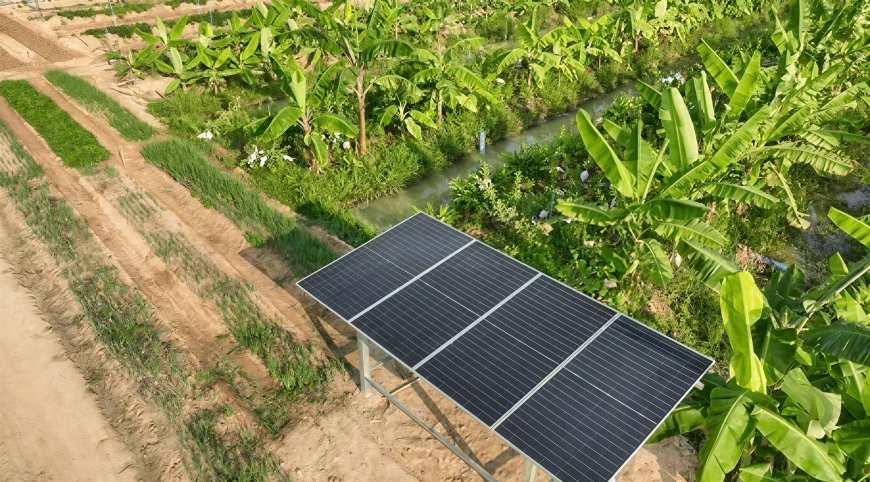
Rooftops alone, however, will not meet Bangladesh's future renewable-energy requirements. Larger solar installations will still be needed, bringing us back to the difficult question of land. This is where agrivoltaics could become particularly important.
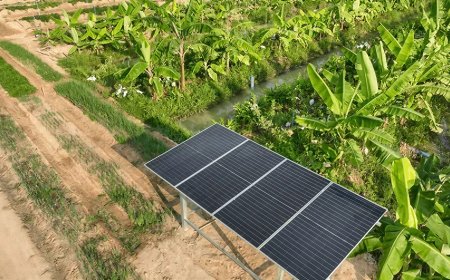
Agrivoltaics allows agricultural production and solar generation to coexist on the same land. Solar panels are elevated or arranged so that crops can continue to grow beneath and between them.
A recent pilot project in Manikganj provides an encouraging example.
The BRAC Institute of Governance and Development, BRAC University's Department of Electrical and Electronic Engineering and the Bright Green Energy Foundation have developed a 98 kW agrivoltaic system that is testing agricultural production alongside solar generation.
The project has been designed to accommodate rice cultivation and agricultural machinery, while also experimenting with other crops.
Its significance goes beyond generating electricity. Solar power can support irrigation, reducing dependence on diesel, while surplus electricity can be supplied to the grid. In other words, the same piece of land can potentially contribute to both food security and energy security.
For a land-scarce country, this transforms the policy perspective. Rather than choosing between food and electricity, Bangladesh can focus entirely on how the same land can successfully produce both simultaneously.
This highlights a powerful guiding principle for future solar development: Prioritizing land sharing over land acquisition.
Agrivoltaics should therefore move beyond isolated experimentation. Bangladesh should establish larger demonstration projects across different agro-ecological regions, testing different crops, panel heights, spacing arrangements, irrigation systems and commercial models.
The government's renewable strategy already recognises agrivoltaics as a potential pathway.
Pakistan May Offer a More Comparable Lesson
In several respects, Pakistan's experience may be more relevant to Bangladesh than Australia's. The two South Asian countries share some structural challenges: large populations, developing economies, pressure from imported fuel costs, expensive electricity and financially stressed power sectors.
Pakistan has experienced exceptionally rapid growth in distributed and rooftop solar. Falling solar-panel prices and high grid-electricity costs have encouraged households and businesses to generate their own electricity.
There are two important lessons here. The first is encouraging: when technology costs, market economics and policy incentives align, distributed solar can expand much faster than conventional government planning anticipates. The second is a warning.
If higher-paying consumers rapidly reduce their grid purchases by installing their own solar systems while the fixed costs of maintaining the electricity network remain, utilities can face financial pressure. Those costs can eventually fall disproportionately on consumers who cannot afford their own solar installations.
Bangladesh therefore needs a carefully designed net-metering and tariff system -- one that rewards households and businesses for investing in renewable energy while maintaining the financial sustainability of the grid and protecting lower-income consumers. Pakistan demonstrates that a solar boom is possible. It also demonstrates why power-market reform must accompany that boom.
Thinking About Regional Alliances
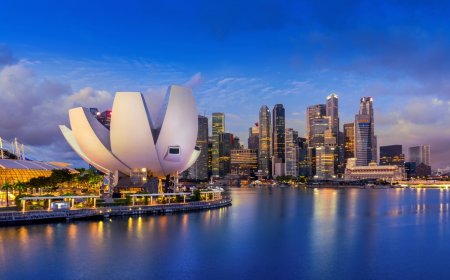
The push for regional alliances and renewable energy trade in Asia is gaining strong momentum through initiatives like the ASEAN Power Grid, which bridges land-scarce economies with resource-rich neighbours.
A prime example is the Indonesia-Singapore energy corridor, where Singapore seeks to import up to 6 gigawatts of low-carbon electricity by 2035 to meet its clean energy targets, while Indonesia capitalizes on its massive renewable potential to drive foreign investment and green manufacturing.
However, realizing these multi-billion dollar cross-border projects -- such as those utilizing high- voltage subsea cables require navigating complex policy hurdles, including domestic permit regulations, carbon credit allocations, and pricing structures.
Beyond this bilateral model, broader regional efforts like the Lao PDR–Thailand–Malaysia–Singapore Power Integration Project (LTMS-PIP) demonstrate the viability of multilateral power wheeling, pushing ASEAN closer toward standardizing shared infrastructure and establishing a unified regional energy market.
South Asia offers a complementary lesson through different resource dynamics. Leveraging its vast Himalayan river system, Nepal possesses a major renewable advantage in hydropower, a resource Bangladesh has already begun tapping through cross-border imports facilitated by India's transmission network.
Far more than a modest electricity-import arrangement, this cooperation lays the groundwork for deeper regional integration. Bangladesh's daytime solar generation can naturally complement the flexible hydropower of Nepal and, eventually, Bhutan, while India's expansive grid infrastructure serves as the vital conduit for cross-border exchange.
Ultimately, these threads could weave together into a robust South Asian green-energy market.
Re-envisioning energy security requires moving beyond the mindset that every unit of electricity must be produced within national borders. True resilience stems from diversification across technologies, energy sources, suppliers, and geography.
For Bangladesh, domestic solar deployment, regional hydropower imports, advanced storage, and energy efficiency can thus form mutually reinforcing pillars of a cohesive long-term strategy.
Is Technology Really Our Biggest Obstacle?
Bangladesh does not suffer from a shortage of renewable-energy policies. Historically, the greater challenge has been implementation. The government's 2026-2030 strategy itself acknowledges that previous renewable-energy ambitions did not deliver the desired results because of shortcomings in the investment environment, supporting policies, financing and administrative coordination.
This is perhaps one of the most important observations in the entire strategy. A renewable-energy investor may have to navigate different agencies for land, environmental clearance, grid connection, tariffs, taxation, equipment imports, financing and power-purchase arrangements.
If a technically and financially viable project spends years moving through administrative processes, an ambitious national target means little.
Bangladesh therefore needs to move from an approval-oriented bureaucracy towards facilitation-oriented governance. A digital One-Stop Renewable Energy Approval System could integrate the relevant agencies and establish statutory timelines for decisions.
The objective should not be to weaken environmental or technical scrutiny, but to make the process transparent, predictable and time-bound.
The Grid Cannot Remain an Afterthought
Rapid renewable expansion will also create technical challenges. Solar and wind are variable sources. Solar generation can be abundant around midday and decline rapidly towards evening while electricity demand remains high. Thousands of additional megawatts of renewable capacity therefore cannot simply be connected to an electricity network designed around conventional generation.
Bangladesh will need Battery Energy Storage Systems, better forecasting, automated grid management, stronger transmission and distribution networks, and smart-grid technologies.
The national strategy already recognizes battery storage and grid modernization as essential parts of the transition. Renewable generation and grid modernization must therefore be planned as one infrastructure programme, not two separate agendas.
What Should Bangladesh Do Now?
The 2030 target should first be translated into a transparent year-by-year implementation roadmap. Bangladesh needs to know how much capacity will come each year from rooftop solar, utility-scale solar, agrivoltaics, floating solar, wind and storage, and which agencies will be accountable for delivery.
A One-Stop Renewable Energy Approval System should reduce bureaucratic uncertainty. A National Solar Rooftop GIS Inventory should begin with government facilities, industrial buildings, hospitals, universities and major commercial properties.
Agrivoltaics should move from experimental projects to a national research and investment programme, while agricultural land, wetlands and natural floodplains should be protected from poorly planned solar development.
At the same time, grid modernization and battery storage must start now, not after thousands of additional megawatts have already been installed. Green loans, green bonds, blended finance and international climate finance should be mobilised to reduce upfront investment costs.
Finally, progress should be publicly measurable. A Renewable Energy Progress Dashboard, updated every six months, could show how much capacity has actually been commissioned, how much investment has been mobilized, which projects are delayed and why, how much fossil-fuel import has been displaced, and how much carbon emission has been avoided.
Bangladesh Needs an Implementation Revolution
Australia shows what can be achieved when renewable-energy policy, private investment, technology, grid modernization and consumer participation move together. But Bangladesh cannot simply replicate the Australian model, particularly its reliance on large areas of land.
Pakistan offers a more comparable lesson: Distributed solar can expand remarkably quickly in a developing economy, but regulation, tariffs and grid management must keep pace. Nepal, meanwhile, demonstrates how geographical advantages and regional electricity trade can become part of a broader energy-security strategy.
Bangladesh must now develop its own model of renewable transition -- one shaped by its high population density, limited land, agricultural importance and ecological vulnerability. Rooftop solar should therefore receive priority, while agrivoltaics can allow food and electricity to be produced from the same land.
Floating solar and utility-scale projects should be pursued only where they are environmentally, socially and economically appropriate. Regional hydropower, battery storage and a modernised grid can complement these domestic resources.
But renewable energy must not be pursued at any cost. A project does not automatically become sustainable simply because it produces clean electricity. Renewable-energy development should not unnecessarily displace communities, convert productive farmland, destroy wetlands or wildlife habitats, obstruct natural drainage, or damage ecologically sensitive landscapes.
Bangladesh should not solve one environmental problem by creating another. Spatial planning and GIS-based suitability mapping should therefore become integral to renewable-energy planning, helping direct investment towards locations where energy benefits are high and environmental and social costs are low.
The central challenge is consequently no longer technology alone. It is implementation-institutional coordination, regulatory certainty, financing, grid readiness, environmental safeguards and the ability to make timely decisions. Communities, too, should be partners in this transition through meaningful consultation, livelihood protection and fair benefit-sharing.
Bangladesh therefore needs more than ambitious renewable-energy targets. It needs an implementation revolution -- one that is fast, investment-friendly, environmentally responsible and socially inclusive. If done well, the renewable transition can simultaneously strengthen energy security, reduce dependence on imported fuels, protect natural resources and make Bangladesh’s economy more resilient and competitive.
The goal should not simply be more renewable energy, but the right renewable energy, in the right place, implemented in the right way.
Dr Faysal is an Australian based environmental researcher and urban planner. He is a fellow member of Bangladesh Institute of Planners He works as a system and asset specialist for Sydney Water. Email: [email protected].