































































Tarique Rahman’s Return and the 1972 Expectation Trap
Tarique Rahman’s return is undeniably historic. But history alone does not guarantee success. The comparison with 1972 is not about personalities -- it is about the structural burden placed on returning leaders in moments of national uncertainty.

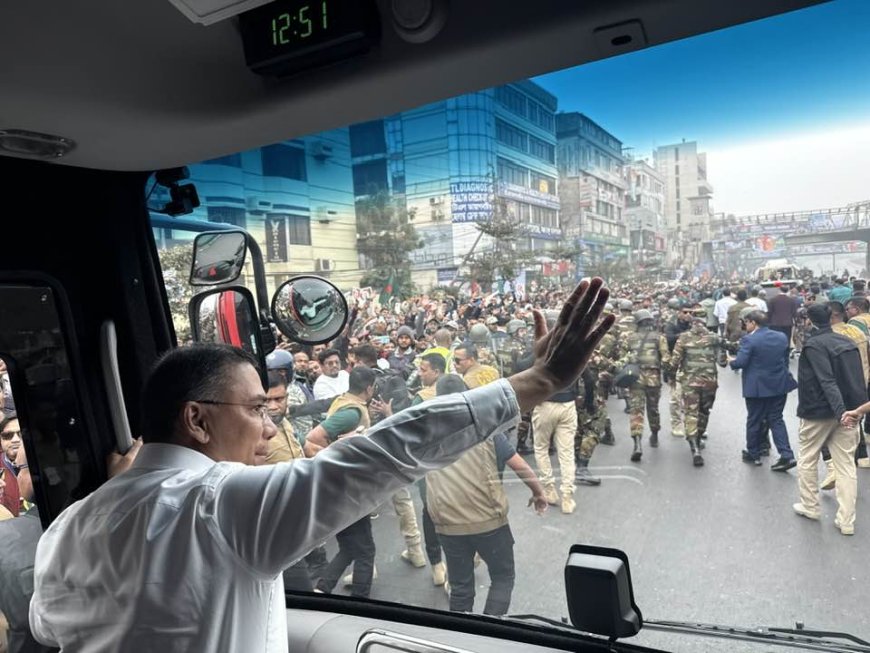
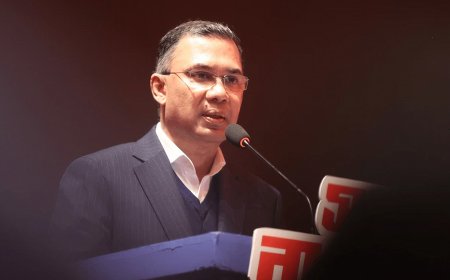
When Tarique Rahman stepped onto Bangladeshi soil after seventeen years in exile, the moment carried a weight far beyond a personal homecoming.
It triggered a wave of political imagination, speculation, and symbolism that Bangladesh has not witnessed in decades.
For many, his return is not simply the re‑entry of a political figure -- it is the re‑emergence of a possibility: that BNP could return to power in the February 2026 election, that Tarique Rahman could become the next Prime Minister, and that the country could return to normalcy and stability.
But beneath the excitement lies a deeper, more complicated question: Are we witnessing the early stages of a 1972‑style expectation trap?
To understand the stakes, one must revisit the emotional, political, and historical landscape surrounding Bangladesh’s most iconic return -- the arrival of Sheikh Mujibur Rahman in January 1972.
When Sheikh Mujibur Rahman returned to independent Bangladesh on January 10, 1972, after being released from imprisonment in Pakistan, the country was devastated.
The economy had collapsed. Infrastructure lay in ruins. Millions were displaced. Institutions barely existed. The political class was exhausted, and the public was traumatized by genocide, famine, and war.
Yet despite this devastation, the people placed extraordinary hope in one man. Mujib was not merely a political leader; he was the embodiment of the nation’s struggle, sacrifice, and identity.
His return was greeted with an almost spiritual expectation that he would rebuild the country, restore dignity, and deliver prosperity.
But the reality of governing a broken state proved far more complex than public imagination allowed. Yes, he was a charismatic leader, but he was not a good administrator.
He failed to deliver hope due to corruption and the misuse of power by his loyal supporters. Within three years, the optimism of independence had given way to frustration, economic hardship, and political disillusionment.
The lesson of 1972 is not about Sheikh Mujib’s intentions or legacy. It is about the danger of placing unrealistic expectations on a returning leader, especially in a country facing deep structural instability.
A New Cycle of Expectation Around Tarique Rahman
After nearly fifteen years of undemocratic rule by Sheikh Hasina, Bangladesh’s political environment became increasingly strained.
Public frustration grew as democratic space narrowed, and the absence of a credible mechanism for peaceful political transition intensified tensions.
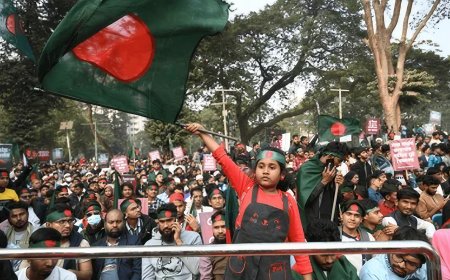
The mass uprising against the government in July 2024 marked by significant casualties, injuries, and widespread unrest and reshaped the political landscape.
The eventual collapse of the Sheikh Hasina regime, and the fact that she fled to India, created huge uncertainty as well as an opportunity to build a democratic state.
Pro‑July political parties then reached a consensus to form an interim government led by Dr Yunus. Yet after one and a half years, we still do not see a stable government or a stable state.
After July 2024, Bangladesh is not a post‑war state, but it is a politically unsettled one. Public trust in institutions remains fragile. Economic pressures are rising. Far‑right populism has gained ground. The electorate is fragmented, impatient, and searching for alternatives.
In this environment, Tarique Rahman’s return has triggered a wave of expectation -- particularly among BNP supporters, but also among segments of the public who feel politically hopeless.
Many believe BNP will form the government in the February 2026 election and that Tarique Rahman will become Prime Minister. His long exile is seen by supporters as having given him clarity, purpose, and a renewed mission.
They argue he can restore competitive politics after years of restricted space and articulate a new national vision.
But this is precisely where the historical parallel becomes a warning.
Bangladesh today faces a deeply polarised electorate, weakened institutions, economic uncertainty, rising ideological extremism, a generation of young voters with no memory of BNP governance, and a political culture shaped by confrontation rather than consensus.
These are not challenges that any single leader, regardless of party, can resolve quickly.
If Tarique Rahman is elevated as the singular figure who will “fix everything,” he risks inheriting the same impossible expectations that confronted Sheikh Mujib in 1972. And when expectations become mythic, disappointment becomes inevitable.
The comparison between Tarique Rahman and Sheikh Mujibur Rahman is emotionally powerful but analytically fragile, yet we can still identify some similarities in this cycle.
Both returned after long periods of absence, both came back at moments of national uncertainty, both were perceived as symbols of political renewal, and both carried the hopes of supporters who believed they could reshape the nation.
However, we must be cautious, because the differences are equally important. Mujib returned to a newly independent state, whereas Tarique returns to a politically fatigued one.
Mujib enjoyed near‑universal legitimacy, while Tarique faces a divided electorate. Mujib’s challenge was reconstruction, but Tarique’s challenge is reconciliation.
The February 2026 election is shaping up to be one of the most consequential in recent memory.
BNP supporters and many outside the party believe this is their best chance in years to return to power and that Mr Rahman could assume the premiership.
But the strategic question remains: What kind of leader does he intend to be?
If Tarique Rahman positions himself solely as the BNP’s leader, he risks reinforcing existing divisions within an electorate still seeking legitimacy and stability.
But if he strives to serve as a national leader, one who recognises recent wounds and actively pursues reconciliation -- he may garner wider support across societal divides.
Tarique Rahman’s return is undeniably historic. But history alone does not guarantee success. The comparison with 1972 is not about personalities -- it is about the structural burden placed on returning leaders in moments of national uncertainty.
Bangladesh has seen what happens when public expectation outpaces political reality. The question now is whether Tarique Rahman can navigate this moment with a clearer understanding of history than public imagination often allows.
His challenge is not only to lead but to avoid becoming a symbol onto whom the nation projects more than any leader can realistically deliver.
The coming months will determine whether his return marks the beginning of a new chapter in Bangladeshi politics or whether it becomes another moment where hope, once again, outruns reality.
Barrister Salah Uddin Bhuiyan is an Advocate, Supreme Court of Bangladesh.