

















































The Meme as a Molotov Cocktail
The Pink Panther protester is no longer simply a person in a costume. He is a symbolic event, detached from the specific context of pension reform or fuel prices, circulating globally as a meme and a joke.
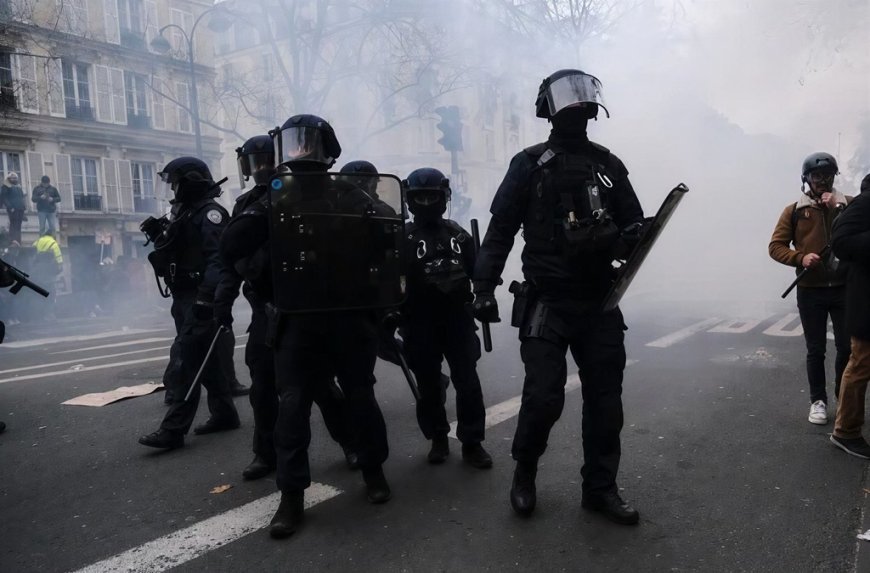
The photograph is almost cinematic in its perfection. On a rain-slicked Parisian street, a figure in a pink, full-body Pink Panther costume sprints across a crosswalk.
Behind him, a massive CRS armored truck unleashes a high-pressure jet of water. In the background, street signs point toward République, Bastille, and Gare de Lyon, names that have echoed through centuries of French uprising.
The image is absurd, vivid, and instantly shareable. It is also a symptom of something deeper.
When the institutional channels of democratic accountability are structurally blocked, the public does not stop expressing its rage. It simply finds a new medium.
Emmanuel Macron is, by the numbers, a profoundly unpopular president. An Ipsos BVA-Cesi poll published in October 2026 found that just 15% of respondents held a favorable view of him. This was the lowest score of his presidency, down a point from the previous month.
The survey, conducted as fuel prices hit record highs and high school students protested, identified purchasing power as the public's top concern, followed by anxieties about the welfare system and national debt. Yet Macron remains in the Élysée Palace. He will remain there until 2027.
This is not a malfunction of French democracy. It is its architecture. Under the Constitution of the Fifth Republic, the president is elected for a fixed five-year term. There is no recall mechanism, no mid-term confidence vote by the public, and no way for a frustrated electorate to cut the mandate short.
The only constitutional path to removal is destitution, an impeachment by a High Court of Parliament for a "manifest failure to perform his duties." This procedure requires a two-thirds majority of the National Assembly and the Senate and has never been successfully used in the modern Republic.
Charles de Gaulle designed the system to end the revolving-door instability of the Fourth Republic. It prioritizes stability over responsiveness. The consequence is a kind of institutional deafness. A president cannot hear the streets, and the public knows its voice cannot reach him.
This is where the psychology of protest begins to shift. In a functioning democracy, the ballot box acts as a psychological release valve. You are angry, you vote, and you feel, at minimum, that you participated.
But when the next election is years away, when the incumbent is term-limited and immune to electoral pressure, and when his approval rating is a number that no longer carries any consequence, the release valve is sealed shut.
The rage does not evaporate. It pressurizes.
The barricade was once the answer. The French tradition of street protest is not decorative. It is a foundational part of the republic's political culture, a physical assertion of popular sovereignty when parliamentary channels fail. But the barricade meets the water cannon.
The body meets the baton. Increasingly, the body carries a smartphone.
Here the French sociologist Jean Baudrillard becomes essential to understanding the moment. Baudrillard argued that in postmodern society, signs and images come to replace reality, creating a hyperreality in which the distinction between truth and simulation collapses.
The Pink Panther protester is no longer simply a person in a costume. He is a symbolic event, detached from the specific context of pension reform or fuel prices, circulating globally as a meme and a joke.
The image does not represent the protest. It replaces it. What the world sees is not the policy debate. It is the cartoon fleeing the water cannon.
And yet, this is not merely escapism. It is a form of psychological agency. When you cannot vote the president out, you can make him the butt of a global joke.
The guillotine sign, featuring Macron's face beside a dating-app flame matched with the blade, is a hyperreal act of violence. It is a simulation of revolution precisely because a real revolution is institutionally impossible.
Sharing it produces a dopamine hit of defiance, a momentary sense of "I see you, I mock you, I reject your authority." It is cathartic, it is safe, and in its own way, it is rational.
But Guy Debord's warning in The Society of the Spectacle hangs over this catharsis. Debord argued that in modern capitalism, life is reduced to a series of spectacles, and passive consumption replaces active engagement. The danger of the meme-protest is that it becomes a pressure valve the system can absorb.
You share the Pink Panther image, laugh with your friends, and feel a fleeting sense of victory. Then you go back to work. The spectacle absorbs the rage and metabolizes it into entertainment. The president's term continues, the policy remains, and the clock ticks toward 2027.
This is the central paradox of hyperreality. It offers the feeling of resistance without the consequence of it. The image is powerful enough to go viral and harmless enough to be ignored by the institutions it mocks. The public has traded the power to change the system for the power to laugh at it.
And yet, look again at the Pink Panther. He is running, but he is running forward. The water cannon misses. The street signs behind him point toward Bastille, the site of the revolution that founded the modern French republic.
The image is a joke, but it is also a memory. It reminds the public, and the world, that the French have done this before. They have toppled kings, built republics, and filled the streets until the streets became the government.
The meme is not a revolution. But it is a rehearsal. It keeps the muscle memory alive. In a system designed to wait out the clock, that memory may be the only thing that survives until the clock runs out.
Zakir Kibria is a Bangladeshi writer, policy analyst and entrepreneur based in Kathmandu, Nepal. He can be reached at [email protected].