






























![A Ledger of the Soul: Navigating the Allah-Bhagavant Nexus in a 19th-Century Puruṣākāra Jñāna Caupara [Gyan Chauper]](https://counterpointbd.com/uploads/images/202608/image_430x256_6a93baa3b09a7.jpg)




















A Gentle Reminder
For decades, Bangladesh placed some of its heaviest moral burdens on Muhammed Zafar Iqbal's shoulders. When students needed someone, we called him. When science needed a champion, we called him. When education failed, we expected him to protest.
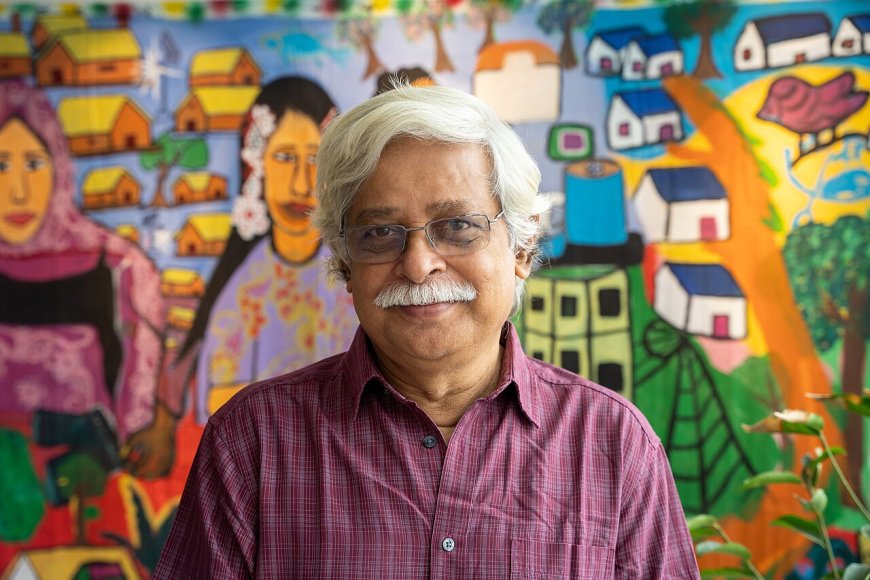
I am not writing this to introduce Muhammed Zafar Iqbal to Bangladesh. Bangladesh knows him. I am writing because sometimes a country, like a person, needs to be reminded of what it already knows.
I was his student. But before I was old enough to understand his politics, I knew what generations of Bangladeshis knew: he made science exciting. He made mathematics feel like an adventure.
He wrote about lonely children, mischievous children, robots, aliens, friendship, courage, and 1971. Dhaka University now lists him among its notable physics alumni: A scientist who worked at Caltech and Bellcore, held patents, wrote more than 180 books and helped popularize mathematics and physics among Bangladeshi youth.
But a résumé does not explain him.
For decades, whenever something went badly wrong in Bangladesh -- particularly for students -- Muhammed Zafar Iqbal had an inconvenient habit of showing up.
When examination questions were being leaked, and the Awami League government seemed more interested in denying the scale of the problem than solving it, he protested. He wrote about it, spoke about it, and ultimately sat at the Central Shaheed Minar with students, parents and teachers demanding accountability.
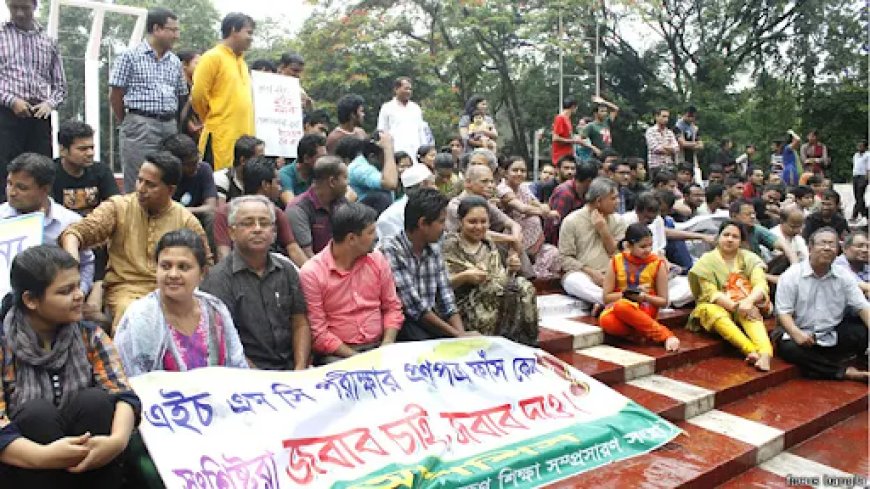
Muhammed Zafar Iqbal leading the protest against question leak in 2014.
When Chhatra League activists were accused of assaulting protesting teachers at his own university, he sat outside in the rain and condemned them. Hearing “Joy Bangla” shouted during an attack on teachers, he said, was an insult to the slogan under which Bangladesh had been liberated.
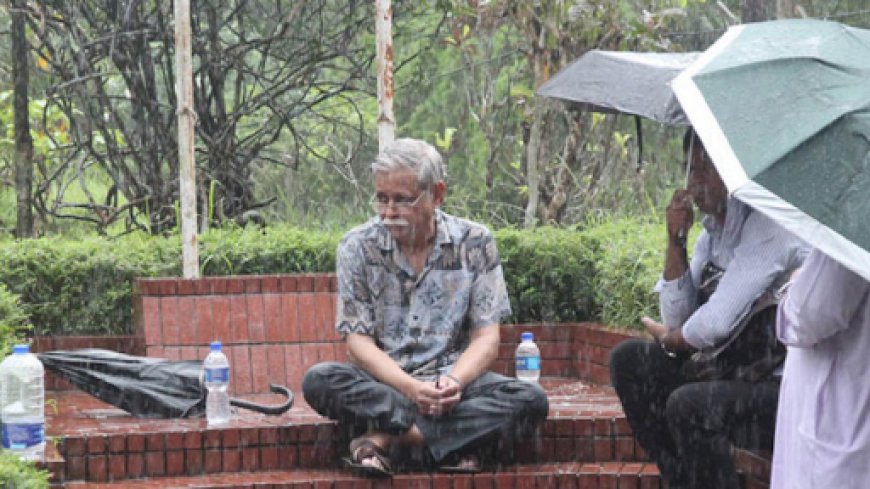
Muhammed Zafar Iqbal right after the attack by Bangladesh Student League on him and his colleagues in 2015.
That is worth remembering because certain quarters are now encouraging us to remember him as an Awami League partisan.
He had political convictions, certainly. But blind partisans do not repeatedly embarrass the governments they supposedly serve.
In 2022, the students of Shahjalal University demonstrated something still more important. After police violence and a prolonged confrontation with the university administration, students began an indefinite hunger strike. Ministers asked them to stop. Politicians asked them. Teachers asked them. They refused. Then, close to four in the morning, their retired professor arrived after driving from Dhaka.
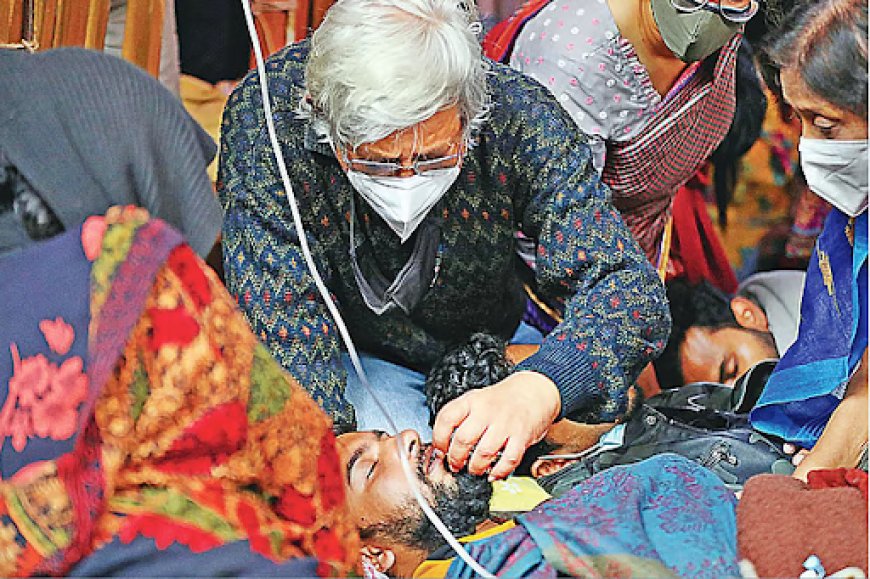
Muhammed Zafar Iqbal breaking the hunger strike of the SUST students in 2022.
He sat among them. He listened. He asked them to live.
They agreed because, one of them said, they trusted him. After more than 163 hours, he gave them water and broke their fast.
Governments possess authority. Very few people possess that kind of trust. Later, we learned that the National Security Intelligence filed a false report that Muhammed Zafar Iqbal was trying to overthrow the Awami League government as a part of the hunger strike.
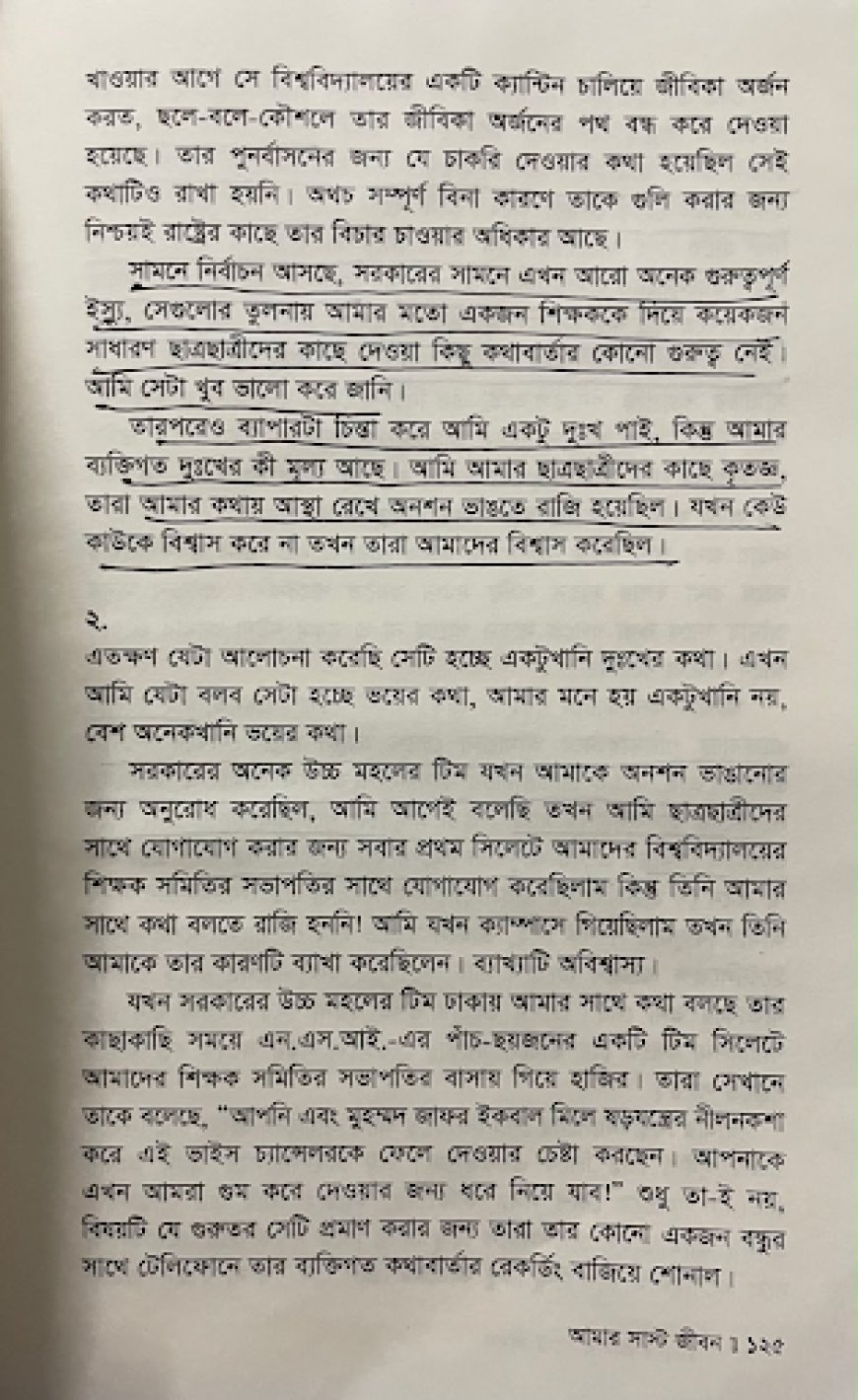
Behind the scenes of the government interaction with Muhammed Zafar Iqbal during the 2022 hunger strike at SUST as published in his memoir.
These days, a group of the July movement activists loves to call themselves Bangladesh Ponthi. What they actually mean is that, as male Sunni Muslim Bangladeshis, they want to dominate the rest of the demography while staying above the law. Muhammed Zafar Iqbal was the OG Bangladesh Ponthi, unapologetically.
Not Awami League-ponthi. Not BNP-ponthi. Certainly not Jamaat-panthi. Bangladesh First. He taught young people a patriotism that was demanding rather than obedient: Love the country enough to challenge it when it fails its children.
Which brings us to the great irony of 2024.
Six years before the July movement, Zafar Iqbal had already said that reserving 56% of public-service positions through quotas was irrational and that the system needed reform. He also condemned police action against the protesting students.
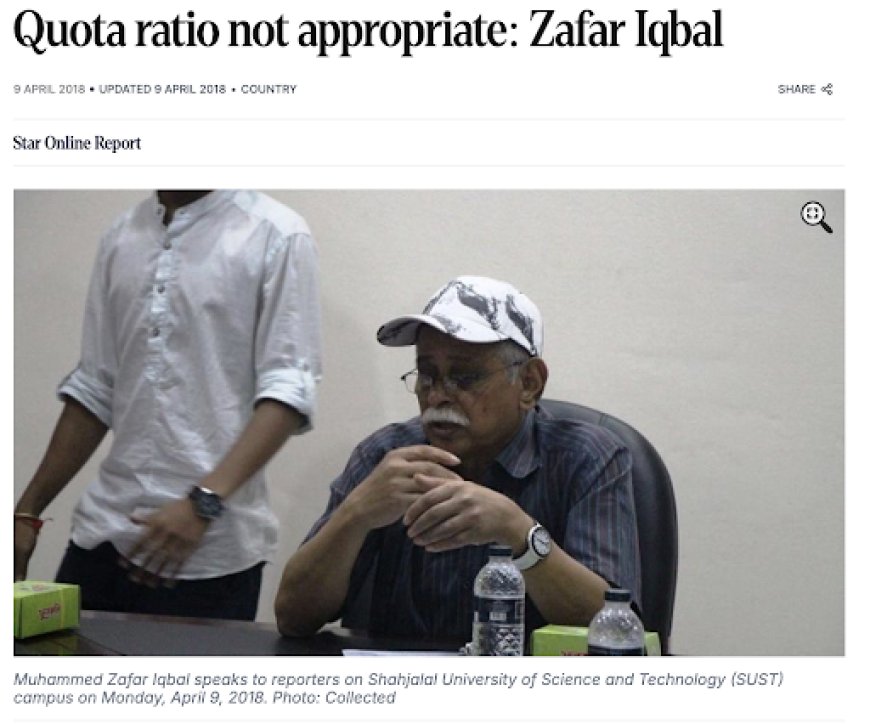
Muhammed Zafar Iqbal criticizing the quota system in 2018.
And on the very night in July 2024 when he wrote the words that would be manipulated by Chatra Shibir to turn so many students against him, he had actually been drafting an essay criticizing unfair quotas.
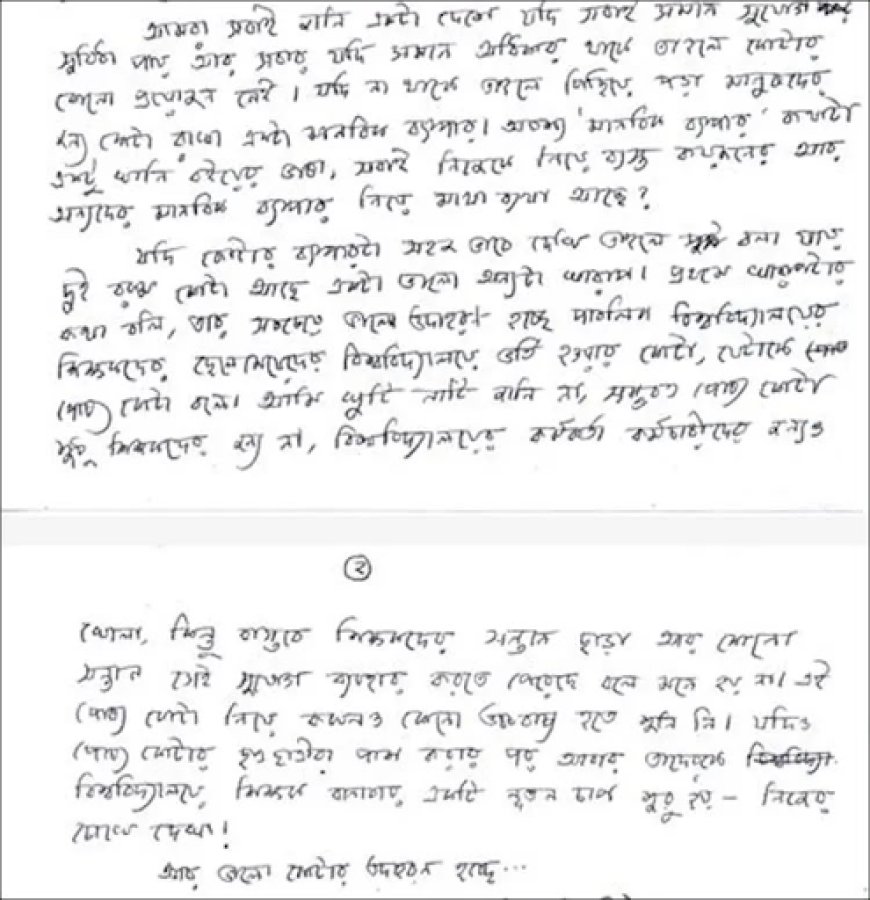
First page of Muhammed Zafar Iqbal’s unpublished 2024 article.
Then he heard the slogan containing the word Razakar.
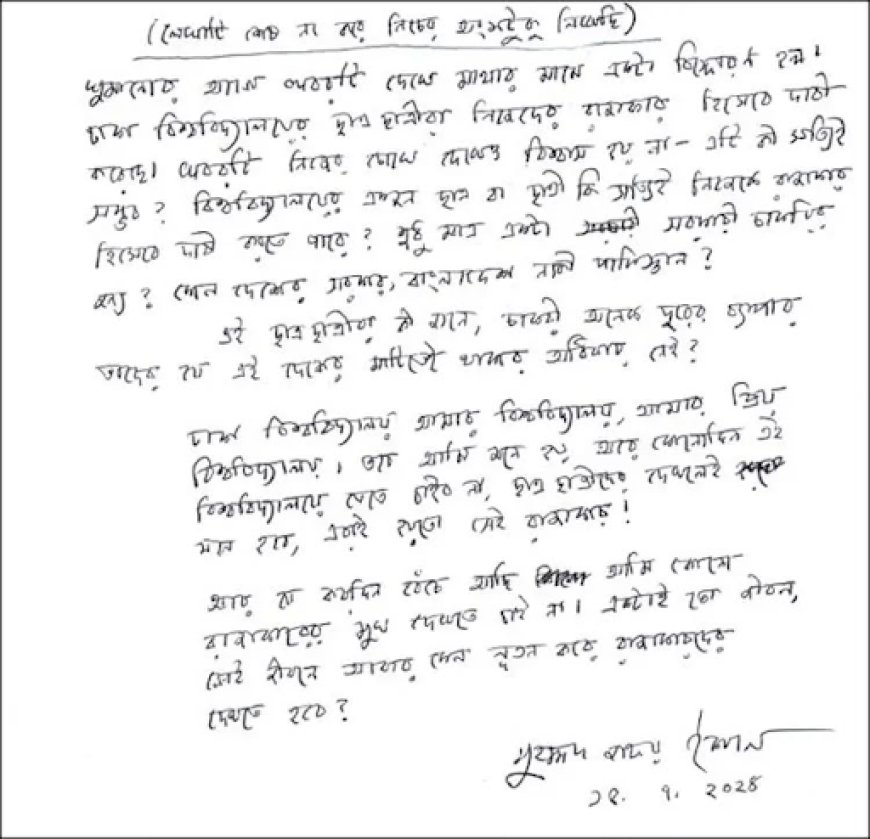
Last page of Muhammed Zafar Iqbal’s unpublished 2024 article.
He reacted. The same reaction we are having now, after seeing zero promises of the July movement materialize. After witnessing a state-supported effort to turn Bangladesh into a theocratic nation. When an activist of the July movement refuses to be known as July Joddha, that is the same reaction.
Why was he ahead of all of us? What did he see that we missed?
His father had been killed in 1971. The Liberation War runs through his books, his public life, and his understanding of Bangladesh. He spent decades confronting religious extremism and defending accountability for the crimes of 1971.
For him, Razakar was not clever political theater. It was one of the ugliest words in the Bengali language. It is the signature of operators of Operation Hasbunallah.
Prosecutors have now told the International Crimes Tribunal that they are preparing formal crimes against humanity charges against Muhammed Zafar Iqbal in connection with the July uprising. Hilariously, he was not even in the country while the movement happened.
The news reports describe an investigation into his alleged “role,” but do not explain what violent act he personally committed, ordered, or facilitated.
Here is another gentle reminder about the man we are discussing.
In 2018, a radicalized young man actually tried to murder Muhammed Zafar Iqbal with a knife. A court later described the attack as religious terrorism. When that attacker was eventually sentenced to life imprisonment, Zafar Iqbal said he felt no joy and no anger toward him. He felt pity.
His anger was directed at the people who had filled a young man's mind with the belief that murdering another human being could earn paradise. The attacker, he lamented, would lose his life to prison while those who poisoned his mind remained free.
The man who tried to kill him was still, in Zafar Iqbal's eyes, a human being.
Surely Bangladesh can extend the same humanity to Zafar Iqbal. I am not asking anyone to forgive a political opinion. I am not asking anyone to become his admirer. I am not even asking anyone to agree with him. I am asking Bangladesh to remember.
Remember the children whose imaginations he opened. Remember the Math Olympiads. Remember the fight against question leaks. Remember the professor sitting in the rain when teachers were attacked. Remember the students who would not listen to ministers but drank water from his hand. Remember the man who accepted responsibility when a textbook he edited contained material another writer had plagiarized. Remember the victim of an assassination attempt who felt compassion for his attacker.
For decades, Bangladesh placed some of its heaviest moral burdens on Muhammed Zafar Iqbal's shoulders. When students needed someone, we called him. When science needed a champion, we called him. When education failed, we expected him to protest. When 1971 needed defending, we expected him to speak.
Now the burden belongs to us.
And this is also an opportunity for BNP. Whatever its political disagreements with Zafar Iqbal, it can demonstrate that political change in Bangladesh does not merely mean changing who gets persecuted. It can insist that accusation requires evidence, that justice is not historical revenge, and that disagreement is not a crime.
In doing so, it can demonstrate a meaningful distinction from Jamaat-e-Islami, a party whose senior leaders were convicted for crimes committed in 1971 -- the history Zafar Iqbal spent much of his life insisting Bangladesh must never forget.
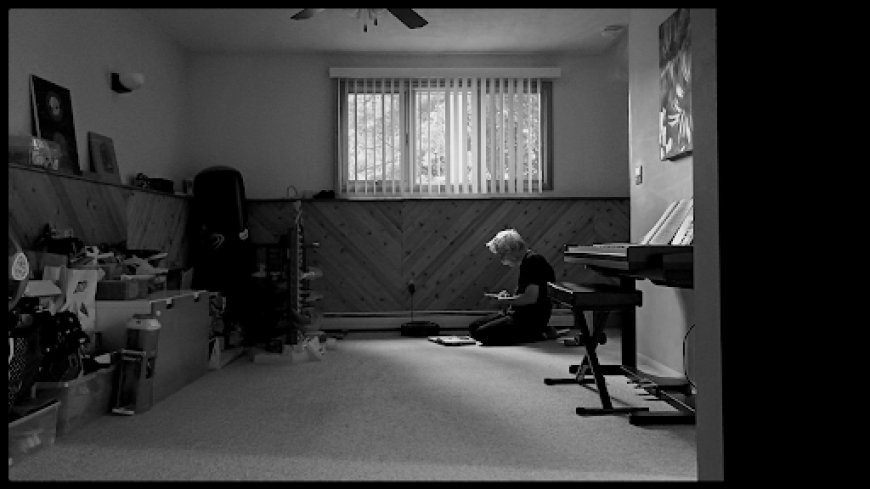
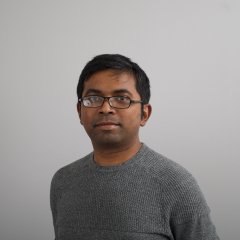
A 2026 photo of Muhammed Zafar Iqbal taken by the author, where he was appreciating the author’s copy of Rubaiyat of Omar Khayyam while taking a break from his braille display project.
He has carried Bangladesh for a very long time. It is time for Bangladesh to carry him.
Omar Shehab is a theoretical quantum computer scientist.