







































































Can AI Solve Dhaka's Traffic Woes?
In many ways, the deployment of AI-controlled traffic signals represents a test of whether Dhaka is prepared to embrace smarter urban governance.

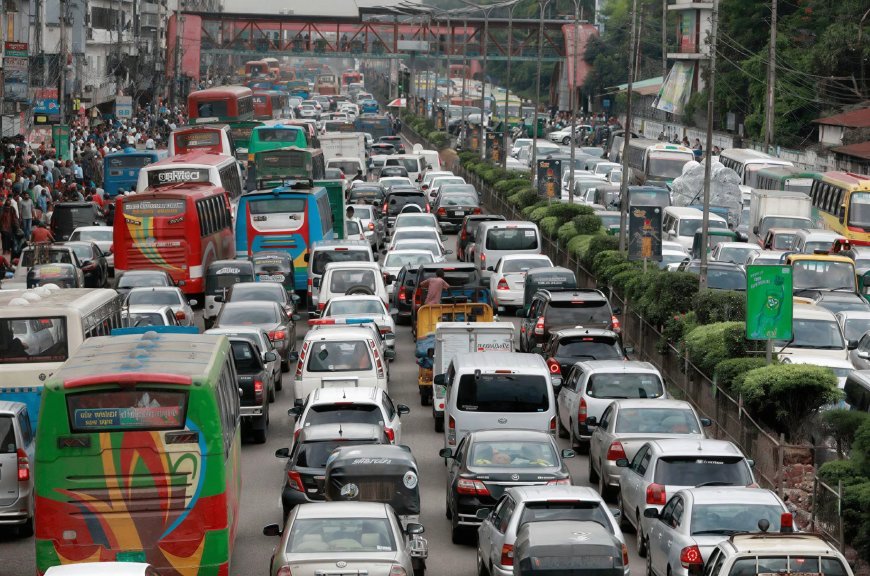
For decades, traffic congestion in Dhaka has symbolized the limitations of urban governance in Bangladesh.
Endless vehicle congestion, manually controlled intersections, malfunctioning traffic lights, and hours lost on the road have become normalized features of daily life. Historically, transport policy in Bangladesh has emphasized expansion rather than optimization.
The assumption was simple: More roads would reduce congestion. Authorities have repeatedly focused on infrastructural development, including the construction of flyovers, road widening, and the launch of mega transport projects.
However, despite these investments, congestion has persisted, largely because traffic management itself remained inefficient and outdated.
Earlier this month, the Dhaka Metropolitan Police (DMP) deployed artificial intelligence (AI) based traffic enforcement signal systems at multiple intersections in Dhaka representing an important and long-overdue shift in policy thinking. For the first time, traffic management is shifting away from purely manual control toward data-driven automation.
Now, 25 cameras are monitoring vehicle movement, detecting five types of traffic violations, including red-light jumping, entering closed left lanes, lane violations, wrong-way driving, and illegal parking, adapting signals according to traffic density.
Initial observations from intersections where AI-controlled systems have been introduced appear encouraging. In the enforced intersections, traffic flow has become more organized, particularly during peak hours. Waiting times at signals have reportedly decreased, and the need for constant manual intervention by traffic police has been reduced.
The early impacts can be compared to the term “Panopticon Effect” -- a theory of social control, which assumes individual change their behavior and conform to social changed as are being watched, regardless of whether surveillance actually occurred.
Although these improvements may appear modest compared to the scale of Dhaka’s broader traffic crisis, it demonstrates that intelligent traffic coordination can produce measurable benefits even without major physical infrastructure expansion.
International experience increasingly shows that urban traffic problems often stem not only from insufficient infrastructure but also from inefficient management of existing infrastructure.
Cities such as Singapore, Seoul, and Dubai have demonstrated that intelligent traffic systems can significantly improve mobility by optimizing road usage through technology and real-time coordination.
Dhaka’s adoption of AI-controlled signals therefore aligns with broader global trends in smart urban management. Every hour spent in traffic reduces worker productivity, increases fuel consumption, and worsens air pollution.
For businesses, unreliable transportation delays supply chains and raises operational costs. For ordinary commuters, traffic congestion imposes psychological stress and reduces quality of life.
The environmental implications are especially important. More importantly, it recognizes that traffic congestion is not merely a transportation issue but also an economic and environmental challenge. Dhaka consistently ranks among cities with severe air pollution, much of which is linked to vehicle emissions.
Congested intersections force vehicles to idle unnecessarily, wasting fuel while releasing pollutants into the atmosphere. AI-based traffic systems can help reduce these inefficiencies by improving traffic continuity and minimizing unnecessary stoppages.
In a climate-vulnerable country like Bangladesh, even incremental reductions in fuel consumption and emissions should be considered valuable policy achievements.
There is also a risk that authorities may treat AI deployment as a symbolic modernization project rather than a sustained institutional commitment. Intelligent traffic systems require regular maintenance, technical monitoring, reliable electricity, and integrated coordination between multiple agencies.
Bangladesh has a history of introducing technologically ambitious projects that later deteriorate due to weak maintenance and administrative fragmentation. AI-controlled signals will succeed only if authorities invest consistently in system upgrades, technical training, and operational accountability.
However, enthusiasm for AI traffic systems should not lead to unrealistic expectations. Technology alone cannot solve Dhaka’s traffic crisis.
Many structural problems remain deeply embedded within the city’s transport culture and governance framework. Illegal parking, poor lane discipline, unauthorized roadside activities, weak pedestrian infrastructure, and inadequate enforcement of traffic laws continue to disrupt road movement regardless of signal technology.
If drivers ignore lane rules or occupy intersections recklessly, even the most advanced AI systems will struggle to maintain order. Many drivers remain unfamiliar with how AI-based enforcement systems work or which violations are being monitored.
The success of AI based traffic management ultimately depends not only on software and sensors, but also on institutional management, infrastructural advancement, and public behavior.
Therefore, authorities should arrange awareness programs explaining which behaviors are monitored, why it matters, and how compliance with the systems will benefit the traffic management and the country’s economy overall.
This deployment of AI traffic system deserves public support because it reflects an important change in urban governance philosophy. Public cooperation will also be critical. Traffic systems function effectively only when road users trust and follow them. The pedestrians, too, should follow road crossing rules.
In Dhaka, years of dysfunctional signal management have created widespread disregard for traffic lights among drivers and pedestrians alike. Rebuilding confidence in automated systems will require stricter enforcement alongside public awareness initiatives encouraging compliance with traffic rules.
Importantly, the expansion of AI traffic management should remain gradual and strategic modification process. The current system must gradually evolve beyond five violations and move towards a broad comprehensive framework. Authorities must evaluate which intersections benefit most from adaptive signal systems and identify where adjustments are needed.
Traffic data collected through these systems can also help policymakers make better long-term urban planning decisions regarding road design, bus routes, pedestrian movement, and emergency response strategies.
In many ways, the deployment of AI-controlled traffic signals represents a test of whether Dhaka is prepared to embrace smarter urban governance. The city’s challenges can no longer be managed solely through manual control systems designed for a smaller and less complex urban environment. Technology cannot replace good governance, but it can strengthen governance when implemented responsibly.
The early introduction of AI traffic systems in Dhaka should therefore be viewed neither as a miracle solution nor as a superficial experiment. It is a promising beginning of a broader transformation rather than a complete solution itself. No technology can completely solve the problems created by years of mismanagement.
If maintained properly, expanded carefully, and supported through broader transport reforms, AI-controlled traffic management could significantly improve. The question is whether institutions, drivers, and pedestrians are finally ready to support it.
Surya Khanum Mim is an Academic and Researcher, currently teaching at Kishoreganj University.